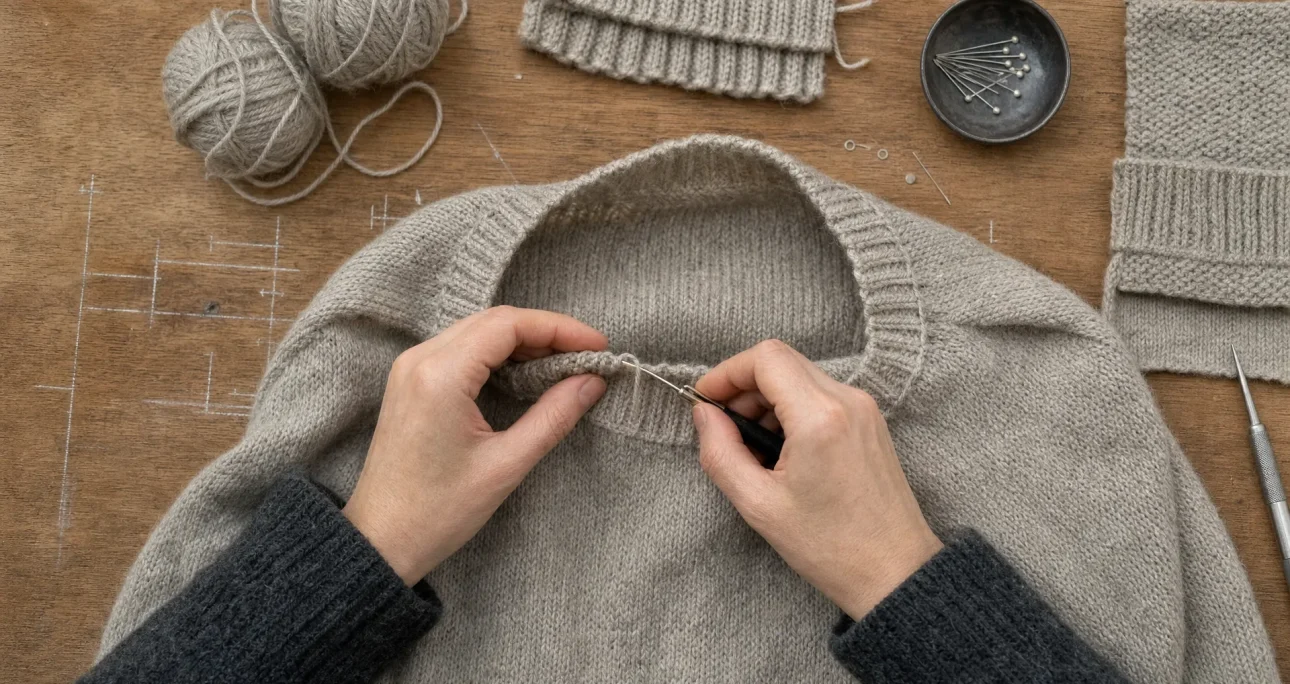
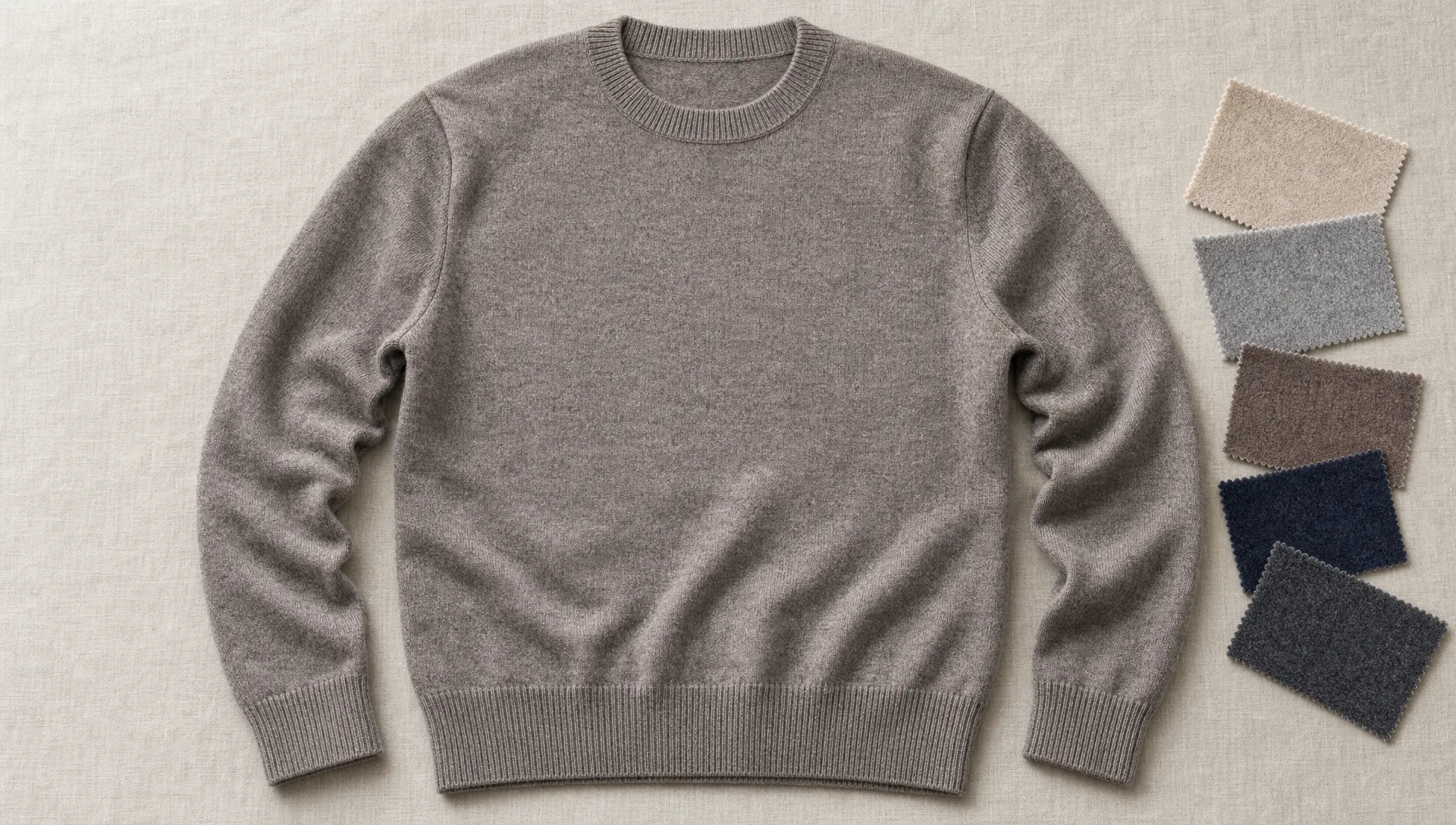
A merino wool crew neck sweater looks simple on the rack, but the best versions are the result of careful fiber selection, pattern engineering, stitch planning and finishing control. For apparel brands, the crew neck is often a core product because it is seasonless, easy to style and widely understood by customers, yet small construction errors quickly show up as neckline stretching, twisting seams, poor recovery or pilling.
This guide breaks down the key development decisions behind a premium crew neck silhouette. It focuses on the practical choices that affect comfort, durability, appearance and production consistency, especially for brands preparing samples or planning small batch manufacturing.
Merino wool crew neck sweater construction priorities
A strong merino wool crew neck sweater starts with a clear product brief. Before discussing yarn counts or trims, define the target wearer, climate, styling intent, price position and care expectation. A lightweight office sweater, a dense outdoor layering piece and a luxury fine-gauge knit may all use merino, but they need different construction logic.
The crew neck adds its own technical challenge. Unlike a V-neck or cardigan opening, the circular neckline must stretch over the head, recover after wear and sit flat against the body without choking the wearer. This means the neck trim, shoulder slope, front neck drop and linking method need to work together.
For brands developing a broader merino range, it helps to standardize a few core specifications across styles. Yarn quality, shrinkage tolerance, pilling targets and approved care instructions should not change randomly from one silhouette to another. Arcus Apparel Group supports this kind of product development approach through custom apparel development, material sourcing, pattern development and production management.
Start with fiber and yarn, not the sketch
The hand feel, warmth and long-term performance of a merino wool crew neck sweater are shaped before the first sample is knitted. Merino wool is prized because its fibers are finer than many traditional wools, which helps create a softer feel against the skin. The Woolmark Company describes merino as naturally breathable, odor resistant and temperature regulating, properties that make it useful for both fashion and performance apparel.
For sweaters, the yarn decision should consider micron count, staple length, ply, twist and spinning method. Finer fibers generally feel softer, but they may need careful yarn engineering to maintain shape. Higher twist can improve strength and reduce pilling, but too much twist may make the fabric feel dry or wiry. A very lofty yarn can look rich at first touch, but it may be more vulnerable to abrasion if the construction is not balanced.
If your team is still defining these fundamentals, Arcus has a useful primer on merino sweater yarn, gauge and care basics that explains how fiber, yarn and finishing choices interact.
Common yarn choices for crew neck sweaters
| Yarn consideration | What it affects | Development guidance |
|---|---|---|
| Micron count | Softness and next-to-skin comfort | Use finer merino for premium hand feel, but validate durability through wear and pilling tests |
| Ply | Stability, thickness and stitch definition | Multi-ply yarns often give better structure for rib trims and jersey bodies |
| Twist | Strength, surface texture and pilling behavior | Balance strength with softness so the garment does not feel harsh |
| Spinning method | Smoothness, loft and drape | Worsted yarns give cleaner definition, woolen yarns create a softer, airier look |
Gauge and stitch structure set the product character
Gauge is one of the clearest ways to control the identity of a merino wool crew neck sweater. Fine gauges create a refined surface suitable for office, travel and layering. Mid-gauge knits feel more casual and substantial. Heavier gauges can create a warm, textured product, but they need more attention to weight, stretch and seam bulk.
A plain jersey body is common for crew necks because it gives a clean surface and predictable fit. Rib trims are typically used at the neck, cuffs and hem because they offer stretch and recovery. The designer may add subtle texture, but the crew neck format usually benefits from restraint. Too much stitch complexity near the neckline can distort the neck opening or create uneven tension after washing.
Brands should also decide whether the sweater is meant to drape softly or hold a sharper shape. A compact jersey in a stable gauge gives a cleaner outline. A looser gauge may feel relaxed, but it can grow in length or width during wear if the yarn and finishing process are not controlled.
Gauge planning table
| Gauge direction | Typical product feel | Construction watchout |
|---|---|---|
| Fine gauge | Lightweight, smooth and layerable | Neck rib must not be too flimsy or it may ripple |
| Mid-gauge | Balanced warmth and everyday structure | Shoulder seams need clean linking to avoid bulk |
| Chunkier gauge | Warm, tactile and casual | Weight can pull the garment down and stretch the neckline |
Engineering the crew neck opening
The neckline is the defining feature of a merino wool crew neck sweater. A well-built crew neck should sit comfortably at the base of the neck, hold its shape after repeated dressing and remain flat after laundering. If the front neck drop is too shallow, the sweater can feel tight. If it is too deep, the garment begins to read like a relaxed scoop rather than a classic crew.
The neck trim usually uses rib because rib structures stretch and recover better than plain jersey. The width of the rib band matters. A narrow band can look refined, but it may roll or collapse if the yarn is soft. A wider band gives structure, though it can look sporty if the proportion is too heavy for the body gauge.
Linking quality is another major factor. The join between the body and neck trim should look clean, feel smooth and distribute tension evenly around the circle. Uneven linking can create puckers, waves or pressure points. In production, the neck opening should be measured both relaxed and stretched to confirm it passes comfortably over the head while returning to the approved measurement.
Shoulder and armhole decisions
The neckline cannot be engineered in isolation. Shoulder slope, shoulder width and armhole shape influence how the neck sits on the wearer. A dropped shoulder creates a more relaxed garment, but it can shift tension away from the high shoulder and make the neckline behave differently during wear. A set-in sleeve gives a cleaner shape, though it requires more precise grading and seam control.
For men’s products, shoulder width and chest ease often carry much of the silhouette. For women’s products, front neck drop, bust ease and cross-front balance may need additional attention. Arcus has separate guides on men’s merino wool sweater construction and women’s merino wool sweater fit and yarn selection if your range needs gender-specific development detail.
Fully fashioned, cut and sew or whole garment construction
A merino wool crew neck sweater can be made through several construction routes. The best choice depends on target price, order quantity, design detail, factory capability and the desired finish.
Fully fashioned knitting shapes the panels during knitting, often creating cleaner edges and better control at the armhole and neckline. Cut and sew construction uses knitted fabric that is cut into panels then sewn, which can support flexible production but may require careful seam stabilization. Whole garment knitting can reduce seams and create a smooth feel, though it depends on machine access, programming skill and design suitability.
No method is automatically premium. A poorly executed fully fashioned sweater can still twist or stretch, while a carefully managed cut and sew sweater can perform well. The important point is to align the construction method with the design goal and quality standard.
| Construction method | Strengths | Risks to manage |
|---|---|---|
| Fully fashioned | Shaped panels, clean armholes and refined finish | Requires accurate panel engineering and skilled linking |
| Cut and sew | Flexible for some programs and fabric developments | Seam stretch, edge fray and distortion must be controlled |
| Whole garment | Minimal seams and smooth wearing comfort | Higher technical dependency and less flexibility for some details |
Fit development and grading
Fit is where a merino wool crew neck sweater becomes commercial or problematic. Merino knitwear moves with the body, which means fit cannot be judged only from flat measurements. The sample should be reviewed on a form or fit model, then evaluated after steaming, resting and wearing.
Core points of measure usually include chest width, body length, shoulder width, sleeve length, bicep, cuff opening, hem width, front neck drop and neck opening. The tolerances should reflect the fabric behavior. Very fine-gauge styles may need tighter control because small measurement shifts are visible. Chunkier sweaters may need slightly more realistic tolerances due to yarn bulk and natural relaxation.
Grading needs particular care around the neckline. Simply scaling the neck opening up by size can create a large, loose neck in bigger sizes or a tight neck in smaller sizes. The grade should preserve the intended relationship between head clearance, shoulder fit and collar recovery.
A practical development process includes at least one wash or care simulation before final approval. Knitwear that looks right straight from sampling can change after relaxation, especially if the yarn swells, shrinks or loses temporary finishing tension.
Rib trims, seams and edge stability
The trims on a merino wool crew neck sweater carry a lot of the garment’s perceived quality. Customers may not know the technical reason, but they notice when cuffs bag out, hems flare or neckbands ripple. Rib construction should be chosen for recovery as well as appearance.
For cuffs and hems, rib depth affects both styling and function. Short ribs feel modern and minimal. Deeper ribs give a more traditional look and can help the garment sit securely at the wrist or hip. The elastane question depends on the product. Some brands prefer pure merino for natural fiber positioning, while others use a small amount of stretch in specific trims for recovery. If any blend is used, care labeling and marketing claims must remain accurate.
Seams need enough strength to withstand dressing, washing and daily movement without feeling bulky. Shoulder seams may be reinforced depending on yarn weight and garment design. Side seams should hang straight after laundering, not torque toward the front or back. At the armhole, bulky joins can reduce comfort and make the sweater look less refined under outerwear.
Finishing, washing and quality control
Finishing can elevate or ruin a merino wool crew neck sweater. Washing, milling, steaming, drying and pressing influence the final hand feel, dimensions and surface appearance. Development teams should document finishing settings during sampling because a sweater that feels excellent in the sample room can change if bulk production uses different processing.
Dimensional stability is a central concern. Merino is a natural fiber, so the product must be tested for shrinkage and growth under the intended care method. If the sweater is labeled hand wash, test hand washing. If it claims machine washability, the development process needs stronger validation and appropriate yarn or treatment choices.
Pilling should also be reviewed before production approval. Soft merino can pill when loose fibers migrate to the surface through abrasion. Yarn twist, fiber length, knit density and finishing all influence the result. Testing methods such as ASTM D3512 for pilling resistance and AATCC TM135 for dimensional change are commonly used in textile quality programs, depending on the product and market.
| Quality checkpoint | What to inspect | Why it matters |
|---|---|---|
| Neck recovery | Relaxed and stretched measurements | Confirms the neck fits over the head and returns to shape |
| Dimensional stability | Body, sleeve and neck measurements after care | Reduces shrinkage complaints and fit inconsistency |
| Pilling behavior | Surface after abrasion or wear simulation | Protects premium appearance over time |
| Seam strength | Shoulder, side seam and armhole joins | Prevents failures during dressing and washing |
| Shade consistency | Panels, trims and production lots | Avoids visible color mismatch across the garment |
For a deeper durability framework, see Arcus Apparel Group’s guide on how to develop a merino wool sweater that lasts.
Production planning for apparel brands
Bringing a merino wool crew neck sweater into production requires more than approving a nice sample. The brand should lock the technical package, yarn source, gauge, stitch map, measurements, tolerances, finishing method, labels and packing requirements before bulk production begins.
Small batch manufacturing can be useful for validating demand, but it still needs disciplined development. Low quantities do not remove the need for testing, quality control or production records. In fact, small batches often expose process gaps because there is less room to average out variation.
A manufacturer with end-to-end oversight can help coordinate sourcing, sample revisions, pattern corrections, production scheduling and quality checks. Arcus Apparel Group works as a full-service custom clothing manufacturer with in-house production management, low minimum order quantity options and international manufacturing pathways. For brands building a knitwear program, that integrated support can reduce the handoff errors that often happen between design, sourcing and production.
Frequently asked questions
What makes a merino wool crew neck sweater high quality? A high-quality sweater combines fine but durable merino yarn, stable gauge, balanced rib trims, clean linking, accurate fit, controlled finishing and tested care performance. The neckline is especially important because it must stretch, recover and sit flat.
Is 100% merino always better than a blend? Not always. Pure merino supports a natural fiber story and can feel premium, but blends may improve recovery, durability or care performance in some products. The right choice depends on the brand position, customer expectation and required performance.
Which gauge is best for a crew neck sweater? There is no universal best gauge. Fine gauge works well for refined layering, mid-gauge suits everyday warmth and chunkier gauges create a more casual statement. The best gauge is the one that matches the design, yarn and fit target.
How should brands test a merino sweater before production? Brands should test dimensional stability, pilling, seam strength, neck recovery, shade consistency and care performance. Wear trials are also valuable because knitwear behavior can change after several hours of movement.
A well-developed crew neck is not just a basic SKU. It is a technical product where fiber, yarn, gauge, fit and finishing have to align. If your brand is planning a merino knitwear program, Arcus Apparel Group can support the process from material sourcing and pattern development through small batch manufacturing and production management.



