
A durable merino wool sweater is not created by choosing a soft yarn and hoping it performs. It comes from a chain of product decisions: fiber quality, yarn construction, stitch density, fit engineering, finishing, testing and care instructions that match how the customer will actually wear the garment. For apparel brands, the goal is not simply to make a sweater feel premium on a hanger. The goal is to build a style that keeps its shape, resists early pilling, washes predictably and earns repeat trust season after season.
What Makes a Merino Wool Sweater Last?
Longevity starts with alignment. The fiber, yarn, gauge, silhouette and price point have to support the same promise. A lightweight office knit, an outdoor layering sweater and a chunky fashion piece can all use merino, but they should not be developed from the same technical brief.
Merino is valued because the fiber is fine, warm for its weight, breathable and naturally soft against the skin. Those strengths can become weaknesses if the sweater is under-engineered. A very soft, low-twist yarn may feel luxurious at first touch, yet pill quickly in high-friction areas. A dense construction may resist abrasion, but feel too heavy or warm for the intended use.
Brands that want durable results should define durability in practical terms before sampling begins. Does it mean holding measurements after laundering? Resisting elbow and underarm wear? Keeping rib cuffs tight? Looking smooth after travel? The clearer the performance target, the easier it becomes to make smart tradeoffs.
Start With the Wearer and Use Case
Before choosing yarn, decide where the garment lives in the customer’s wardrobe. A commuting sweater needs abrasion resistance at the seatbelt, backpack and desk-contact zones. A travel sweater needs wrinkle recovery, odor management and shape retention after repeated packing. A luxury casual knit may prioritize hand feel, drape and visual refinement.
This use case should shape the full development brief. Include expected season, styling context, layering behavior, target retail price, wash preference and the customer’s tolerance for natural wool maintenance. A sweater that requires delicate handling can still be successful, but only if the customer understands that promise before purchase.
For a merino wool sweater positioned as a long-term wardrobe staple, avoid designing only for first impression. Softness matters, but durability depends on the entire construction system. That means evaluating yarn strength, stitch recovery, seam stability and finishing as connected choices rather than separate boxes to check.
Select Merino Fiber and Yarn With Durability in Mind
A durable sweater starts at yarn selection. Finer merino usually feels softer, but the lowest micron count is not always the best choice for everyday wear. Mid-fine merino can provide a better balance of comfort, resilience and abrasion resistance, especially when paired with the right spinning method and twist.
Yarn structure is just as important as fiber diameter. Worsted-spun yarns tend to create smoother, cleaner knit surfaces with less fuzz, making them useful for refined sweaters that need better pilling resistance. Woolen-spun yarns are loftier and warmer, but they can show surface fuzz sooner depending on twist, fiber length and finishing.
| Development choice | Why it matters | Common durability consideration |
|---|---|---|
| Micron count | Influences softness and next-to-skin comfort | Extremely fine fibers may need stronger yarn engineering |
| Staple length | Affects yarn strength and surface stability | Longer fibers generally support smoother yarns |
| Ply | Adds body and balance to the yarn | Multi-ply yarns can improve stability when correctly twisted |
| Twist level | Controls firmness, strength and hand feel | Too little twist may increase pilling, too much can feel wiry |
| Spinning method | Shapes texture and surface appearance | Worsted is cleaner, woolen is loftier |
| Blend choice | Adjusts strength, recovery or cost | Nylon, silk, cashmere or elastane change performance and care |
If animal welfare or traceability is part of the brand promise, sourcing standards should be built into the brief early. The Responsible Wool Standard is one recognized framework used by many brands to address wool sourcing claims. Certification availability, lead time and documentation should be confirmed before bulk commitments are made.
Engineer Gauge, Stitch and Density Together
Gauge is often misunderstood as a style decision only. It does influence appearance, but it also affects weight, stability and wear behavior. A fine-gauge knit can look polished and layer easily, yet it may need a compact stitch and stable yarn to avoid bagging. A chunky gauge can feel substantial, but loose stitch tension may stretch out faster than expected.
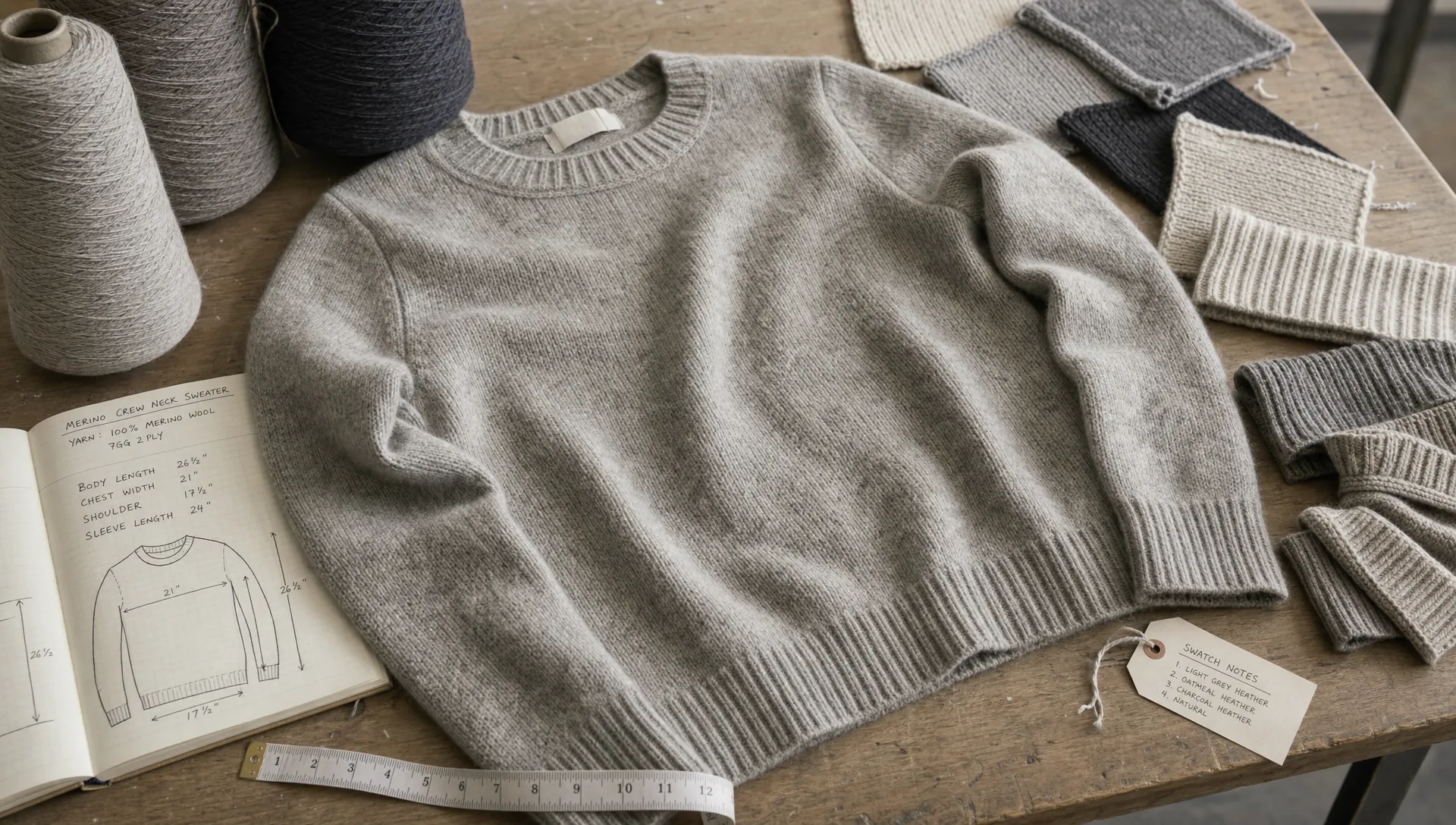
For a merino wool sweater, gauge should be tested alongside stitch density, garment weight and recovery. A 12-gauge jersey, 7-gauge rib and 5-gauge textured stitch will behave differently even if they use the same fiber. The sample process should compare how each construction responds to washing, steaming, hanging, wearing and folding.
Jersey is clean and versatile, but it can roll at edges if trims are not engineered correctly. Rib provides stretch and recovery, making it useful for cuffs, hems, necklines and body panels where shape retention matters. Cables and textured stitches add visual value, but they increase yarn consumption and can alter drape.
For more foundational detail on how yarn and gauge choices influence sweater performance, Arcus has a companion guide to merino sweater yarn, gauge and care basics.
Build the Pattern for Shape Retention
A lasting sweater is not only about materials. Fit and pattern engineering determine how stress moves through the garment during wear. If the armhole is too tight, the underarm seam will work harder. If the shoulder is too wide without enough structural support, the sleeve can drag the body out of shape. If the body length depends heavily on steaming, measurements may shift after washing.
Start with clear garment measurements, not just body measurements. Define chest, sweep, shoulder width, sleeve length, bicep, cuff opening, armhole depth and neck opening. Then decide where the sweater should relax over time. Knitwear changes with wear, so the development target should account for natural growth and recovery.
A merino wool sweater intended for frequent use should also be reviewed on body, not only flat. Fit sessions reveal whether the garment twists, pulls at the armhole, collapses at the neckline or bags at the elbow. These issues are often easier to correct at pattern and linking stages than after bulk production begins.
Fully fashioned construction can improve shape and reduce seam bulk, especially at shoulders and armholes. Cut-and-sew knit construction may be appropriate for some programs, but edge stability, seam type and recovery need careful testing. The right method depends on design intent, machinery, order quantity, cost and quality target.
Reinforce the High-Stress Details
Durability often fails first in small areas. Necklines stretch, cuffs relax, hems flare, shoulder seams grow and elbows thin. These problems are not always caused by poor yarn. They often come from trims and stress points that were not engineered with enough recovery.
Rib trims should be tested for return after stretching. Necklines need the right balance of opening comfort and long-term recovery. Shoulder seams may need tape, linking precision or construction support depending on the sweater weight. For cardigans or quarter zips, plackets and closures add another layer of stress that should be stabilized before production.
If the style is menswear-specific, construction expectations can differ by category, fit and retail positioning. Arcus covers those decisions in more detail in its guide to premium men’s merino wool sweater construction.
Control Finishing Without Hiding Problems
Finishing can make a sweater look better, but it should not be used to disguise weak construction. Washing, fulling, steaming, brushing and pressing all change the hand feel, dimensions and surface appearance. A beautiful finished sample that cannot repeat its measurements after laundering is not production-ready.
The final character of a merino wool sweater depends heavily on finishing discipline. Too much agitation can shrink or felt the knit. Too much steaming can temporarily force the garment into spec, only for it to relax later. Too much brushing can create a soft hand but increase surface fuzz.
Finishing instructions should be written into the tech pack with measurable targets. Include wash method, drying method, final measurements, acceptable tolerance, pressing instructions and hand-feel expectations. If the bulk production location changes, finishing should be revalidated because equipment, water quality and operator technique can affect outcomes.
Test Samples Like the Customer Will Wear Them
Testing should happen before bulk approval, not after the first customer complaint. Lab tests provide controlled data, while wear trials reveal real-world friction, stretching and care behavior. Both are useful.
For knitwear, dimensional stability is one of the most important checks. Measure the garment before and after washing according to the intended care label. Then check length, width, sleeve measurements, rib recovery and twisting. Pilling should be assessed in friction zones, especially underarms, sides, cuffs and areas that contact bags or outerwear.
| Test area | What to check | Why it matters |
|---|---|---|
| Dimensional stability | Shrinkage, growth and twisting after wash | Protects fit and sizing consistency |
| Pilling resistance | Surface fuzz and pills after abrasion | Preserves premium appearance |
| Seam strength | Linking, shoulder seams and side seams | Reduces failure at stress points |
| Rib recovery | Cuffs, hem and neckline after stretching | Helps the sweater keep its shape |
| Colorfastness | Washing, rubbing and perspiration | Prevents dye transfer and fading issues |
| Wear trial | Comfort, bagging, elbow wear and care response | Validates real customer experience |
A commercial merino wool sweater should be approved against a performance standard, not only a nice-looking prototype. Standards such as ASTM and ISO methods can be used by testing labs for pilling, dimensional change and colorfastness, depending on market needs. The key is to decide what acceptable performance means for the brand before production starts.
Plan Production Around Consistency
Once the product is approved, consistency becomes the main challenge. Yarn lots can vary slightly in shade, hand feel and behavior. Knitting tension can shift between machines. Finishing can change dimensions. These variables are normal in apparel manufacturing, but they need active control.
A strong production plan includes approved yarn references, swatch standards, graded specs, tolerance tables, construction notes, finishing instructions and inspection checkpoints. Pre-production samples should represent the true bulk process as closely as possible. If the sweater will be made in multiple colors, each color should be reviewed because dye and finishing can affect hand feel and shrinkage.
For brands that need support across development, sourcing, sampling and production management, working with a full-service partner can reduce handoff errors. Arcus Apparel Group supports apparel brands through custom clothing development and manufacturing, including material sourcing, pattern development, small batch manufacturing, low minimum order quantities and quality control at every stage.
Care Instructions Are Part of the Product
A sweater that lasts also depends on how it is cared for after purchase. Care labeling should reflect actual test results, not ideal conditions that only work in a lab. If the garment is labeled machine washable, it should be tested that way. If it needs hand washing or dry cleaning, the customer should know before buying.
The Woolmark care guidance is a useful reference for consumer-facing wool care practices. Many merino sweaters benefit from cool washing, wool-safe detergent, gentle handling, drying flat and storage folded rather than hung. Simple education can reduce returns and help customers preserve the garment.
A premium care card or product page can explain why some pilling is normal in natural fibers, how to remove pills safely and why resting wool between wears helps recovery. This is not an excuse for poor quality. It sets realistic expectations for a natural fiber garment designed for long-term use.
Frequently Asked Questions
What is the best yarn for a long-lasting merino sweater? The best yarn depends on the sweater’s purpose, but a balanced multi-ply merino yarn with appropriate twist, good staple length and stable spinning usually performs better than a yarn chosen only for softness.
Does a heavier merino sweater always last longer? Not always. Weight can add substance, but durability also depends on yarn quality, stitch density, seam construction, finishing and how the garment is worn.
How do you reduce pilling in merino knitwear? Start with stronger yarn engineering, appropriate twist, compact stitch construction and controlled finishing. Then validate with pilling tests and wear trials before approving bulk production.
Should a merino sweater be 100 percent wool or blended? Both can work. Pure merino offers a natural fiber story and excellent comfort, while blends can improve strength, recovery or cost. The decision should match the brand promise and care requirements.
How many samples are needed before production? Most brands should expect swatches, at least one prototype, fit samples and a pre-production sample. More rounds may be needed for new yarns, complex silhouettes or strict performance targets.
Develop a Sweater Customers Keep Reaching For
A lasting sweater is built through disciplined decisions, not one premium material choice. When fiber, yarn, gauge, pattern, finishing, testing and production control all support the same use case, the result feels better and performs better.
If you are developing a merino wool sweater for a new collection or scaling an existing style, Arcus Apparel Group can help turn the concept into a production-ready garment with sourcing, pattern development, sampling, manufacturing management and quality control built into the process.



