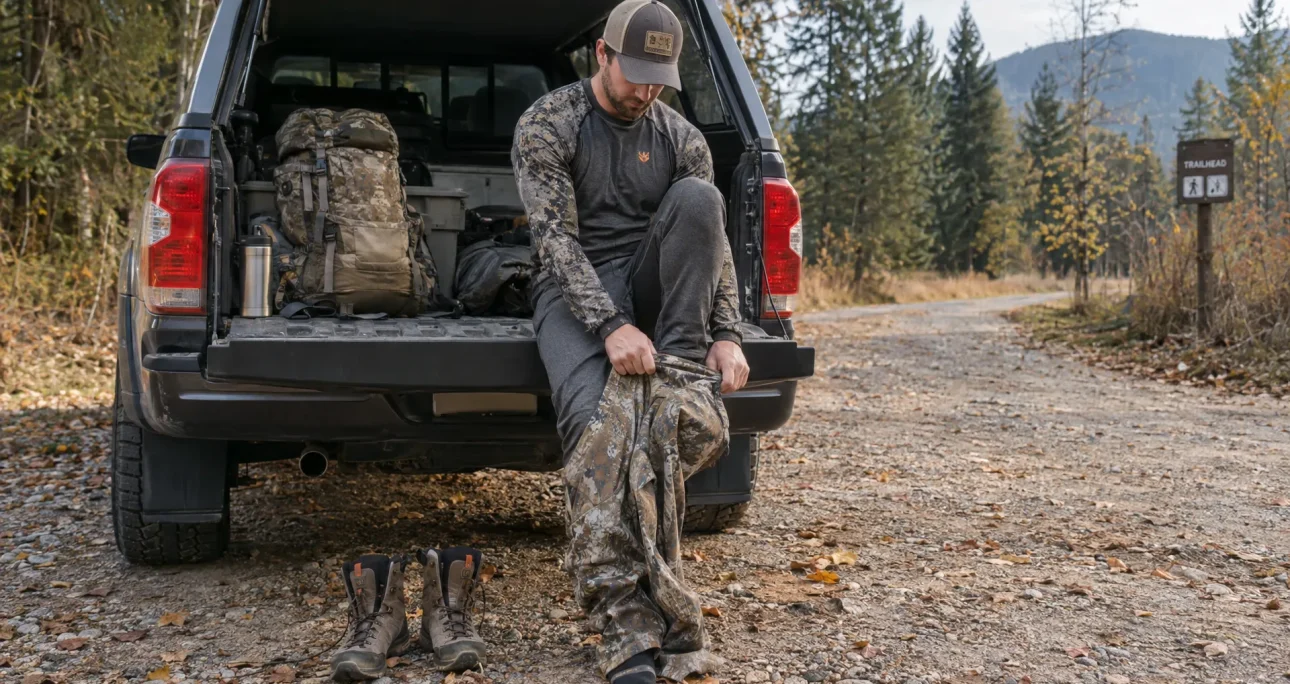
Merino wool hunting pants can provide comfortable, low-rustle fieldwear, but the fiber alone does not make a pant quiet or durable. Fabric construction, reinforcement placement, pocket hardware and fit determine how the finished garment performs when a hunter kneels, climbs or moves through brush.
For apparel brands, the development challenge is balancing those requirements without turning a comfortable wool trouser into a stiff, noisy shell. For buyers, the same details help distinguish a purpose-built hunting pant from a merino legging or casual trouser. Start by defining the conditions the pant must handle, then evaluate the complete garment rather than relying on its wool percentage.
Match the Pant to the Hunt
A lightweight layer worn beneath a shell has a different job from an outer pant exposed to branches, rocks and damp ground. Product descriptions should make that distinction clear.
| Hunting conditions | Main requirement | Details to evaluate |
|---|---|---|
| Slow stalking in woodland | Low movement noise and brush resistance | Fabric surface, reinforcement panels and pocket closures |
| Active travel through mixed terrain | Mobility and moisture management | Seat ease, crotch construction and ventilation options |
| Long periods sitting in cold weather | Insulation and layering room | Fabric thickness, wind exposure and seated fit |
| Wet vegetation or sustained rain | Protection from external moisture | Tested water resistance and compatibility with rainwear |
The best merino wool hunting pants for one setting may be unsuitable for another. A dense fabric that feels comfortable during a stationary hunt can become cumbersome on a steep approach, while a lighter construction may need additional protection at the knees and seat.
Set a clear primary use case before choosing fabric. Trying to serve warm-weather hiking, prolonged cold-weather sitting and hard brush travel with one construction usually creates unnecessary compromises.
Choose Fabric Construction Before Fiber Percentage
A high merino content is not a complete performance specification. Yarn structure, fabric density, finishing and supporting fibers all influence how the material handles wear. Ask for representative swatches and sample yardage, not just a composition sheet.
Woven Outer Pants Versus Knit Layers
Knitted merino fabrics generally offer useful stretch and next-to-skin comfort. Those qualities make them attractive for leggings and underlayers, but a soft knit needs careful evaluation before it becomes an exposed field pant. Branches can catch loops, and repeated knee loading can affect shape retention.
A woven construction is often a better starting point for an outer trouser that must tolerate brush and maintain a structured fit. It still needs testing: a loose weave can snag, while a tightly constructed fabric may restrict movement if the pattern does not compensate.
When evaluating merino wool hunting pants, identify whether the garment is intended as an outer layer or an insulating layer first. For under-shell designs, the specification priorities in merino wool base layers for hunting are more relevant than those of a brush-facing trouser.
Fabric weight in grams per square meter helps compare candidates, but it does not establish warmth, wind resistance or durability by itself. Compare finished fabrics in the intended garment construction.
Blends and Reinforcement Should Solve Specific Problems
Nylon or polyester can be incorporated to support strength and wear resistance, while elastane can add stretch. The benefit depends on how those fibers are used, not simply whether they appear on the label. Two fabrics with similar percentages can behave differently because of their yarns and construction.
Do not assume the finest, softest merino available is automatically the right choice for exposed fieldwear. Evaluate hand feel alongside abrasion, pilling and recovery after repeated bending.
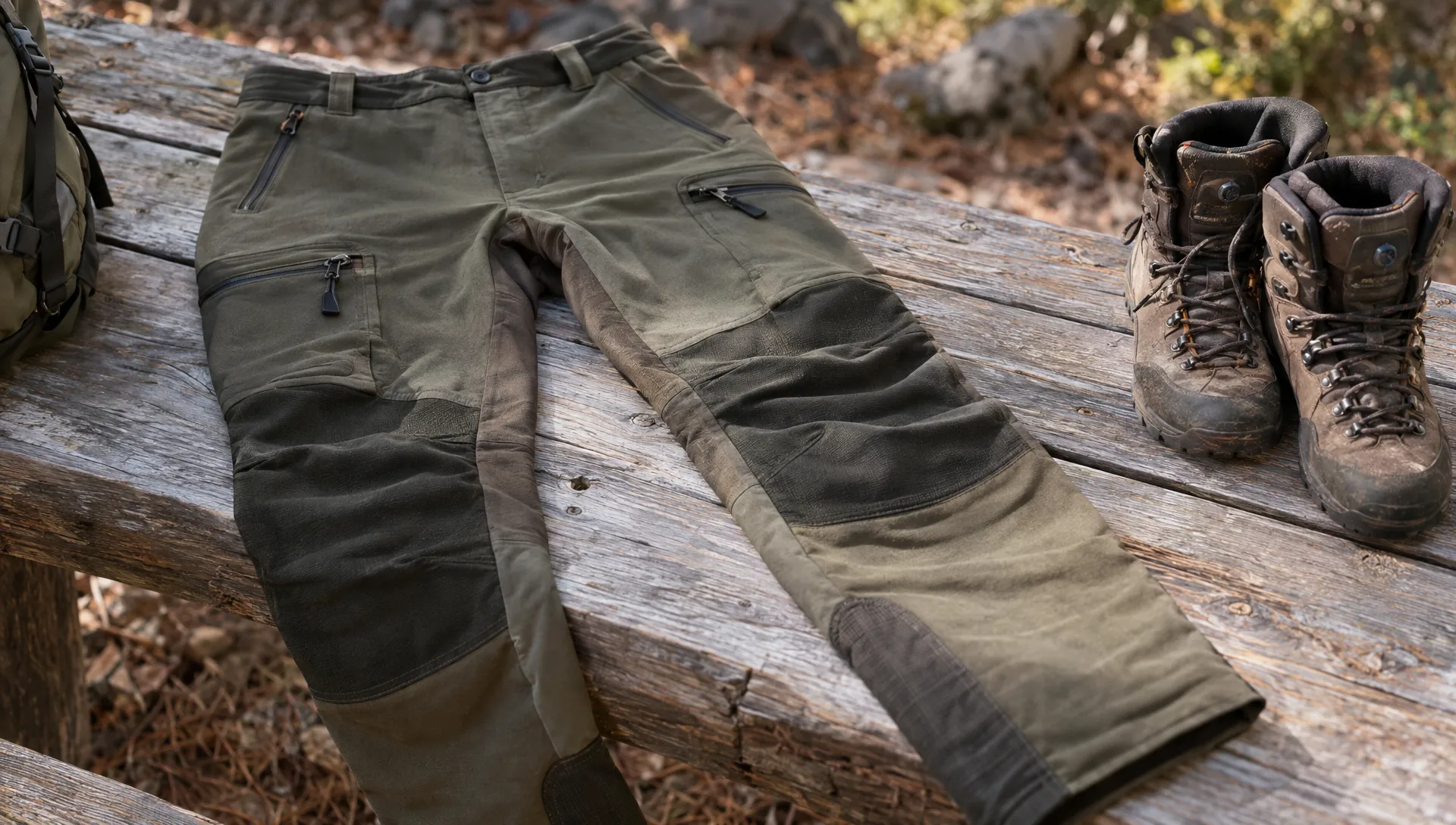
Localized reinforcement can protect knees, the seat and lower legs without changing the entire pant. However, every added panel introduces another material interface, seam and potential source of noise. Use reinforcement where testing shows it is needed, then check whether its stiffness, drying behavior and care requirements suit the main fabric.
Build Merino Wool Hunting Pants for Quiet Movement
Quietness is a garment-level property. Even a soft wool fabric can produce noticeable sound when it rubs against a stiff knee panel, a rain shell or a loaded pocket. Closures and accessories can also rattle independently of the fabric.
A lightly brushed surface may reduce some rustling, but it can also collect burrs or develop surface wear. Likewise, a smooth synthetic reinforcement is not necessarily noisy, and a wool-rich panel is not necessarily silent. Evaluate the actual material combination.
Use a repeatable movement sequence during sample review: walking, stepping over an obstacle, squatting, kneeling and accessing pockets. Keep the pace, pocket load and listening position consistent. Include the layers hunters are likely to wear underneath and over the pant.
Record separate observations for fabric rubbing, hardware contact and brush contact. This makes the feedback actionable. “Noisy while squatting” is less useful than “the knee panel rubs against the adjacent thigh fabric during deep flexion.”
Merino wool hunting pants should also be checked after laundering and after exposure to damp vegetation, since material hand and friction can change. A phone recording can help compare prototypes under consistent conditions, but it is not a calibrated acoustic measurement. Avoid claims such as “silent” unless you can define and support them.
Engineer Fit for Kneeling, Climbing and Sitting
A standing fitting can miss the most important problems. Hunting pants need enough room for a long step, a crouched approach and extended sitting without pulling at the waistband or concentrating stress at the crotch.
Articulated knees can accommodate bending, while a crotch gusset can provide useful mobility when properly shaped and positioned. Neither feature compensates for an unsuitable rise or insufficient seat and thigh ease. Evaluate the pattern as a whole.
Check samples with the intended base layer, belt and boots. A comfortable waistband in a showroom may press into the abdomen when seated or interfere with a pack hip belt. Excess fabric can create its own problems by rubbing, catching on vegetation or bunching behind the knee.
Fit-test merino wool hunting pants with loaded pockets rather than empty ones. A phone, gloves or small field accessories can change pocket behavior and pull the leg out of position. Review whether the wearer can retrieve an item without exaggerated movement or loud closure handling.
Keep Pockets and Hardware Purposeful
Place bulky storage away from areas that repeatedly fold during sitting or kneeling. A thigh pocket may work well in one position and interfere with a high step in another. Test it through the full movement sequence.
Secure zipper pulls so they do not strike nearby hardware, and evaluate closures for noise as well as access. Hook-and-loop fasteners can be convenient, but their opening sound may conflict with a quiet-use brief. Buttons, snaps and zippers each bring different handling requirements.
At the hem, check clearance around boots and the risk of loose fabric catching underfoot. Reinforcement should protect the wear zone without creating an unnecessarily rigid cuff.
Verify Durability With Fabric and Garment Tests
Durability should be demonstrated, not inferred from a heavy fabric or a rugged appearance. Laboratory tests help compare candidates, while wear trials reveal problems caused by the pattern, seams and interaction between materials.
ISO 12947-2 provides a Martindale abrasion method for assessing specimen breakdown. ISO 12945-2 addresses surface pilling, fuzzing and matting using the modified Martindale method. These tests answer different questions, so a favorable abrasion result does not establish good pilling performance.
| Evaluation | What it helps reveal | Development decision |
|---|---|---|
| Abrasion testing | Resistance to repeated rubbing under specified conditions | Compare fabrics and reinforcement candidates |
| Pilling testing | Changes in the fabric surface | Refine yarn, construction or finishing choices |
| Seam testing | Failure or opening at joined areas | Adjust seam construction, thread or allowances |
| Snag assessment | Vulnerability to catches and pulled yarns | Reconsider exposed fabrics for brush-heavy use |
| Movement and wear trials | Problems under real garment loading | Revise fit, pocket placement and panel boundaries |
When comparing merino wool hunting pants, ask whether test results describe the main fabric, a reinforcement material or the finished garment. A strong knee panel cannot prevent a poorly positioned seam from failing nearby.
Use the same test method and conditions when comparing materials. For wear trials, record the terrain, duration, carried load and observed damage. Establish acceptance criteria against the intended use and a suitable benchmark, rather than assigning arbitrary pass scores.
Check Recovery and Care Compatibility
Repeated bending can produce bagging at the knees or seat even when a fabric does not tear. Measure sample dimensions before wear, immediately afterward and after a defined recovery period. This separates temporary deformation from persistent loss of shape.
Launder complete garments according to the proposed care instructions, then reassess dimensions, seam appearance and panel alignment. Test more than once: the first wash may not reveal every compatibility issue.
A reinforcement that remains stable while the main fabric shrinks can cause puckering or distortion. Pocket bags, waistband components and trims also need to tolerate the same care process.
Merino wool hunting pants should have care instructions supported by the finished construction, not copied from a generic wool garment. If a treatment is intended to improve washability or water resistance, verify its performance after the planned care cycles. Do not describe a product as machine washable solely because its main fabric is sold that way.
Set Realistic Moisture and Weather Expectations
Wool can absorb moisture vapor and help buffer changes in humidity near the body. That does not make an outer pant waterproof, nor does it ensure fast drying after saturation. Drying depends on fabric construction, garment thickness and environmental conditions.
A dense fabric may reduce airflow, but wind protection should be evaluated rather than assumed. During stationary use, wind and contact with cold surfaces can make an otherwise comfortable pant inadequate without additional layers.
For merino wool hunting pants intended for wet vegetation, assess water penetration at the fabric, seams, knees and seat. If the design lacks a waterproof barrier and suitable seam protection, position it as fieldwear that may need rainwear rather than as a rain-shell replacement.
Odor resistance also needs careful language. Reduced odor buildup does not mean scent-free clothing, and it does not establish that game animals cannot detect the wearer. Keep marketing claims limited to benefits you can substantiate. The broader guide to merino wool hunting clothes helps place the pant within a complete layering system.
Turn Sample Findings Into a Production Brief
Translate successful sample details into measurable specifications. The production brief should identify fiber composition, fabric construction, finished weight, reinforcement locations, seam types, hardware and graded garment measurements. Include tolerances and approved material references so that later substitutions do not quietly alter performance.
Specify which changes require a new review. Replacing a knee fabric, zipper or finishing process can affect sound, mobility and care compatibility even when the garment looks similar.
For US retail, review the FTC’s textile and wool labeling guidance when preparing fiber-content and identification labels. Keep descriptions consistent with the actual composition rather than allowing “merino” to imply an all-wool garment.
The final approval for merino wool hunting pants should combine fit, noise, durability and care results. Inspect production garments against the approved sample, with particular attention to reinforcement alignment, pocket placement and seam consistency. Those details can change how a pant performs without changing the fabric specification.
Frequently Asked Questions
Are 100% merino pants better than merino blends for hunting? Not automatically. An all-wool construction may provide a desirable feel, but a well-designed blend can be more suitable for exposed wear. Compare abrasion, snagging, recovery and noise in the actual garment rather than choosing by fiber percentage alone.
Are merino wool hunting pants waterproof? Merino content does not make a pant waterproof. Protection from sustained rain requires an appropriate barrier and garment construction, including attention to seams. Wool-rich field pants may still need a separate rain layer.
Can merino leggings replace an outer hunting pant? Only if the product is designed and tested for exposed use. Many leggings are intended as base layers and lack the construction, storage and wear resistance needed for brush or repeated ground contact.
How should a brand evaluate quietness before production? Compare complete prototypes using the same movement sequence, pocket load, layers and listening position. Include closure handling, brush contact and checks after laundering. Identify the source of each sound so revisions address the actual problem.
Develop a Fieldwear Brief With Arcus Apparel Group
A useful starting brief includes the hunting environment, intended layer position, expected wear zones and claims the finished pant must support.
Arcus Apparel Group offers custom apparel development, material sourcing, pattern development and small-batch manufacturing, with production management and quality control throughout the process. Discuss your proposed wool construction, reinforcement needs and sampling plan with the team to confirm material availability, manufacturing feasibility and the steps needed before production.