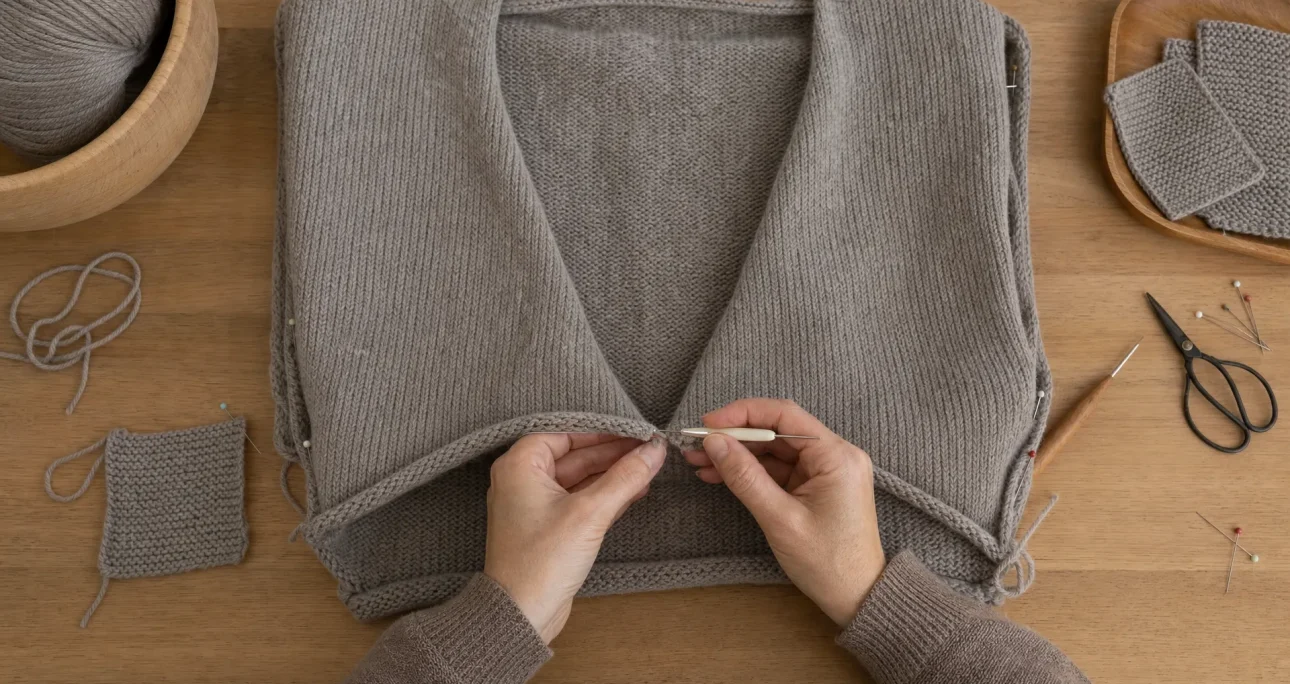
A strong merino v neck sweater starts at the neckline, not at the final fit sample. The V opening is where yarn behavior, rib tension, stitch structure, pattern geometry and finishing all meet in a small area that the wearer notices immediately. If the neckline waves, collapses, twists or feels tight at the back neck, the whole garment reads as poorly developed even when the body fabric is premium.
For apparel brands, the goal is not simply to draw a flattering V. The goal is to engineer a neckline that looks clean on the hanger, sits correctly on different bodies and recovers after wear. That requires decisions before sampling: neckline depth, shoulder position, rib width, pickup ratios, center-front construction, seam bulk and wash performance all need to work together.
Why neckline engineering matters in premium merino
Merino wool has a different character from cotton, acrylic or compact synthetic yarns. It is soft, resilient and naturally elastic, but it can also grow, torque or distort if the construction is not balanced. A V-neck concentrates that movement at the center front, where two angled edges meet and where the eye naturally looks first.
A crew neck distributes tension around a continuous curve. A V-neck asks the fabric to control two diagonal edges, a sharp lower point and a rib trim that must turn the corner without flaring. That makes the neckline one of the most technical parts of the garment.
When a brand develops a merino v neck sweater for a premium collection, the neckline should be treated as a performance zone. It has to support the garment through fitting, washing, steaming, folding, packing and repeated wear. The better the engineering, the less the sweater relies on aggressive finishing to hide instability.
If you want a wider view of premium construction details beyond the neckline, Arcus Apparel Group covers fiber, yarn and finishing considerations in its guide to merino wool V-neck sweater quality.
How to engineer the neckline of a merino v neck sweater
The neckline should be built from measurable points, not from a visual sketch alone. A good tech pack defines high point shoulder, neck width, front drop, back neck drop, V point position, trim width and finished neck circumference. These dimensions become the baseline for sampling and grading.
Start with the intended wearer and styling
Before a brand approves a merino v neck sweater, the product team should decide how it will be worn. A shallow V over a T-shirt needs a different angle from a deeper V intended for layering over a shirt. Womenswear may require more sensitivity around bust shaping and shoulder placement, while menswear often needs a V depth that accommodates a collared shirt without looking too open.
Neck width is just as important as V depth. A narrow neck with a deep V can pull toward the center and stress the lower point. A wide neck with a shallow V may slide outward at the shoulder and lose structure after wear. The best proportion depends on body block, size range, yarn behavior and brand aesthetic.
Define the V angle before adjusting the rib
A common development mistake is trying to fix a poor V shape by changing only the rib trim. If the underlying neckline angle is wrong, the rib will expose the problem rather than solve it. The knit panel must be shaped so the V sits smoothly before trim tension is added.
On fully fashioned knitwear, the angle is controlled through narrowing frequency and panel shaping. On cut-and-sew knit fabric, it is controlled through pattern lines, seam allowances and fabric relaxation. In both cases, the sample should be evaluated after the garment has rested, since freshly steamed merino can temporarily look more stable than it will in real use.
Build stability into the rib trim
The rib trim does more than frame the opening. It controls stretch, recovery, edge firmness and the visual weight of the neckline. Rib that is too light may ripple. Rib that is too heavy can drag the V point downward or create a raised ridge around the neck.
For a refined merino v neck sweater, 1×1 rib is often chosen because it can look clean and compact. A 2×2 rib can work for more casual products, but it adds width and texture that may overpower a fine gauge body. The trim should be swatched with the same yarn family, wash process and finishing route planned for production.
| Neckline decision | What it controls | Risk if poorly specified |
|---|---|---|
| V depth | Layering, coverage and visual proportion | Too deep, too conservative or inconsistent by size |
| Neck width | Shoulder stability and opening shape | Slipping shoulders or pulling at center front |
| Rib width | Edge firmness and styling | Bulky trim or weak neckline recovery |
| Pickup ratio | Smoothness along the angled edge | Waving, puckering or tightness |
| Center-front miter | Sharpness and durability of the V point | Twisting, holes or uneven trim alignment |
Use pickup ratios based on the actual fabric
Pickup ratio is the relationship between the neckline edge and the stitches used to attach the trim. There is no universal ratio that works across all merino constructions. Fine gauge jersey, compact rib and heavier plaited fabrics each behave differently after washing and steaming.
A development team should test the pickup on the washed and relaxed swatch, not only on greige fabric. Too many stitches along the neckline create waves. Too few stitches pull the body fabric inward and make the neckline feel smaller than the spec suggests. The ideal ratio often changes slightly around the back neck, shoulder curve and angled front edges.
Engineer the center-front miter
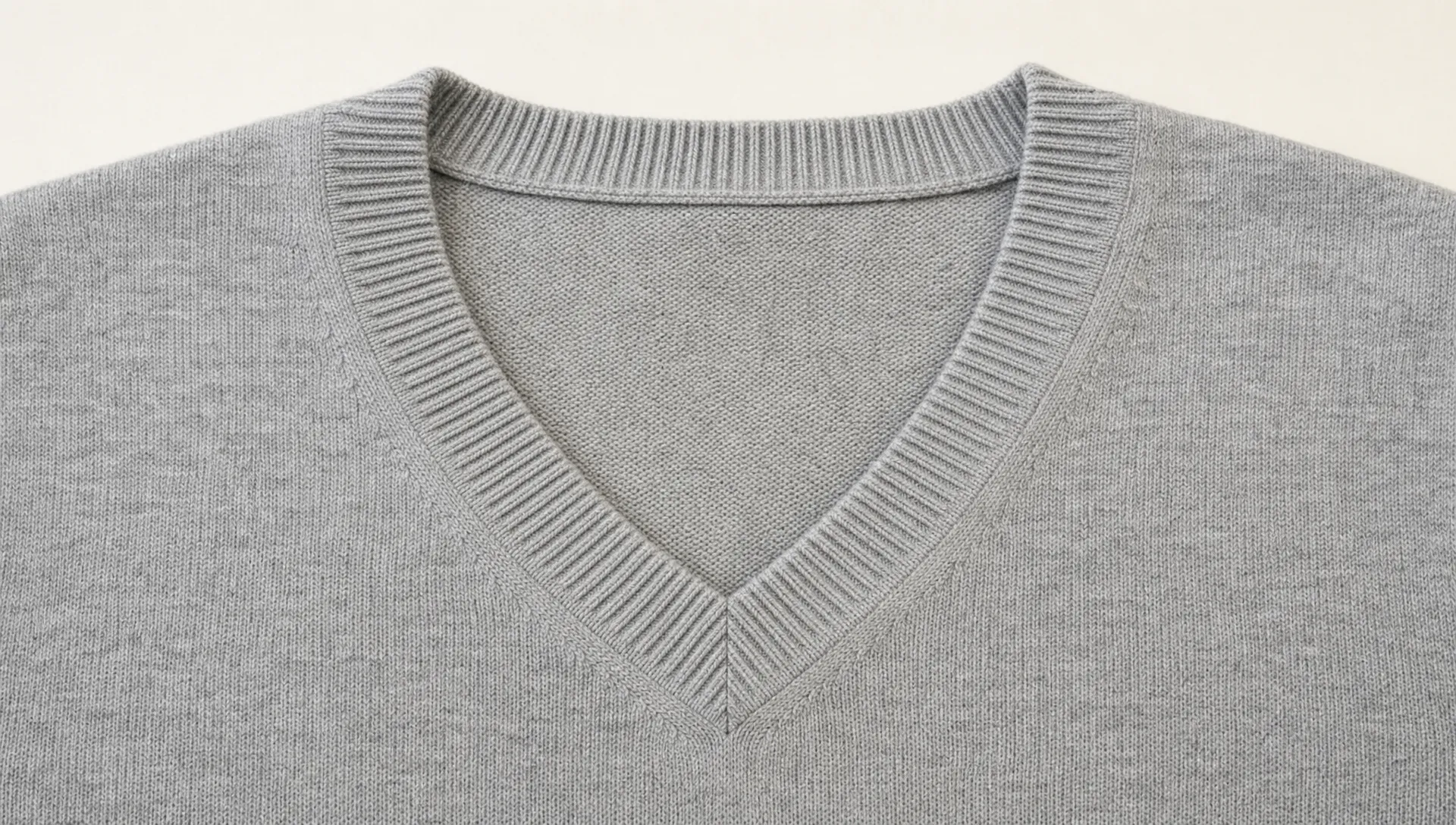
The V point is where many otherwise good samples fail. A clean miter requires symmetrical trim, controlled seam bulk and a secure joining method. If the rib is simply overlapped or forced into a point, the result can look acceptable after steaming but distort quickly during wear.
A better approach is to specify the miter construction clearly in the technical package. The V point should show how the rib ends meet, how the seam is secured and how excess bulk is reduced without weakening the area. For a merino v neck sweater, this point should be checked on the body, not only flat on the table, because chest shape can reveal twisting that is invisible on a hanger.
Match yarn, gauge and neckline shape
A neckline that works in one merino yarn may fail in another. Fiber fineness, twist, ply, spinning method and yarn count all influence recovery. Softer yarns can create a luxurious handfeel, but if they lack enough structure the V opening may stretch and flatten over time.
Gauge also matters. A fine gauge sweater can support a sleeker neckline, but the edges may need more precise control because small distortions are highly visible. A heavier gauge garment has more body, yet the rib can become bulky at the V point if the trim is not scaled carefully.
When developing a merino v neck sweater, yarn and gauge should be chosen with the neckline in mind from the beginning. If the brand wants a deep, elegant V, the yarn must have enough recovery to hold that opening. If the brand wants a relaxed fit, the neck shape may need added stability so the casual silhouette does not become sloppy after wear.
For related durability decisions across the whole garment, including gauge, seams and testing, see Arcus Apparel Group’s guide on how to develop a merino wool sweater that lasts.
Grade the neckline, not just the body
Grading a V-neck is more complex than scaling the front body. Larger sizes do not always need a proportionally deeper V, and smaller sizes can become too closed if the grade is too conservative. Neck width, shoulder slope, front drop and center-front placement should be reviewed together.
The most reliable method is to create graded neckline points of measure and compare them on fit forms or live models across the target size range. A V that looks balanced in a medium can become too open in larger sizes if depth increases faster than body proportion. It can also become too sharp in smaller sizes if the neck width narrows excessively.
A production-ready merino v neck sweater should include clear tolerance standards for neckline dimensions. Because the neckline is visually prominent, tolerances often need to be tighter than less visible body measurements. Factories also need a standard relaxation period before measuring, especially when merino garments have been steamed.
Test the neckline through real handling
A neckline can pass a first fitting and still fail in use. Brands should evaluate the garment after wash testing, drying, hanging, folding and try-on cycles. This is especially important for merino because finishing can temporarily improve appearance.
The testing process should answer practical questions. Does the V point remain centered? Does the rib recover after being stretched over the head? Does the back neck sit flat? Does the trim ripple after washing? Does the shoulder seam support the neckline or allow it to drift outward?
For a merino v neck sweater, the sample review should include both flat measurements and worn assessment. Flat specs confirm production consistency, but the worn assessment shows whether the neckline interacts correctly with posture, chest shape and layering. Photos from front, side and three-quarter angles can help the development team identify imbalance before bulk production.
Common neckline problems and corrections
Neckline defects usually come from a combination of causes rather than one isolated mistake. A wavy edge may involve pickup ratio, rib weight and finishing tension. A twisted V point may involve miter construction, yarn torque and uneven handling during linking.
| Problem | Likely cause | Development correction |
|---|---|---|
| Wavy front edge | Too many pickup stitches or unstable trim | Reduce pickup density, adjust rib structure and retest after wash |
| Puckered neckline | Too few pickup stitches or excessive tension | Add stitches in the tight zone and relax linking tension |
| Twisted V point | Uneven miter or yarn torque | Rebuild the miter, balance trim lengths and review panel symmetry |
| Neck grows after wear | Yarn lacks recovery or trim is too soft | Increase trim firmness, adjust yarn construction or add discreet stabilization |
| Bulky lower V | Rib width or seam allowance is too heavy | Narrow trim, reduce overlap and refine joining method |
The best correction is made during development, not after production starts. Once bulk panels are knitted or cut, there are fewer options for improving the V without adding cost, rework or inconsistency.
Production controls that protect the final neckline
After the fit sample is approved, production teams need repeatable controls. The technical package should include neckline diagrams, finished measurements, trim specifications, construction notes, miter details, measurement method and acceptable tolerances.
Quality control should happen at multiple stages. In-line checks can catch trim tension issues before they affect a full batch. Final inspection should review symmetry, V point alignment, back neck shape, seam smoothness and measurement after relaxation. If garments are pressed or steamed before packing, the process should be standardized so one operator does not stretch the neckline more than another.
A consistent merino v neck sweater depends on communication between design, technical development and manufacturing. The neckline is small, but it reflects every decision behind the garment: yarn selection, pattern discipline, machine setup, operator skill and finishing control.
Frequently Asked Questions
What makes a merino V-neck neckline difficult to produce? The angled front edges and center-front point concentrate tension in a small area. Merino’s softness and elasticity add comfort, but they also require careful control of rib tension, pickup ratio, miter construction and finishing.
How deep should the V be on a merino sweater? V depth depends on the target customer, gender category, fit block and styling purpose. A layering style may need a deeper V, while a standalone sweater usually needs more coverage and neckline stability.
Is 1×1 rib or 2×2 rib better for the neckline? 1×1 rib often gives a cleaner, more refined edge for fine merino sweaters. 2×2 rib can work for casual or heavier styles, but it needs careful scaling so it does not look bulky at the V point.
Why does the neckline look good after steaming but distort later? Steam can temporarily relax and reshape merino fibers. If the underlying construction is unstable, the neckline may wave, grow or twist after wear and washing. Testing after relaxation gives a more accurate result.
Should the neckline be graded differently from the body? Yes. Neck width, V depth, shoulder slope and center-front placement need their own grading logic. Proportional scaling can make larger sizes too open and smaller sizes too tight or sharp.
Build a better merino neckline from development to production
A better neckline is engineered long before the final sample is approved. It starts with the right yarn and gauge, then moves through pattern geometry, rib specification, miter construction, grading, testing and production quality control.
Arcus Apparel Group helps brands develop custom apparel with material sourcing, pattern development, small batch manufacturing, production management and quality control at each stage. If you are planning a merino knitwear program and want a production partner that can support both development and manufacturing, explore Arcus Apparel Group’s custom clothing manufacturing services.



