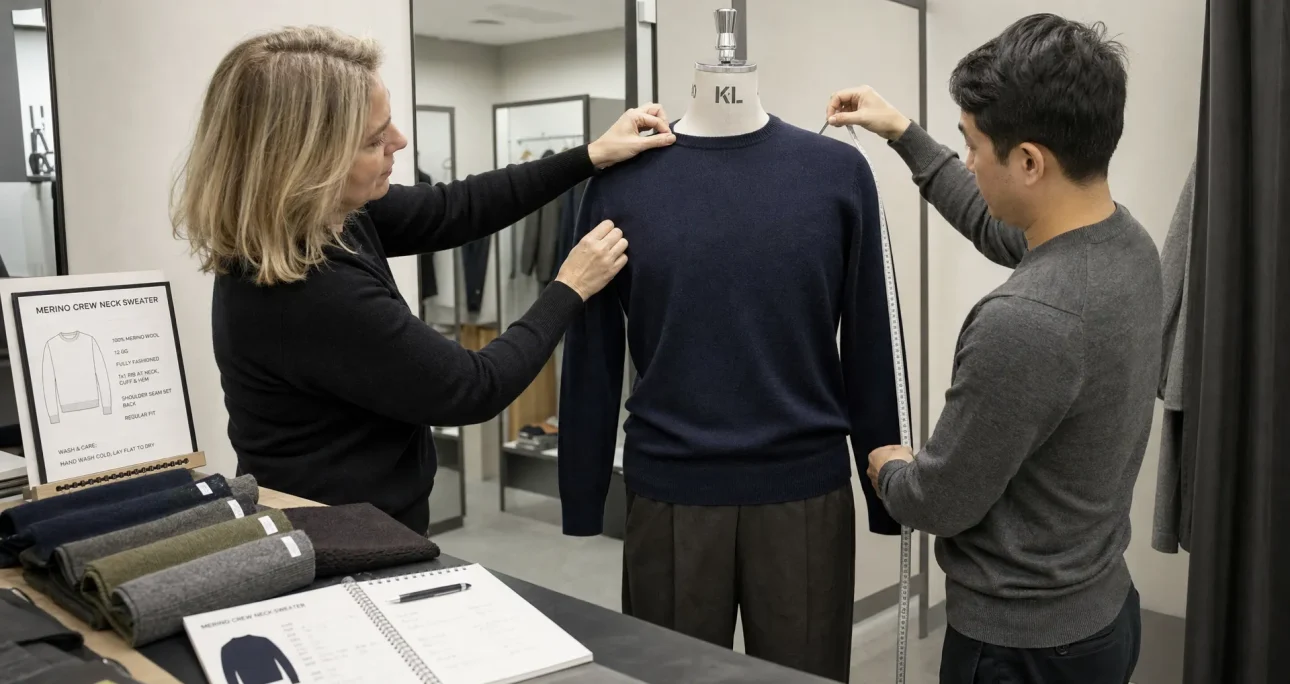
For an apparel brand, a merino crew neck sweater is a deceptively technical product. It looks simple on the rack, yet the final result depends on decisions made long before production: the yarn count, the knitting gauge, the amount of body ease, the neck rib construction and the finishing route. If those choices are not aligned, the sweater may feel beautiful in a hand sample but stretch, twist, pill or lose shape after real wear.
This guide focuses on the development decisions behind a commercially viable crew neck style. It is written for founders, merchandisers and product teams that need to brief a manufacturer clearly, compare sample options and avoid quality issues that become expensive once bulk production begins.
Why the merino crew neck sweater needs a tighter spec
Crew necks are often treated as safe basics, but basic does not mean forgiving. A simple silhouette leaves fewer places to hide poor yarn behavior, uneven tension or a neckline that grows after washing. The customer will judge the garment by touch, drape, recovery and whether it still looks sharp after repeated wear.
A strong merino crew neck sweater brief starts by locking three decisions before any sample is knitted: the yarn type, the gauge it will run on and the fit block it needs to serve. These choices influence one another. A fine worsted yarn may suit a clean 14 gauge office layer, while a loftier woolen-spun yarn may be better for a warmer casual style in a lower gauge.
If you are planning a full construction spec, Arcus also has a detailed Merino Wool Crew Neck Sweater Construction Guide that expands into seams, trims, finishing and quality control. Here, the focus is narrower: how to make yarn, gauge and fit work together from the start.
Start with yarn: fiber quality, spinning, ply and twist
Merino is valued because it can be soft next to skin while still offering the natural breathability and odor resistance associated with wool. The Woolmark Company describes Merino wool as fine, soft and naturally breathable, which is why it is used across both performance apparel and premium knitwear.
For a merino crew neck sweater meant to be worn directly over a T-shirt or against the skin, fiber fineness matters. Lower micron fibers usually feel softer, but very fine fibers can also be more delicate if the yarn construction is not robust. Many commercial sweaters balance softness with durability by looking beyond micron alone and specifying spin type, ply and twist.
Worsted-spun yarns tend to look smoother, cleaner and more refined because the fibers are more aligned. Woolen-spun yarns usually feel loftier and warmer, with a softer visual surface. Neither is automatically better. The right choice depends on whether the design goal is a polished layering piece, a cozy seasonal knit or a more textured casual sweater.
| Yarn decision | What it changes | Development note |
|---|---|---|
| Fiber fineness | Handfeel, perceived quality and next-to-skin comfort | Very fine fibers need suitable yarn construction to avoid excess wear |
| Spinning method | Surface clarity, loft and warmth | Worsted is cleaner, woolen is airier and more textured |
| Ply count | Stability, thickness and stitch definition | Higher ply can improve structure but may add weight |
| Twist level | Strength, drape and surface behavior | Too little twist can pill, too much can feel wiry |
| Blend choice | Cost, recovery and care performance | Nylon, cashmere or other fibers should serve a clear purpose |
A good development brief should not just say "100 percent merino." It should define the target handfeel, the visual surface, the expected wear occasion and the care requirements. That gives the manufacturer enough context to recommend yarn options that are realistic for the product and price point.
Gauge: how density changes handfeel, cost and silhouette
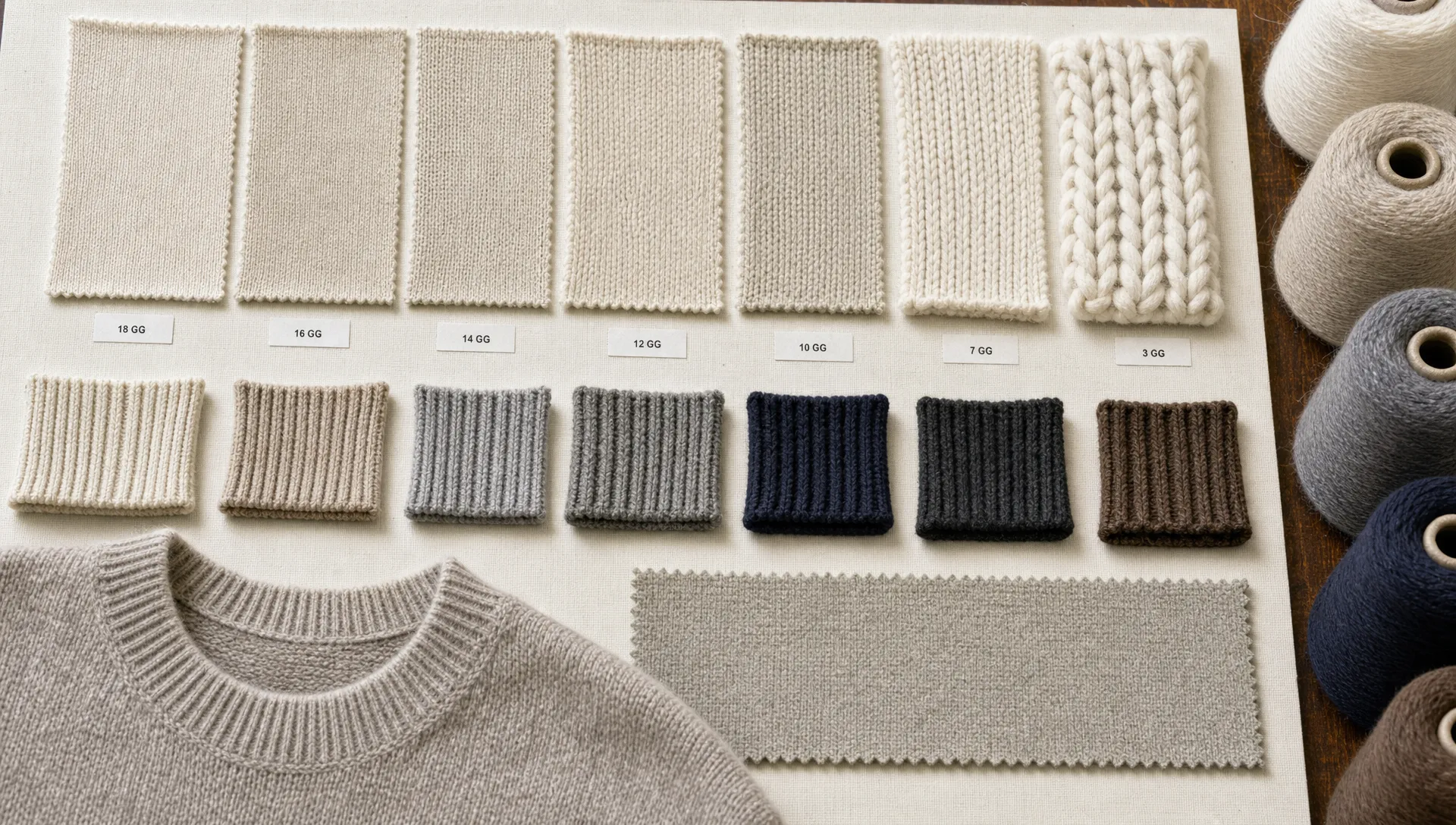
Gauge is one of the most important decisions in knitwear development. In flat knitting, gauge generally refers to the number of needles per inch. Lower gauges create larger stitches and heavier structures, while higher gauges create finer stitches and smoother surfaces.
Gauge is where a merino crew neck sweater starts to become a specific product rather than a generic sketch. The same yarn can look too loose in one gauge, too dense in another and balanced in a third. This is why swatching is not optional. A yarn should be tested in the intended stitch structure and finished as close as possible to the expected bulk process.
| Gauge range | Typical result | Best suited for | Main watchpoint |
|---|---|---|---|
| 3 to 5 gauge | Chunky, warm, visible stitches | Statement knits, cold weather layers | Weight, stretching and yarn cost |
| 7 to 10 gauge | Medium weight, versatile handfeel | Everyday crew necks and seasonal basics | Balance between density and drape |
| 12 to 14 gauge | Fine, smooth, polished surface | Office layers and premium basics | Transparency, seam strength and snagging |
| 16 gauge and finer | Very fine, lightweight structure | Luxury layering and refined silhouettes | Durability, recovery and production consistency |
The table is a starting point, not a rule. A 12 gauge sweater in a lofty yarn may feel warmer than expected, while a 7 gauge sweater in a compact yarn may feel structured rather than soft. Development teams should review swatches after steaming or washing because unfinished knit panels can mislead the eye and hand.
Gauge and yarn must be developed together
One common mistake is choosing a yarn from a shade card, approving its touch in a loose hank and only later discovering that it behaves differently in knitted form. Yarn is engineered material. It changes when tensioned, looped, linked, washed, dried and pressed.
A practical sampling process should compare at least two gauge options if the brand is still defining the product. Review the swatches for opacity, weight, stretch, recovery, pilling tendency and seam compatibility. If the swatch curls heavily, grows too much or feels boardy after finishing, the problem may be the gauge, not the fiber itself.
Fit: the crew neck block has to match the yarn behavior
Fit is not only a set of measurements. In knitwear, fit is a relationship between the body block, the stretch of the knitted structure and the recovery of the yarn. A woven shirt pattern cannot simply be translated into a sweater shape, because knit loops move and relax in wear.
The fit of a merino crew neck sweater should be defined by intended use before measurements are finalized. A slim layering piece needs controlled ease at the chest, cleaner armholes and a hem that does not flare. A relaxed weekend sweater needs more body ease, a slightly lower armhole and enough sleeve width to avoid pulling across the upper arm.
| Fit area | What to specify | Why it matters |
|---|---|---|
| Shoulder | Set-in, saddle, dropped or fully fashioned shoulder shape | Controls visual structure and how the garment hangs |
| Chest ease | Slim, regular or relaxed allowance | Affects comfort, layering and perceived size |
| Body length | High hip, mid hip or longer proportion | Changes styling and shrinkage tolerance |
| Sleeve shape | Bicep width, cuff opening and sleeve taper | Impacts mobility and recovery after wear |
| Hem rib | Rib depth, tension and opening measurement | Determines whether the sweater sits cleanly or balloons |
Measurements should be reviewed on a fit model after the garment has rested. Knitwear can change after steaming, washing or even hanging. A sample that measures correctly immediately after pressing may relax by the next day, especially in softer yarns or looser gauges.
Neckline and rib details define quality quickly
The crew neck is the most visible performance point of the garment. It frames the face, sets the style and reveals whether the product was engineered with care. A rib that is too loose will ripple or grow. A rib that is too tight can feel uncomfortable and pull the shoulder area inward.
On a merino crew neck sweater, the neck rib should recover after being stretched over the head and should sit flat without choking the wearer. The neck drop, rib width, binding method and seam bulk all matter. Even a premium yarn can look cheap if the neckline does not retain its shape.
Rib structure also affects production consistency. A 1×1 rib, 2×2 rib or tubular neck finish will each behave differently. The correct choice depends on the main body gauge, the desired look and the target level of stretch. This is where a manufacturer with knitwear experience can help translate a design sketch into a workable spec.
Grade rules need more than proportional scaling
Knitwear grading should not rely on simple proportional increases across all sizes. Larger sizes may need different ease distribution, shoulder shaping and sleeve width to preserve the intended look. Smaller sizes may need adjusted rib tension so openings are not too loose.
The development team should review the base size first, then check at least one smaller and one larger size before bulk production. If the brand plans to sell across a wide size range, grading should account for how the fabric stretches on the body, not just how the garment measures flat.
Sampling and testing before bulk production
A merino crew neck sweater should be evaluated through the same conditions the customer will create: wearing, stretching, washing, drying and folding. A showroom sample is not enough. The garment needs to be checked for dimensional stability, pilling, twisting, seam strength and neckline recovery.
Testing does not always require a complicated lab plan at the earliest stage, but it does require discipline. Wash a sample according to the proposed care label. Measure it before and after. Let it dry fully, then measure again. Wear-test it if possible, especially at the elbows, cuffs, underarms and neck.
For brands building a longer-lasting sweater program, Arcus explains the relationship between fiber, construction, finishing and care in its guide on how to develop a merino wool sweater that lasts. That durability mindset is useful even when developing a clean seasonal basic.
Before approving production, confirm the following points in the tech pack and sample review notes:
- Yarn composition, count, ply, twist direction if relevant and approved supplier reference
- Knitting gauge, stitch structure, rib structures and panel tension targets
- Finished garment measurements, tolerances and post-wash measurement expectations
- Neckline construction, shoulder construction, cuff and hem rib specifications
- Care label instructions supported by sample washing results
- Approved bulk standard for handfeel, shade, surface appearance and weight
Common spec mistakes that hurt sell-through
A merino crew neck sweater often fails because the development team approved one appealing element in isolation. A soft yarn is chosen without enough attention to pilling. A fine gauge is selected for elegance but creates a garment that feels too thin for the price. A relaxed fit is requested, but the shoulder and sleeve are not reshaped to support the extra volume.
Another frequent mistake is under-specifying the neckline. Buyers notice a growing or rippled neck faster than they notice many other technical problems. If the neck trim is not tested for recovery, the garment can look tired after only a few wears.
Cost engineering can also go too far. Reducing yarn quality, shortening body length or loosening the knit density may improve margin on paper, but those changes can undermine customer trust. In knitwear, the cheapest spec is rarely the most profitable spec if returns, poor reviews and low repeat purchase are considered.
Frequently Asked Questions
What gauge is best for a merino crew style? There is no universal best gauge. A 7 to 10 gauge works well for many everyday sweaters, while 12 to 14 gauge is better for fine layering pieces. The best option depends on yarn count, desired weight, target price and fit.
Should a brand choose pure merino or a blend? Pure merino gives a clear premium wool story and strong natural performance. A blend can improve durability, recovery, cost or handfeel, but the added fiber should have a specific purpose rather than being used only to reduce cost.
How many samples should be made before production? Most brands should expect at least a proto sample, a fit sample and a pre-production sample. More rounds may be needed if the yarn, gauge or fit block is new to the brand.
Why does the neckline stretch out after wear? Neckline growth can come from loose rib tension, unsuitable yarn twist, weak recovery, poor linking or finishing that relaxes the trim too much. It should be tested before bulk approval, not corrected after production.
Build a better merino program with Arcus
Developing premium knitwear is easier when design, sourcing, sampling and production are managed as one connected process. Arcus Apparel Group supports custom apparel development, material sourcing, pattern development, small batch manufacturing, flexible scaling and quality control at each stage.
If you are planning a merino knitwear program, Arcus Apparel Group can help translate your concept into a production-ready garment with the right yarn, gauge and fit decisions from the beginning.



