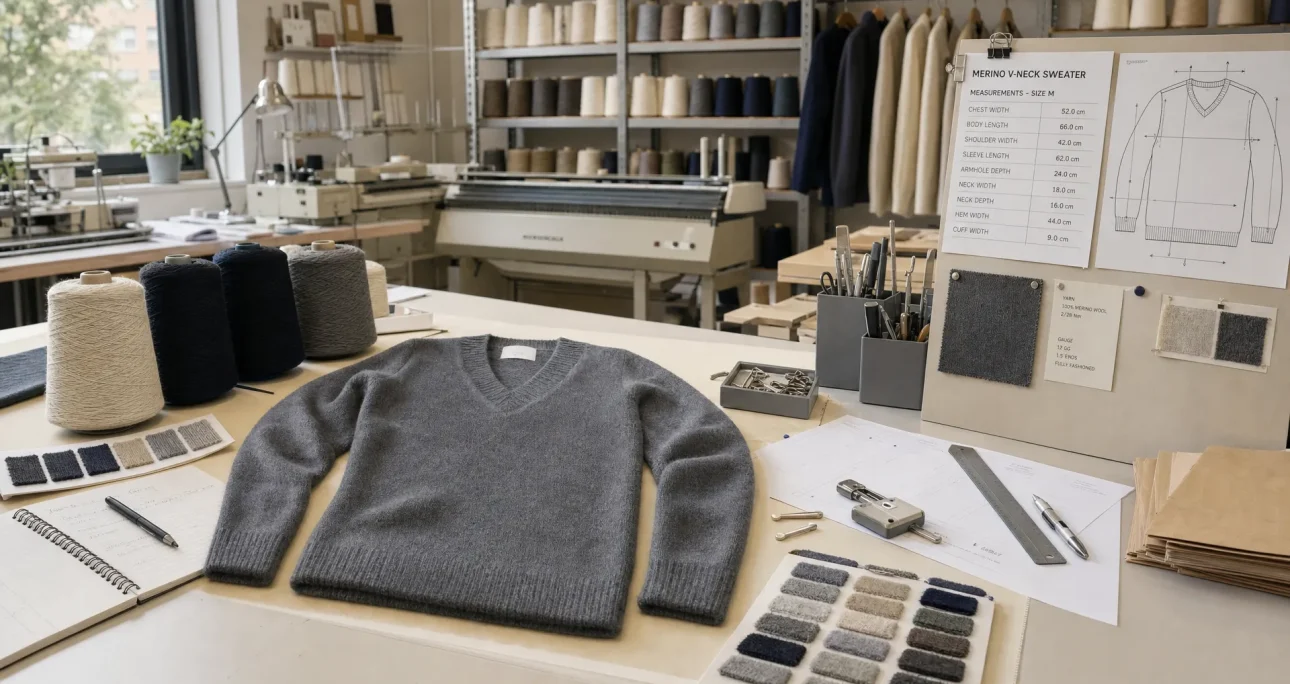
A merino wool V-neck sweater looks simple on a hanger, which is exactly why quality can be easy to miss. The difference between a premium sweater and an average one often appears after the first few wears: the neckline starts waving, the V point twists, the cuffs stretch out or the body loses its clean shape.
For apparel brands, those issues are not minor defects. They affect return rates, customer reviews and whether a buyer trusts the next product drop. A well-made merino wool V-neck sweater needs the right fiber, yarn, gauge, neckline engineering, fit balance and finishing process working together.
This guide focuses on the details that define quality from a product development and manufacturing perspective.
Why the V-neck is harder to execute than it looks
A crewneck sweater gives the neckline a closed circular structure. A V-neck does not. The neckline is interrupted by a sharp center point, which means the trim has to control stretch, tension and symmetry across two angled sides.
That center V is one of the first places quality shows. If the band is too loose, the neckline ripples. If it is too tight, it pulls the shoulder and upper chest out of shape. If the mitered point is poorly joined, the sweater can look twisted even when the body measurements are technically correct.
The V-neck also affects how the garment is worn. Many customers buy it for layering over a shirt, T-shirt or dress. That means the opening must be deep enough to look intentional but stable enough not to collapse. The best products are designed around this balance from the first sample, not corrected at the end.
Fiber quality starts the product story
Merino wool is prized because the fibers are generally finer and softer than many other wool types. That softness makes it suitable for next-to-skin or near-skin garments, but the word “merino” alone does not guarantee luxury.
Brands should define the fiber standard before sampling. Important sourcing details include fiber fineness, staple length, color consistency, crimp, contamination control and whether the wool is traceable. Finer fibers usually improve softness, but extremely fine yarns can need more support through ply, twist, gauge or blending to maintain shape.
For a deeper sourcing overview, Arcus has a useful guide to merino wool properties brands should know before sourcing, including comfort, moisture behavior, elasticity and shrinkage considerations.
Responsible sourcing can also influence brand positioning. Certifications such as the Responsible Wool Standard from Textile Exchange help brands communicate animal welfare and land management expectations through the supply chain. Not every product needs the same certification route, but sourcing claims should be verifiable before they appear on packaging, hangtags or product pages.
Yarn construction affects softness, recovery and pilling
A sweater’s hand feel comes from fiber quality, but its long-term performance depends heavily on yarn construction. Two merino sweaters made from similar fiber can wear very differently if one uses a balanced, well-spun yarn and the other uses a loosely spun yarn that pills quickly.
Worsted-spun yarns generally create a cleaner, smoother appearance because the fibers are more aligned. Woolen-spun yarns tend to feel loftier and warmer but can look more casual. Neither is automatically better. The right choice depends on whether the brand wants a refined office sweater, a relaxed lifestyle piece or a cozy winter layer.
Ply and twist matter as well. A single-ply yarn can feel soft and airy, but it may not give enough dimensional stability for a sharp V-neck unless the overall construction supports it. A two-ply or multi-ply yarn can improve balance, abrasion resistance and shape retention. Too much twist, however, can make the sweater feel wiry or dry.
When developing a merino wool V-neck sweater, the yarn spec should not stop at “100% merino.” It should describe the yarn count, ply, twist character, spinning method where relevant, shade standard and performance expectations.
Gauge and knit density define the sweater’s character
Gauge refers to the number of needles per inch on a knitting machine. In simple terms, lower gauges create heavier, chunkier knits while higher gauges create finer, smoother sweaters. Gauge works together with yarn count and stitch structure, so it should be evaluated through physical samples rather than chosen from a chart alone.
A lightweight 14-gauge V-neck may be ideal for an elevated layering program. A 7-gauge version can feel more substantial and casual. The main quality issue is not choosing the “best” gauge, but matching gauge, yarn and intended use.
| Gauge range | Typical appearance | Common use case | Quality risk to manage |
|---|---|---|---|
| 5 to 7 gauge | Chunky, textured, warmer | Casual winter sweaters | Heavy neckline stretch, bulky seams |
| 8 to 10 gauge | Midweight, versatile | Everyday layering | Body shape distortion if density is loose |
| 12 to 14 gauge | Refined, smooth, lighter | Office, travel, premium basics | Thin neckline trim or visible stress at seams |
| 16 gauge and above | Very fine, dressier | Lightweight luxury knitwear | Transparency, fragility, difficult recovery |
Knit density is just as important as gauge. A loose knit may feel soft in the showroom but lose shape quickly. A dense knit can feel more stable but may reduce drape or breathability. Product teams should test both hand feel and recovery after steaming, wear simulation and laundering.
Arcus explores these fundamentals further in its article on merino sweater yarn, gauge and care basics, which is especially helpful before building a development brief.
The neckline is the signature detail
On a V-neck sweater, the neckline is not just a design feature. It is a structural system.
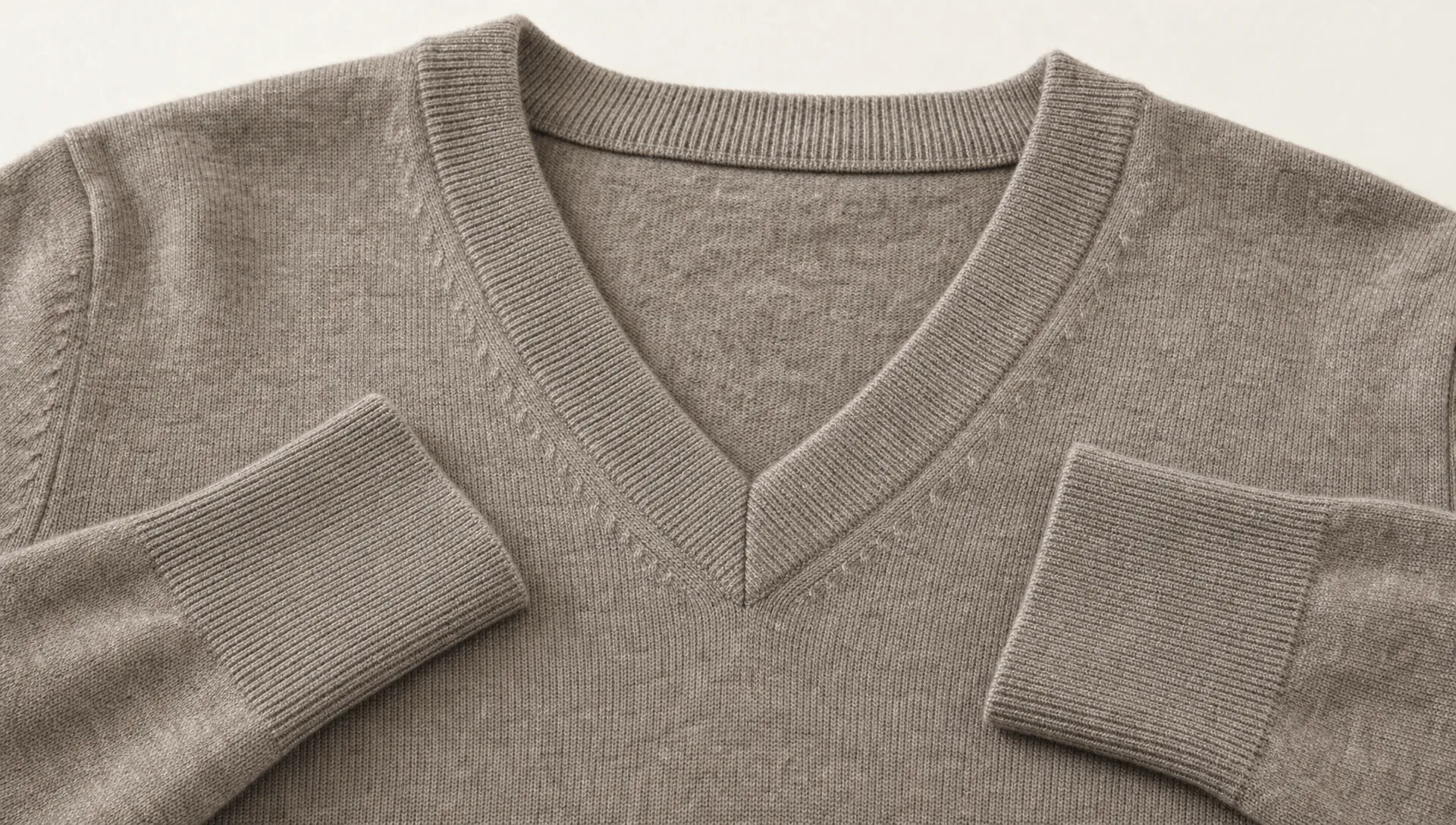
A high-quality V-neck usually has a clean rib or tubular trim that lies flat against the body without gaping. The angle should be symmetrical from shoulder to center front. The V point should meet cleanly, with no twisting, puckering or visible bulk.
The depth of the V also needs to match the target customer and styling use. A shallow V works well for conservative office layering. A deeper V may feel more modern but needs careful grading across sizes so larger sizes do not become overexposed or unstable.
Key neckline decisions include:
- Neckband width: Wider bands can look classic and substantial, but too much width may feel dated or heavy.
- Rib structure: 1×1 rib creates a fine appearance, while 2×2 rib can add more visual weight and recovery.
- Trim tension: The band must be slightly controlled without pulling the neckline inward.
- V-point construction: A clean miter or linked point is essential for premium presentation.
- Back neck stability: Reinforcement or careful linking helps prevent stretching across the back neckline.
These details are easier to engineer when the sweater is treated as a complete product from the start. Trying to “fix” neckline collapse after the bulk yarn, gauge and body proportions are already locked can limit the available solutions.
Fully fashioned construction signals a more refined product
Many premium sweaters use fully fashioned panels, where the garment pieces are shaped during knitting rather than cut from a larger knitted fabric. This approach can create cleaner armholes, more stable edges and visible fashioning marks that many customers associate with high-quality knitwear.
Cut-and-sew sweater construction can still be appropriate in some categories, especially when managing cost, speed or specific fabric needs. However, for a premium merino wool V-neck sweater, fully fashioned construction often supports better shaping and a more intentional finish.
The shoulder is especially important. A sweater can have beautiful yarn and still feel cheap if the shoulder seam droops, twists or creates bulk under a jacket. The armhole must also support movement without distorting the upper chest. This is where pattern development and knit engineering need to work together.
For men’s programs, Arcus covers related structural considerations in its guide to premium construction for men’s merino wool sweaters.
Fit must account for stretch, recovery and layering
A woven shirt pattern cannot simply be translated into a sweater. Merino knitwear moves differently, relaxes during wear and changes after steaming or washing. Fit specifications need to account for all of that.
A quality merino wool V-neck sweater should have enough ease to layer comfortably without looking oversized by accident. The shoulder should sit where intended, the sleeve should hang cleanly and the body should not torque after wear. The hem should recover after stretching, especially if customers push the sweater up at the waist or layer it over a shirt.
Fit balance should be reviewed on body, not just on a table. A garment may meet flat measurements yet still pull at the neckline, balloon at the lower back or create diagonal drag lines from the armhole. Those are development issues, not styling issues.
Brands should also decide early whether the sweater is intended to be gender-specific, unisex or part of a broader size-inclusive range. Each approach affects neckline depth, shoulder slope, body length, sleeve length and grading rules.
Finishing changes how the sweater feels in hand
Finishing is where a merino sweater develops much of its final character. Washing, steaming, pressing and blocking can soften the garment, set dimensions and improve drape. Poor finishing can do the opposite, creating uneven panels, shiny press marks or inconsistent sizing.
Blocking is particularly important in V-neck sweaters because it helps set the neckline shape and body dimensions. If panels are not blocked consistently, one side of the V may sit higher than the other or the front body may appear skewed.
A strong finishing process should define:
- Finished garment measurements after wash or steam
- Acceptable tolerance by measurement point
- Hand feel target and reference sample
- Pressing method and temperature controls
- Fold marks, packaging method and storage conditions
The approved sample should become the benchmark for bulk production. Without a physical reference, “soft,” “premium” and “clean” can mean different things to different teams.
Quality control should happen before the final inspection
Final inspection matters, but it is too late to catch many sweater quality problems efficiently. The best quality control process starts at material approval and continues through knitting, linking, washing, finishing and packing.
A merino wool V-neck sweater should be checked at multiple points because defects can be introduced at different stages. Yarn shade variation may appear before knitting. Stitch irregularity may appear during panel production. Twisting may only become obvious after washing. Neckline instability may show during fitting and wear testing.
| Development stage | Quality checkpoint | Why it matters |
|---|---|---|
| Yarn approval | Hand feel, shade, ply, twist, contamination | Prevents softness, color and durability issues before knitting |
| Panel knitting | Gauge, stitch consistency, panel dimensions | Controls body shape and seam alignment |
| Linking or assembly | Neckline point, shoulder seams, armholes | Defines visual quality and fit stability |
| Washing and blocking | Shrinkage, recovery, final measurements | Confirms size consistency and care performance |
| Final inspection | Pilling, holes, loose ends, stains, labels | Protects customer experience and brand reputation |
Testing should reflect the care instructions that will appear on the garment. If the sweater is labeled as machine washable, it must be tested under the intended wash conditions. If it is dry clean only, that decision should be based on product performance, customer expectations and brand positioning.
In the United States, wool labeling is also regulated. The Federal Trade Commission provides guidance on wool product labeling requirements, including fiber content, country of origin and manufacturer or marketer identity requirements. Brands should confirm labeling details with qualified compliance support before production.
Common signs of lower-quality V-neck sweaters
Some quality problems are visible immediately. Others only show after the garment has been worn. Product teams can reduce risk by training development and buying teams to look for the right warning signs during sampling.
| Quality issue | What it may indicate | Why customers notice |
|---|---|---|
| Wavy neckline | Neckband tension is too loose or finishing is inconsistent | The sweater looks stretched out before wear |
| Twisted V point | Poor linking, imbalance or panel distortion | The front appears off-center on the body |
| Excessive pilling | Fiber, yarn or knit density mismatch | The sweater looks old quickly |
| Dropped shoulder seam unintentionally | Fit or panel shaping issue | The garment feels sloppy rather than relaxed |
| Hem flare | Rib recovery is weak or body tension is unbalanced | The sweater loses a polished silhouette |
| Uneven sleeve length | Blocking or measurement control issue | Sizing feels unreliable |
Not every issue requires a complete redesign. Sometimes changing neckband tension, adjusting the stitch density or refining the wash process solves the problem. Other times, the issue traces back to yarn selection or fit engineering and needs to be corrected earlier in the development process.
Care performance is part of product quality
Customers judge quality partly by how easily a sweater fits into their life. A beautiful merino V-neck that shrinks unexpectedly, pills heavily or loses shape after gentle care will not feel premium for long.
Care performance should be built into development, not treated as a label decision at the end. This includes shrinkage testing, colorfastness checks, pilling assessment and dimensional recovery after laundering or dry cleaning. The care label should match proven performance, not marketing preference.
Brands also need to consider how customers will actually use the garment. A fine-gauge office sweater may be worn under a blazer and cleaned less frequently. A casual travel sweater may be packed, reworn and washed more often. Those different use cases can require different yarn choices, knit densities and care instructions.
What brands should include in a V-neck sweater brief
A strong development brief helps manufacturers create accurate samples faster and reduces costly back-and-forth. The more precisely a brand defines quality, the easier it is to reproduce that quality at scale.
For a merino wool V-neck sweater, a useful brief should include fiber content, yarn count, gauge, stitch structure, target hand feel, neckline depth, trim width, fit reference, measurement tolerances, care expectations, labeling requirements and packaging preferences.
Visual references are also helpful, but they should not replace technical direction. A photo can show mood and styling, but it cannot communicate recovery, shrinkage allowance or neckband tension. Pair design references with a technical package and an approved physical sample whenever possible.
Developing quality with the right manufacturing partner
A premium merino wool V-neck sweater is the result of many small decisions made in the right order. Fiber affects yarn. Yarn affects gauge. Gauge affects fit. Fit affects neckline stability. Finishing affects the final hand feel and measurement control.
For brands, the challenge is coordinating all of those decisions without losing sight of the commercial goal. The sweater has to look right, feel right, meet margin targets and perform consistently in production.
That is where an end-to-end development and manufacturing partner can help. Arcus Apparel Group supports apparel brands with custom development, material sourcing, pattern development, small batch manufacturing, production management and quality control across the process. For a product like a merino wool V-neck sweater, that coordination can make the difference between a nice concept and a reliable finished garment.
Frequently Asked Questions
What makes a merino wool V-neck sweater high quality? A high-quality merino wool V-neck sweater combines fine, appropriate merino fiber with stable yarn, suitable gauge, clean neckline construction, balanced fit, consistent finishing and tested care performance.
Is 100% merino wool always better than a blend? Not always. 100% merino can feel luxurious and natural, but some blends may improve strength, recovery or care performance depending on the product goal. The best choice depends on the intended use, price point and brand positioning.
Why does the V-neckline stretch out on some sweaters? Neckline stretching often comes from loose trim tension, weak rib recovery, poor blocking or a mismatch between yarn, gauge and neckline shape. The issue should be addressed during sampling before bulk production.
What gauge is best for a merino wool V-neck sweater? There is no single best gauge. A 12 to 14 gauge sweater often works well for refined layering, while lower gauges create a heavier, more casual look. The right gauge depends on yarn count, target hand feel, season and customer use case.
How can brands reduce pilling in merino sweaters? Brands can reduce pilling risk by selecting appropriate fiber and yarn, avoiding overly loose knit density, testing abrasion performance and aligning care instructions with real garment behavior.
Build a better merino wool V-neck sweater
If your brand is developing a merino wool V-neck sweater, quality needs to be engineered before production begins. The right development process can help you avoid unstable necklines, inconsistent sizing and disappointing wear performance.
Arcus Apparel Group works with apparel brands to move from concept to production with material sourcing, pattern development, small batch manufacturing and quality control built into the process. If you are ready to develop a sweater program with stronger technical direction, Arcus can help you build it with intention from the first sample.



