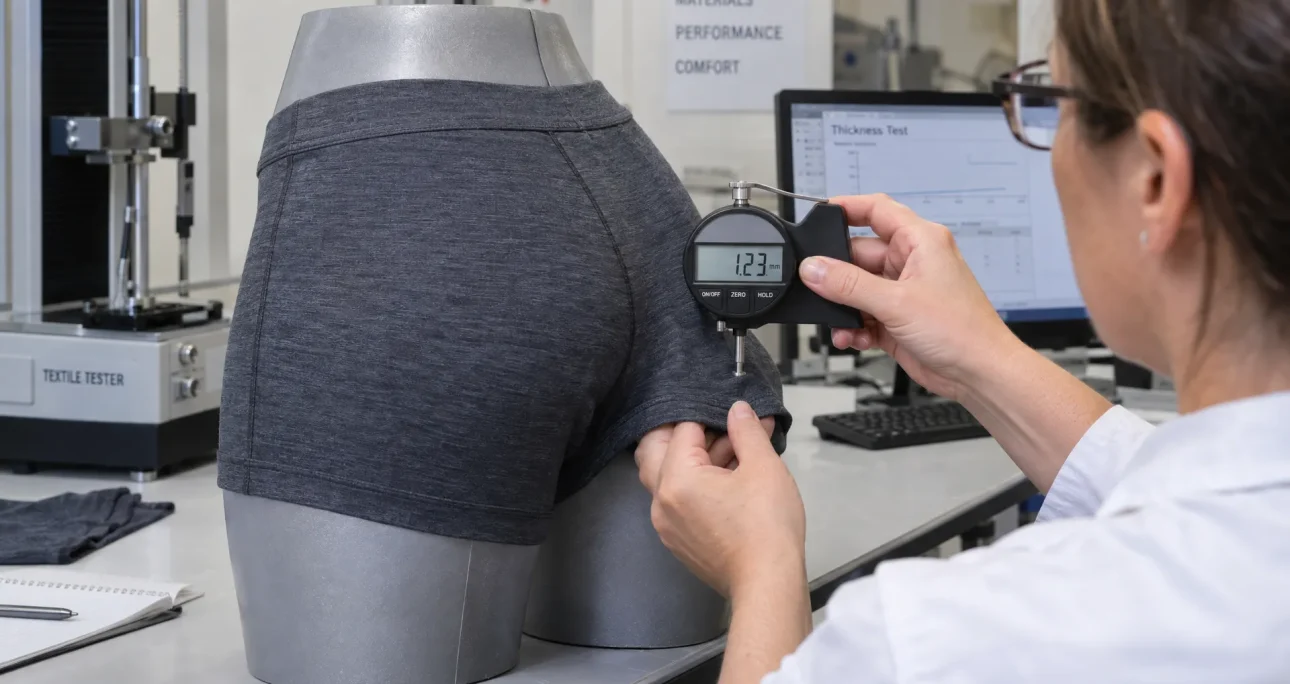
For apparel brands, merino wool shorts present a different fabric challenge than merino tops. Shorts must withstand thigh friction, repeated sitting, loaded pockets and frequent bending while remaining comfortable against the skin. A soft swatch is a useful starting point, but it does not establish whether a fabric can handle those demands.
The right choice begins with the garment’s role. A running liner needs different properties from a hiking shell, a fitted training short or a relaxed travel style. Fiber composition, knit or weave structure, fabric weight and finishing all influence the result. Treat these as separate development decisions rather than assuming that a higher wool percentage automatically creates a better product.
This guide focuses on selecting and validating fabrics for shorts, with practical considerations for sampling, production and repeat orders.
Choosing fabrics for merino wool shorts
Choose the fabric architecture before narrowing the fiber percentage. Two fabrics with identical merino content can behave differently if one is a loose single jersey and the other is a compact double knit.
Merino absorbs moisture vapor and can help buffer changes in next-to-skin humidity. That is different from rapidly moving liquid sweat through a fabric or drying quickly after saturation. The finished construction determines how those properties translate into wear. Woolmark’s overview of wool fiber provides background on the material, but garment-level testing remains necessary.
| Fabric approach | Potential role in a shorts collection | Main development concern |
|---|---|---|
| 100% merino jersey | Relaxed shorts or protected liners | Abrasion, bagging and dimensional stability |
| Merino with nylon reinforcement | Liners and active shorts exposed to friction | Yarn architecture and actual abrasion performance |
| Merino with polyester | Lightweight active fabrics where drying behavior matters | Hand feel, moisture transport and odor performance |
| Merino with elastane | Fitted shorts requiring extension and recovery | Recovery after wear, washing and repeated stretch |
| Merino-blend double knit | Training or travel styles needing more coverage | Weight, heat buildup and flexibility |
| Merino-blend woven | Structured outdoor or lifestyle shorts | Mobility, seam slippage and surface durability |
These are development directions, not guaranteed performance outcomes. Request the complete composition and construction details for each candidate rather than approving a fabric from its marketing description alone.
Match the fabric to the garment’s job
Running shorts: separate shell and liner requirements
For merino wool shorts designed for running, decide whether wool belongs in the outer shell, the liner or both. A lightweight synthetic shell paired with a merino-blend liner can place wool against the skin without asking a delicate knit to carry pockets or resist brush contact.
The liner needs comfortable seams, controlled stretch and enough recovery to avoid bunching. The shell needs freedom of movement, stability around pocket openings and appropriate coverage when wet. Evaluate the assembled garment because a comfortable liner can still perform poorly inside a restrictive shell.
If the product uses a wool liner beneath a non-wool shell, describe that construction clearly. The product name and fiber disclosure should not imply that the entire garment is merino.
Training shorts: prioritize coverage and recovery
Squats, lunges and floor exercises stretch fabric across the seat and upper thigh. Compact double knits or suitable stretch blends are worth sampling when coverage and shape retention matter more than minimum weight.
Elastane can provide extension, but its presence alone does not establish reliable recovery. Yarn placement, knit geometry and finishing also affect whether a garment returns to shape.
Evaluate opacity at the intended garment stretch, not only with an unstretched swatch held against a light. Sample the actual colors because pale shades and darker shades may provide different coverage. Check waistband stability separately: a body fabric that performs well may still need a dedicated waistband material or enclosed elastic.
Hiking and travel shorts: consider friction and pocket loads
Outdoor merino wool shorts need a fabric specification that accounts for sitting on rough surfaces, carrying a phone and wearing a backpack hip belt. These demands can justify a reinforced blend, a more compact construction or a woven option rather than a very lightweight jersey.
A woven fabric may provide useful structure, but mobility must come from stretch, pattern shaping or adequate ease. Check seam slippage where the seat and crotch are loaded.
Travel-focused styles may benefit from wool’s odor-management properties, but they still need practical laundering instructions. A garment that holds its shape during wear yet changes size after washing is not a dependable collection staple.
Evaluate more than the merino percentage
Fiber diameter affects comfort, not the entire performance profile
Micron count describes fiber diameter. Finer merino generally offers a softer next-to-skin feel, although individual sensitivity, yarn construction and finishing also influence comfort.
Ask the supplier for the specified diameter and available supporting documentation. Do not treat a low micron number as proof of abrasion resistance, stretch recovery or finished-garment durability.
For liners and close-fitting shorts, assess softness after laundering as well as when new. Finishes can alter the initial hand feel, so approval should include washed samples rather than relying solely on the presentation swatch.
Fabric weight must be read alongside construction
The weight of merino wool shorts fabric helps narrow the options, but grams per square meter (GSM) cannot establish coverage or durability by itself. A compact fabric and an open jersey at the same weight can behave quite differently.
The following ranges are illustrative sampling windows, not industry standards or guaranteed specifications.
| Intended application | Initial sampling window | What to verify |
|---|---|---|
| Protected next-to-skin liner | Approximately 140 to 180 GSM | Wet comfort, coverage and friction resistance |
| Relaxed knit short | Approximately 180 to 230 GSM | Seat bagging, shrinkage and pocket distortion |
| Compact training short | Approximately 200 to 280 GSM | Opacity under stretch, recovery and heat buildup |
Start outside these ranges when the design requires it. Let the wear conditions and test results determine the final specification.
Stretch and recovery are separate measurements
A fabric can stretch easily yet remain elongated after the load is removed. That distinction matters at the seat, knees during deep bends and pocket openings carrying a phone.
Ask suppliers to distinguish extension from recovery and explain the test conditions behind their figures. Compare candidates under the same conditions, including after laundering. For fitted products, assess both directions of stretch rather than assuming that crosswise elasticity provides sufficient movement everywhere.
Before approving merino wool shorts, evaluate recovery in a sewn prototype as well as in the fabric. Fit, seam placement and garment tension can expose weaknesses that are not obvious in an isolated swatch.
Engineer around the highest-stress areas
The inner thighs, crotch junction, seat and pocket edges deserve particular attention. Fabric failure in these locations may appear as pilling, thinning, broken yarns or permanent distortion. Each points to a different problem, so “improve durability” is too broad a revision instruction.
For example, a phone pocket can pull a soft jersey out of shape even when the fabric performs adequately elsewhere. Pocket bags, localized reinforcement or a different pocket position may address the issue without increasing the weight of the entire garment.
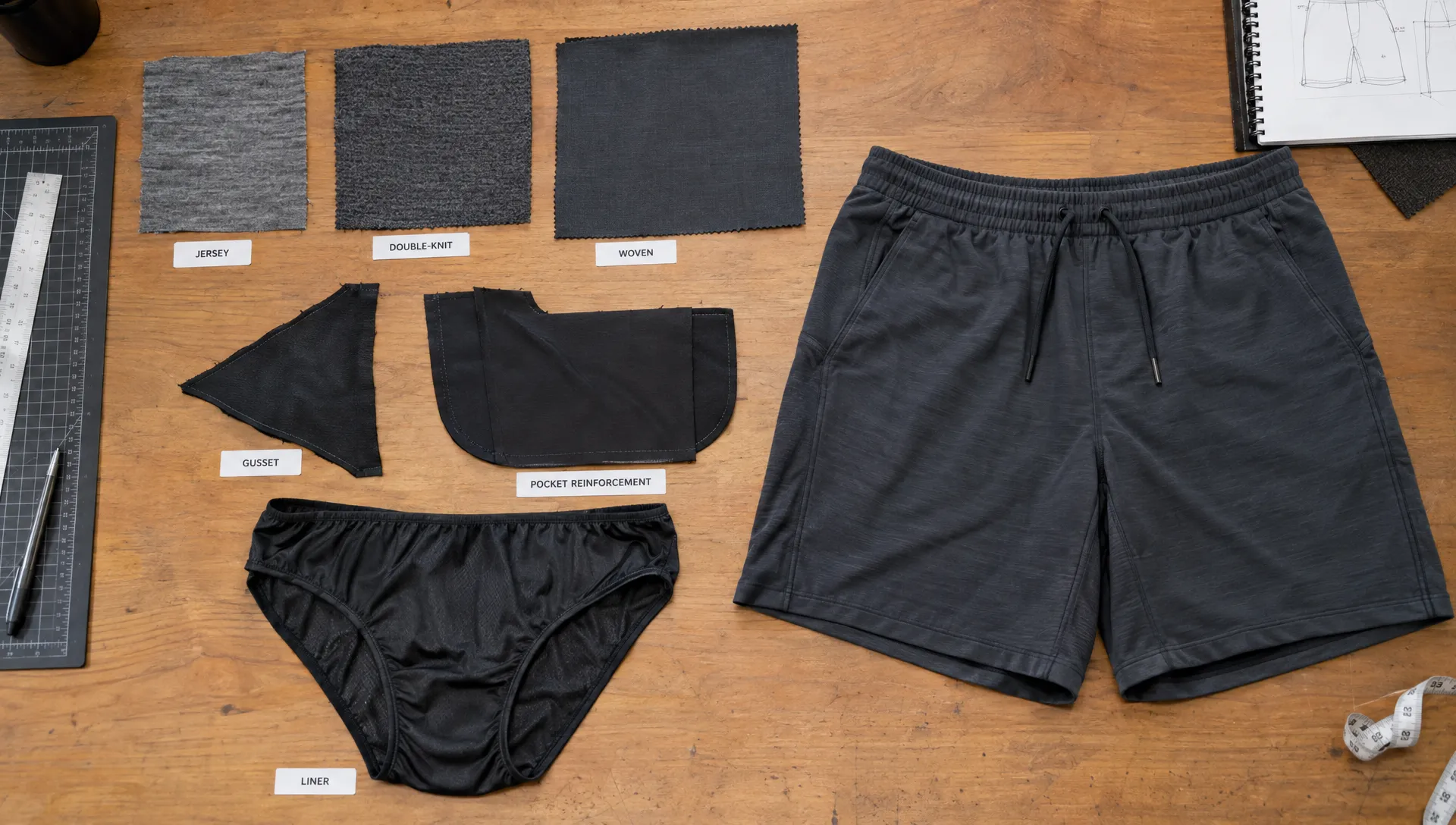
A gusset can redistribute strain, but it does not compensate for insufficient fabric strength. Similarly, a flat seam may reduce bulk while still creating irritation if its thread, tension or placement is wrong. Compare construction options in motion and after repeated washing.
If the style includes a liner, develop it as a separate component with its own fit and material requirements. The considerations in merino undergarment fabric and construction development are especially relevant to these skin-contact areas.
Build a test plan before approving bulk fabric
Use laboratory testing to compare materials, then confirm the results through wear trials. Neither replaces the other: a fabric test cannot reveal every fit problem, while a few comfortable workouts cannot establish production consistency.
Set acceptance criteria before testing. The criteria should reflect the garment’s intended use and approved benchmark, not an arbitrary threshold copied from an unrelated product.
| Risk | Evaluation approach | Decision it supports |
|---|---|---|
| Inner-thigh wear | Martindale abrasion testing, such as ASTM D4966 | Comparing resistance under defined laboratory conditions |
| Surface pilling | A suitable method such as ISO 12945-2 | Assessing appearance changes after controlled rubbing |
| Shrinkage or growth | Home-laundering dimensional testing, such as AATCC TM135 | Confirming size stability under the intended care routine |
| Loss of shape | Repeated extension and recovery assessment | Evaluating bagging and fitted-garment stability |
| Wet transparency | Defined wet and stretched coverage checks | Approving colors and constructions for the intended use |
| Color transfer | Appropriate perspiration and rubbing fastness tests | Assessing staining risks at skin-contact and friction areas |
Record test conditions so that later samples can be compared meaningfully. For drying comparisons, use a consistent starting moisture level, environment and endpoint rather than judging by touch alone.
Approve merino wool shorts only after checking the finished garment through repeated wear-and-wash cycles. Include sitting, running or deep bending as appropriate, then inspect the seat, thigh seams, pockets and waistband for changes.
Source for repeat production, not just the first sample
A successful prototype does not guarantee a repeatable collection. Confirm whether the supplier can maintain composition, construction, finished weight, width and treatment across future orders. Clarify acceptable tolerances before placing bulk commitments.
Ask about fabric minimums separately from garment minimums. A manufacturer may support small-batch production while a specific mill still requires a larger fabric or color order. Available stock fabrics can help with an initial launch, but continuity and reorder availability need confirmation.
For merino wool shorts, reorder consistency also includes hand feel, shrinkage and color. Retain an approved fabric reference and a washed reference so production teams are not comparing bulk goods only against a pristine swatch.
Document the wool treatment and the finished garment’s care requirements. Washability depends on the fabric, trims and construction together. If sourcing claims matter to the collection, the Responsible Wool Standard addresses animal welfare and land-management requirements with chain-of-custody provisions. Verify the applicable documentation before making a product claim; certification is not proof of garment performance.
Turn the fabric decision into a usable development brief
A clear brief connects the material choice to the intended customer experience. “Soft merino blend” leaves too much unresolved for consistent sampling or production.
Specify the garment’s activity, fit and component structure first. Then identify the proposed composition, construction, weight range, stretch direction and care method. Record the risks that need validation, including coverage, pocket distortion or inner-thigh wear.
For a running style, this might mean a lightweight outer shell with a separately specified wool-blend liner. For training, it might mean a compact stretch knit tested during deep bends. For travel, dimensional stability and loaded-pocket performance may take priority over achieving the lowest possible weight.
The broader principles in merino activewear design for better performance can help connect these material decisions to fit and construction.
A useful development brief for merino wool shorts should give the sampling team a measurable objective and a clear reason for each fabric choice. That makes revisions more precise and reduces the risk of approving a material that feels appealing but does not suit the garment.
Frequently asked questions
Is 100% merino better than a blend for active shorts? Not automatically. Pure merino can suit relaxed styles or protected components, while blends may better address abrasion, stretch or shape retention. Compare the finished fabrics and garments rather than ranking them by wool percentage alone.
What fabric weight should a brand choose? Start with the intended activity and construction. A protected liner may use a lighter material than an opaque training short. GSM is useful for screening samples, but coverage, recovery and wear testing should determine approval.
Can merino wool shorts be machine washed? Some can, depending on the wool treatment and complete garment construction. Validate the proposed care instructions on production-representative samples, including the waistband, liner and trims. Do not infer washability from fiber content alone.
Does adding nylon guarantee better durability? No. Nylon reinforcement can help, but the amount, yarn structure and fabric construction influence the result. Confirm performance with abrasion testing and wear trials in the garment’s highest-friction areas.
Develop the material and garment together
Arcus Apparel Group offers custom apparel development, material sourcing, pattern development and small-batch manufacturing with quality control throughout the process. These services can help connect a fabric brief with the practical requirements of sampling and production.
Bring your intended activity, fit direction, target quantities and material priorities to Arcus Apparel Group to discuss development options. Confirm fabric availability, minimums and testing requirements before finalizing the collection.



