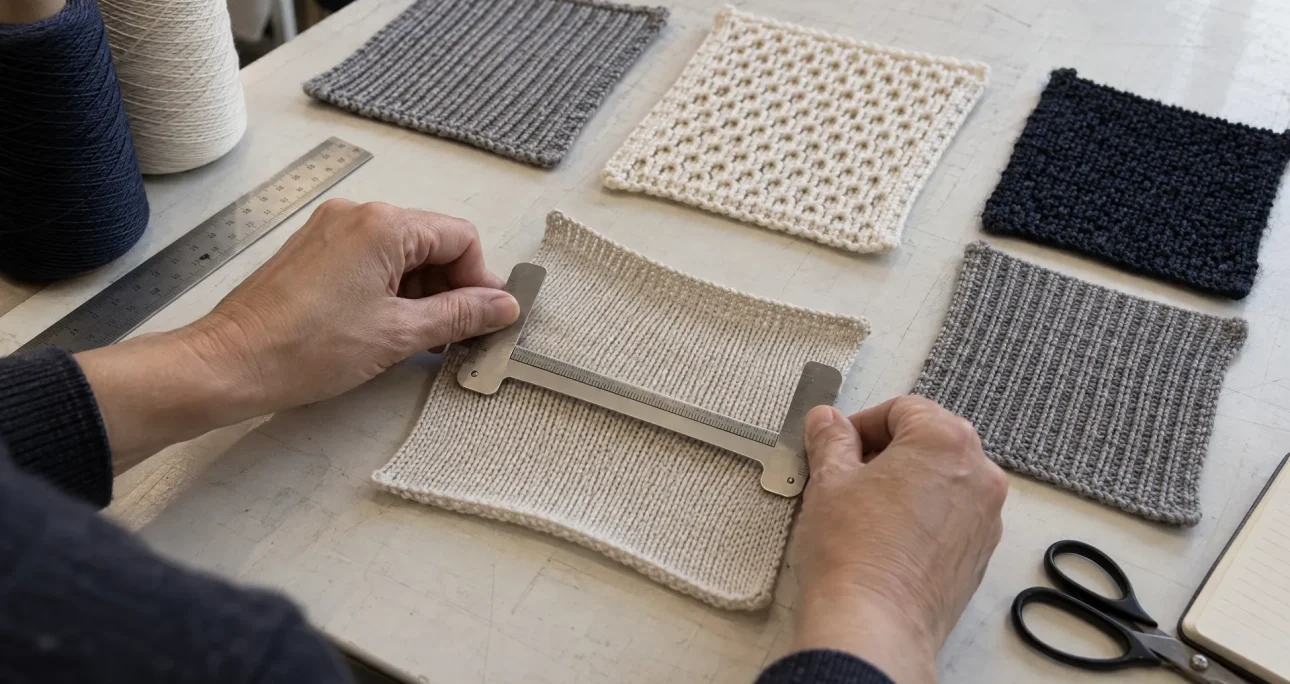
A merino wool tank top exposes construction problems that sleeves can hide. Armholes can flare, shoulder straps can stretch and a soft neckline can lose its shape after washing. For apparel brands, a successful design depends on matching the fabric to the edge finishes, then validating that combination on a finished garment. This guide focuses on cut-and-sew development, with practical decisions for fabric sourcing, binding, fit and production control.
Start with a measurable product brief
Before requesting fabric swatches, define how the tank should sit on the body. A close-fitting layering piece needs different stretch and coverage than a relaxed everyday tank. Specify intended ease, neckline depth, shoulder width and armhole coverage rather than relying on a reference photograph alone.
Also decide whether the garment will be worn against bare skin, over a bra or beneath another layer. Those conditions affect seam placement, armhole shape and the acceptability of visible binding. Identify any backpack straps or other friction points that belong in wear testing.
Brands extending an existing collection can use their merino T-shirt fabric and fit specifications as a starting reference. However, removing sleeves changes how the upper garment is supported. The tank still needs its own pattern, edge treatment and approval process.
How do you specify fabric for a merino wool tank top?
Evaluate fiber diameter and finished fabric weight
Fiber diameter, measured in microns, helps describe wool fineness. Fine merino around 17.5 to 19.5 microns is a reasonable sourcing range to investigate for next-to-skin garments, but it is not a comfort guarantee. The distribution of fiber diameters, yarn construction and finishing also influence how the material feels.
Fabric weight, expressed in grams per square meter (GSM), describes mass per unit area. Use the following ranges as development starting points, not universal performance grades.
| Finished fabric weight | Development direction | Main checks before approval |
|---|---|---|
| Approximately 140 to 170 GSM | Lightweight jersey with minimal bulk | Opacity, edge curling and resistance to holes |
| Approximately 170 to 200 GSM | A starting range for everyday tanks | Drape, recovery and finished binding thickness |
| Approximately 200 to 230 GSM | More substantial or structured designs | Bulk at joins, comfort and neckline behavior |
Compare swatches after the proposed care cycle. A fabric that looks smooth off the roll may change in width, length or surface appearance after laundering. Request finished-weight data, not just the mill's nominal target.
Choose composition for the actual wear conditions
For a merino wool tank top, fiber composition should support the intended appearance and wear conditions rather than serve as a marketing shortcut. A 100% merino jersey can offer a soft hand, but its suitability still depends on yarn quality, stitch density and finishing.
Nylon blends or nylon-core yarns are options to evaluate where abrasion and hole formation are concerns. Elastane can improve stretch recovery, although the result depends on its percentage and how it is incorporated. Do not assume that every blend is stronger or more stable than every pure-wool fabric.
Woolmark's overview of wool fiber provides useful background on moisture management and other wool properties. Translate those fiber-level characteristics into garment claims only after testing the selected construction. Wool content alone does not establish drying speed or justify an antimicrobial claim.
Match the knit structure to the silhouette
Single jersey usually provides a lighter, fluid fabric, but cut edges can curl and the garment may show spirality. Both issues can complicate narrow binding and hem alignment.
A 1×1 rib offers pronounced crosswise stretch and a body-following appearance. Check whether it recovers after wear instead of simply expanding. Interlock can provide a smoother, more stable starting point, although it may create greater bulk at a comparable yarn specification.
Approve stretch and recovery in both directions. Two fabrics with the same composition and GSM can behave differently under the same pattern because their yarns, loop structures and finishing differ.
Engineer the neckline and armhole edges
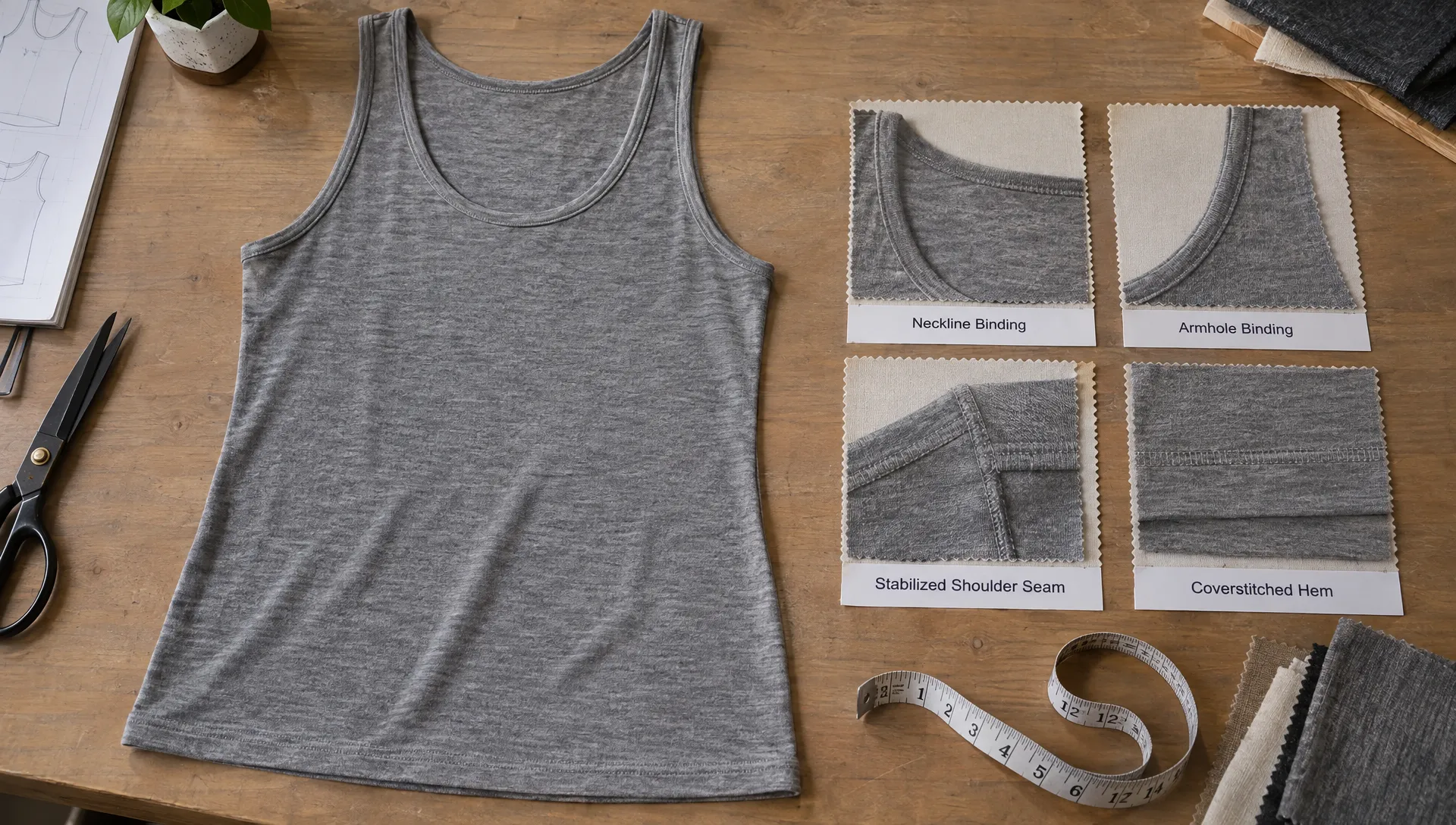
The neckline and armholes of a merino wool tank top are structural components, not just decorative finishes. Their job is to maintain coverage while allowing the garment to move. Excessive tension can pull the opening inward, while insufficient tension can produce waviness or gaping.
Review these edges on the body and after laundering. A flat photograph cannot show whether a binding cuts into the underarm or whether the neckline lifts during movement.
Choose binding or a separate band deliberately
A folded binding encloses the raw edge and can create a narrow, clean finish. Its success depends on consistent feeding through the attachment and enough seam stretch for dressing and movement. Very light jersey can be difficult to control, especially where several layers meet.
A separate self-fabric or rib band is joined to the opening and then secured as needed. It can provide a more substantial edge, but its recovery must be compatible with the body fabric. A firm band on a soft body may gather the surrounding material.
For either approach, specify finished width, attachment seam, visible stitching and join location. Include a cross-section or clear construction sketch in the tech pack. Avoid instructions such as “standard binding,” which leave critical details open to interpretation.
Check the armhole binding join for comfort. Placing a bulky join directly in the underarm can create a noticeable rubbing point.
Establish band length through sampling
Do not apply one band-to-opening ratio to every fabric. Required tension varies with recovery, curvature, band width and sewing equipment. The neckline and armhole may need different settings even when they use the same material.
For a merino wool tank top, record both the opening seam-line length and the band's sewing length. As a calculation example, a 36 cm band attached to a 40 cm opening represents a 0.90 ratio when both measurements exclude joining allowances. That illustrates the calculation, not a recommended ratio for production.
Test several nearby lengths on the actual fabric. Let the samples relax, then inspect them after washing and drying according to the proposed care instructions. Select the version that sits cleanly without puckering, flaring or restricting movement.
Differential feed, presser-foot pressure and thread tension also affect edge appearance. Record the settings used for the approved sample. Otherwise, the factory may try to solve a feeding problem by changing the pattern or band length.
Stabilize seams without making the garment stiff
A merino wool tank top needs seam stretch where the body expands, but controlled extension at the shoulders. Evaluate narrow stabilization tape or another suitable reinforcement at the shoulder seam, especially for heavier fabrics or narrow straps. The reinforcement should not feel rigid against the skin.
An overlock seam can work well for side seams when its allowance, stitch formation and thread are compatible with the fabric. Flatlock is another option, but it creates a different appearance and must be assessed for comfort and seam strength. It is not automatically the best choice because a garment is marketed for performance.
Use an appropriate knit needle and verify its size through sewing trials. Inspect for needle damage, skipped stitches and holes after washing. A coverstitched hem also needs sufficient extension to avoid broken stitches when the wearer pulls the garment on.
Develop sleeveless fit and size grading
Fit approval for a merino wool tank top should include more than chest circumference and body length. Record neckline width and depth, shoulder width, armhole depth, front and back coverage and the position of the side seam. Define whether opening measurements follow the seam line or the finished edge.
Test the sample while reaching forward, lifting both arms and bending. These movements reveal neckline gaping, underarm exposure and straps that migrate toward the neck or shoulder edge. If the tank is intended for layering, evaluate it with the relevant undergarment rather than on a bare mannequin alone.
Negative ease needs a fabric-specific decision. A pattern that works in a resilient blend may cling or lose shape in a less recoverable jersey. Arcus's guide to merino undergarment fit and construction offers useful context for close-to-skin applications.
Grade opening shapes intentionally across the size range. Increasing chest width does not establish the correct shoulder position or armhole coverage. Approve representative sizes before assuming the base-size sample scales successfully.
Validate fabric and finished garments separately
An approval program for a merino wool tank top should distinguish fabric performance from garment construction. A fabric can pass dimensional-change testing while the finished neckline still distorts because its binding has different recovery.
Agree on test methods, laundering conditions and acceptance limits before bulk production. The following checks address different failure modes; none substitutes for the others.
| Check | What it helps identify | What to record |
|---|---|---|
| Dimensional change | Growth or shrinkage after care | Length and width change, including key openings |
| Spirality or garment twist | Side seams rotating away from their intended position | Change after laundering and drying |
| Pilling | Surface changes caused by repeated rubbing | Method, exposure and approved appearance rating |
| Bursting strength | Fabric resistance under multidirectional loading | Method and agreed minimum result |
| Seam extension | Stitch breakage or seam restriction during movement | Extension and recovery under the chosen procedure |
| Wear testing | Chafing, strap movement and localized abrasion | Wear conditions, duration and observed failures |
ISO 6330 provides domestic washing and drying procedures for textile testing, while ISO 5077 addresses dimensional-change measurement. A testing laboratory can help select suitable procedures and complementary methods. Specify the relevant method and conditions rather than asking for a generic “wash test.”
Make care instructions part of development
Test the proposed care instructions, including any restriction on tumble drying. Wool finishes and blends differ, so the fiber name alone cannot determine a safe care procedure.
Evaluate the whole garment after repeated care cycles. Look at binding flatness, hem appearance, strap length, seam integrity and label comfort. Record whether measurements are taken immediately after drying or after a defined relaxation period so results are comparable.
If the design only looks acceptable after careful reshaping, decide whether that requirement is realistic for the customer. Change the fabric or construction when the care burden conflicts with the product brief.
Turn the approved sample into a production specification
A production-ready merino wool tank top requires more than an approved fit sample. Lock the fabric composition, finished weight tolerance, knit structure and finishing requirements alongside the pattern and construction details.
The bill of materials should identify body fabric, binding fabric, stabilization, thread and labels. The construction specification should capture seam allowances, finished edge widths, stitch types, band lengths and hem depth. Add measurement tolerances with clear diagrams so inspectors measure consistently.
Keep pre-wash and post-wash approval records. Retain an approved garment as a construction reference, with separate color references where needed, rather than relying entirely on photographs.
Before scaling, check a production-representative sample made with the intended fabric lot, attachments and machinery. A development sample assembled with different equipment may not reveal the feeding or seam problems that appear during a longer production run.
Frequently asked questions
Is 100% merino better than a blend for a tank? Neither composition is automatically better. Compare hand feel, recovery, abrasion resistance and care performance in the intended construction. A blend may solve a durability problem, but its percentage alone does not establish the result.
What is the best fabric weight for a merino wool tank top? Approximately 170 to 200 GSM is a useful everyday-development starting range, not a universal optimum. Lighter options need closer opacity and edge-stability checks, while heavier options require attention to bulk and drape.
Why do armholes become wavy? Possible causes include stretching during sewing, insufficient band tension, mismatched recovery or unsuitable machine settings. Examine the pattern, binding and feeding process together before changing any single variable.
Should the same fabric be used for the body and binding? It can be, provided the fabric forms a stable edge and recovers adequately. A separate rib or other binding material may work better, but it needs compatible shrinkage, color and hand feel.
Move from fabric selection to a controlled sample
Prepare your silhouette, intended fit, care expectations and initial fabric requirements before starting development. Those inputs make sampling decisions clearer and provide a basis for evaluating revisions.
Arcus Apparel Group offers custom apparel development, material sourcing, pattern development and small-batch manufacturing with quality control throughout the process. Discuss your tank's requirements and confirm the available fabric and construction options before committing to production.



