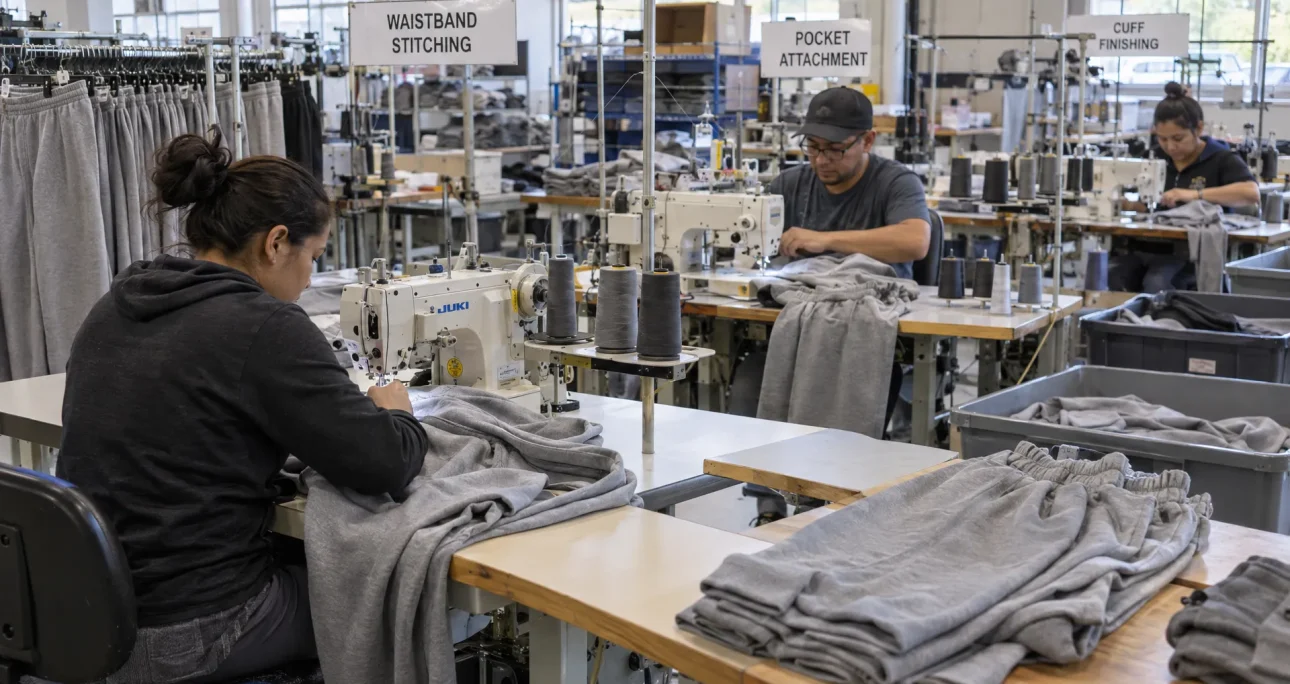
Softness can sell the first pair of merino sweatpants. Knees that bag out, pockets that stretch and a seat that pills can prevent the second purchase. For apparel brands, the development challenge is to preserve the warmth and comfort shoppers expect without making the garment too heavy, fragile or demanding to maintain.
The answer is not simply a higher wool percentage or heavier fabric. A successful design combines an insulating interior with an exterior that tolerates friction, a pattern that allows movement and a care routine the finished garment can survive. Start with the intended wearer, then validate those choices through sampling.
Define the wear scenario before choosing the fabric
A lounge pant and a cold-weather walking pant may share a silhouette, but their fabric requirements differ. Indoor lounging puts sustained pressure on the seat and repeated bending at the knees. Walking adds friction at the inner thighs, exposure to wind and potentially abrasion from bags or outdoor seating.
Write a short product brief that identifies the main activity, intended fit, layering expectations and care method. Include whether customers will wear the pants directly against the skin or over a base layer. That decision changes how much interior softness matters and how much room the pattern needs.
For everyday merino sweatpants, the brief should also define what acceptable wear looks like. Some surface fuzz may suit a relaxed wool aesthetic; conspicuous pills, stretched pocket openings and permanent knee bulges usually do not.
Separate essential performance from optional features. If the product is primarily for home and travel, it may not need the abrasion resistance of hiking pants. If it is positioned for outdoor activity, a cozy hand feel alone is insufficient evidence of performance.
Understand warmth beyond GSM
Grams per square meter, or GSM, measures fabric mass per unit area. It does not directly measure insulation. Two fabrics with the same GSM can differ in thickness, trapped air, permeability and warmth under compression.
Wool's crimp helps create spaces that hold air within a textile structure. Wool also absorbs moisture vapor, which contributes to comfort as conditions change. Woolmark's overview of wool fiber provides background on these properties. Neither property makes a loose knit windproof or guarantees comfort in every climate.
For sweatpants, evaluate three separate characteristics: the loft of the interior, the density of the outer face and the ease of the garment. A lofty backing may feel warm indoors but lose heat outdoors if air passes readily through the fabric. A dense construction may reduce airflow while feeling less plush.
Fit matters too. Excessively tight knees compress the fabric and increase tension during sitting. An oversized silhouette can admit drafts through wide leg openings. Cuffs, waistband fit and layering allowances should therefore be part of the warmth assessment, not late styling decisions.
Build merino sweatpants around a durable outer face
Sweatpants experience repeated contact with chairs, upholstery and the opposite leg. Their exterior needs enough yarn and knit stability to tolerate that friction without quickly developing an uneven surface.
French terry, interlock and brushed fleece are useful sampling directions, but none is automatically durable. Yarn quality, stitch density, finishing and the distribution of fibers across the fabric all influence performance.
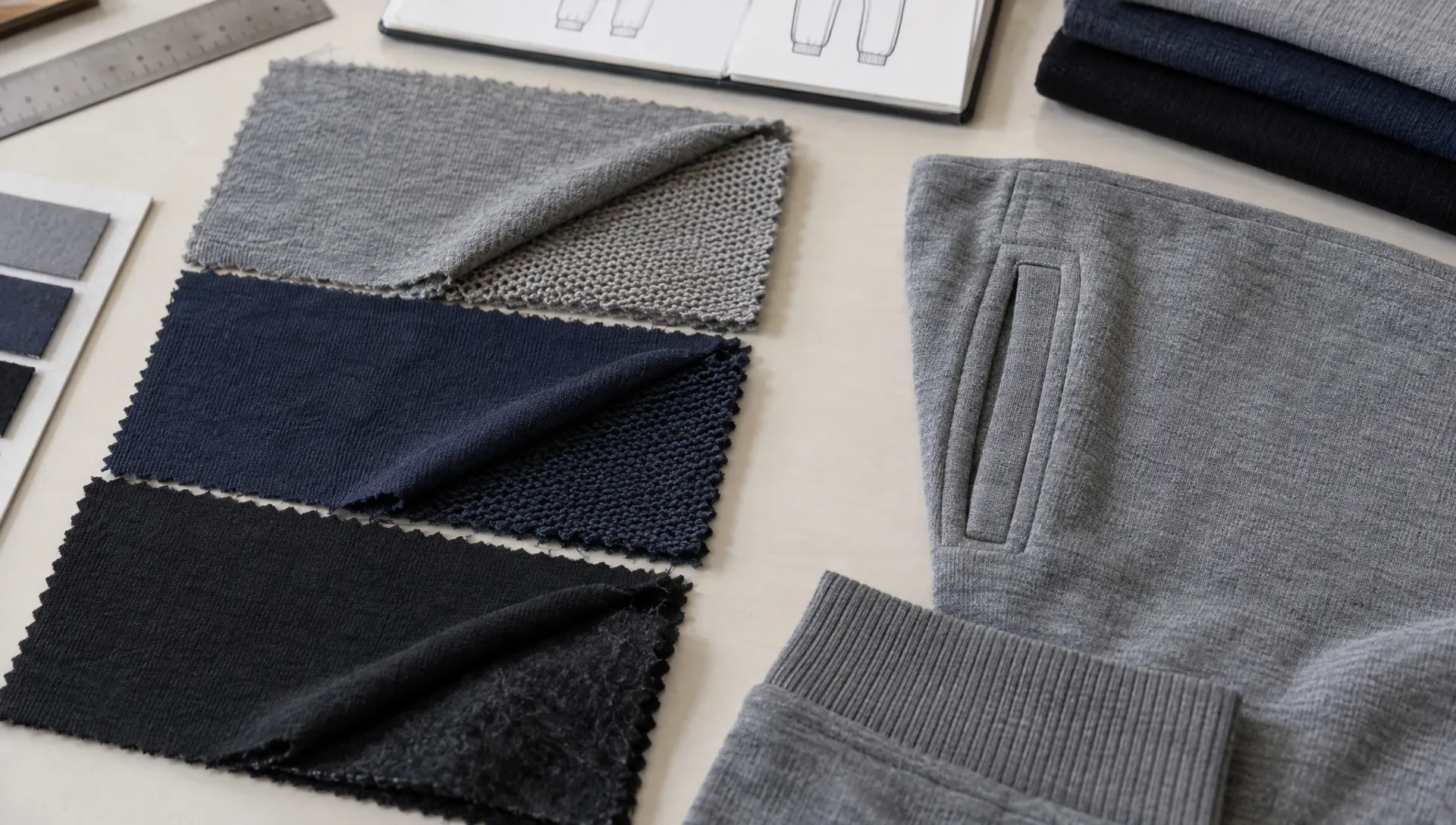
A loopback interior can provide comfort without heavily raising the surface. An interlock or other double-knit construction may offer a smoother, more substantial fabric, though recovery still needs testing. Brushed fleece can deliver a plush interior, but aggressive raising can release fibers and increase shedding or pilling in some constructions.
Ask the mill for more than a composition label. Request the knit construction, finished weight, finishing route and available test results. If the fabric uses different yarns on its face and backing, confirm where the wool and reinforcement fibers sit.
Fiber fineness is another separate decision. A low micron count describes fine fibers, not guaranteed garment life. Staple length, yarn twist and fabric construction also matter. Unlike more structured merino wool trousers, sweatpants must accommodate substantial movement through the knit, the pattern or both.
Use brushing selectively
Brushing should serve a defined purpose, such as improving next-to-skin comfort or creating additional interior loft. It should not be used to disguise an unstable base fabric.
For merino sweatpants, request samples before and after the proposed brushing treatment whenever possible. Compare thickness, surface shedding, stretch recovery and appearance after laundering. A sample that feels excellent before washing may look or behave differently once loose fibers have been released.
Keep the exterior finish aligned with the use case. A smooth face can be preferable where the pants will rub against chairs or bags, while the inside supplies the softness. Heavy brushing on both surfaces deserves particular scrutiny for a daily-wear product.
Also check whether the finished fabric catches easily on rough surfaces. Resistance to pilling, abrasion and snagging are related wear concerns, but they are not interchangeable properties.
Compare blends and weights through a sampling matrix
Blending can strengthen a fabric or improve recovery, but the outcome depends on how the yarns are constructed and knitted. Adding a synthetic fiber does not automatically solve every durability problem.
Nylon can be useful for abrasion resistance when incorporated effectively. Polyester can change drying behavior and fabric stability. Elastane can support stretch and recovery, although the garment still needs a suitable pattern and compatible care instructions.
The following options are development directions, not performance rankings:
| Fabric direction | Reason to sample it | Main issue to validate |
|---|---|---|
| All-merino loopback knit | Wool-focused positioning with an unbrushed interior | Pilling, abrasion and knee recovery |
| Wool-rich knit with nylon | Potential reinforcement for frequent wear | Actual abrasion improvement and hand feel |
| Wool-rich interlock or double knit | Smooth surfaces and a substantial feel | Weight, drying behavior and recovery |
| Wool-blend brushed fleece | Plush interior for a warmth-focused product | Shedding, pilling and retained loft after washing |
| Wool-rich knit with elastane | Added stretch for a closer silhouette | Growth after movement and laundering durability |
When comparing merino sweatpants samples, change as few variables as possible. Testing a lightweight loose knit against a heavy compact knit will not isolate the effect of the blend.
If the silhouette is still open, a starting trial might compare approximately 260, 320 and 380 GSM fabrics within a similar construction family. These are illustrative sampling points, not universal categories or temperature ratings. Use the results to narrow the range rather than treating the heaviest option as the winner.
Engineer the knees, seat and pockets for daily wear
A strong fabric cannot compensate for a pattern that constantly strains it. When the wearer sits or squats, the rise, seat and knee areas need sufficient room to move without pulling heavily against the seams.
Evaluate knee growth on complete garments, not only fabric strips. Have wear testers sit, walk and climb stairs, then assess how much shape returns after a consistent rest period. A closer silhouette may need additional shaping or carefully selected stretch; a relaxed silhouette still needs enough stability to avoid looking stretched out.
Pockets deserve their own review. A phone or key bundle adds weight to a small area, and repeated hand entry stresses the opening. Pocket bags should support the intended load without dragging the leg out of shape. Secure their attachment points and evaluate reinforcement on the actual fabric, since overly dense stitching can damage a soft knit.
For merino sweatpants, inspect the inner-thigh seams and crotch junction during movement trials. Seam construction needs to accommodate the fabric's stretch without creating excessive bulk or uncomfortable ridges.
Waistbands and cuffs also affect perceived durability. Check elastic recovery, drawcord channel construction and whether rib trims recover at a compatible rate with the body fabric. After washing, a stable leg paired with a distorted cuff still produces an unacceptable garment.
Validate warmth and durability before production
A useful test plan combines laboratory comparisons with wear trials. Lab results help isolate material behavior; wear trials reveal garment problems such as pocket sag, waistband rolling or knee distortion.
Measure warmth under relevant conditions
If warmth is central to the product claim, ask a textile laboratory about thermal-resistance testing using ISO 11092, the sweating guarded-hotplate method. It can also assess water-vapor resistance. Interpret results alongside fabric thickness, air permeability and the intended wearing conditions.
For outdoor use, air permeability testing can help explain why a lofty sample feels less warm in a breeze. Thermal resistance alone does not describe wind protection.
Field trials should use comparable layers, activities and conditions. Record whether discomfort comes from cold, overheating, dampness or drafts at the openings. Merino sweatpants intended for a heated home should not be selected solely on performance during an outdoor winter trial, or vice versa.
Avoid translating GSM or one laboratory result into a universal temperature rating. Activity, wind, layering and individual comfort make that promise difficult to support.
Test abrasion and pilling separately
Ask the laboratory to identify the method, test conditions and endpoint in each report. ISO 12947-2 assesses abrasion resistance through specimen breakdown using the Martindale method. ISO 12945-2 evaluates surface pilling, fuzzing and matting using the modified Martindale method.
A fabric can resist wearing through yet develop visible pills. Conversely, an attractive surface does not prove that it will withstand prolonged friction. These results answer different questions and should remain separate in the development scorecard.
Do not adopt an arbitrary abrasion-cycle threshold without context. Compare against an approved reference fabric suited to the intended use and agree on acceptance criteria before testing begins.
Include the finished garment in wear evaluation. Look especially at the seat, inner thighs and pocket edges. Also assess whether reinforcement creates stiffness, puckering or new stress points next to the strengthened area.
Check laundering and recovery together
Test the proposed care method on garments made from production-intent fabric and trims. ISO 6330 provides domestic washing and drying procedures for textile testing, while ISO 5077 addresses dimensional change after washing and drying.
Record more than overall shrinkage. Check inseam length, waist circumference, leg twisting, cuff distortion, surface appearance and seam condition. Repeat the agreed care cycle to assess changes that a single wash may not reveal.
Merino sweatpants should also be assessed for recovery after laundering and wear. A garment may retain its measured dimensions but develop baggy knees or a sagging seat during use.
Machine-washable positioning needs evidence from the finished product, not just the fabric supplier's description. Wool treatments, dyes, elastic and construction can all affect the result. If developing a lounge set, apply compatible care checks to the matching merino hoodie so the pieces remain practical to wash together.
Select the sample against a written scorecard
Compare samples using the same criteria: warmth for the intended environment, next-to-skin comfort, exterior appearance, abrasion performance, shape recovery and laundering stability. Add cost and production repeatability before making the final selection.
Some criteria should be pass-or-fail gates. A sample that shrinks beyond the agreed tolerance should not win because it has the softest hand feel. Others can be weighted according to positioning, such as plushness for a lounge product or abrasion resistance for frequent outdoor wear.
Approve a reference garment and fabric standard before bulk production. Define tolerances and inspection points for weight, dimensions, surface finish and construction. This makes the approved sample a usable production benchmark rather than a showroom impression.
Frequently asked questions
Are 100% merino sweatpants durable enough for daily wear? They can be, but wool percentage alone cannot answer the question. Yarn quality, knit density, finishing, fit and care all affect durability. Test the intended fabric and garment rather than assuming either pure wool or a blend will perform better.
Does heavier fabric always make warmer sweatpants? No. Loft, thickness, airflow and garment fit also affect warmth. A heavier fabric may improve coverage without providing a proportional increase in insulation.
Which blend is best for reducing knee bagging? There is no universal blend. Elastane may help recovery, but knit structure, pattern ease and finishing remain important. Evaluate complete garments after repeated movement and laundering.
Should the inside be brushed? Brush the interior when the added softness or loft supports the product brief. Compare it with an unbrushed sample and check shedding, pilling and retained appearance after care.
Develop a production-ready sweatpant
A clear fabric brief and documented sample results make development decisions easier to defend. Arcus Apparel Group offers custom apparel development, material sourcing, pattern development and small-batch manufacturing with quality control at every stage. Bring your intended use, target hand feel and testing priorities to the development discussion so the garment can be evaluated before scaling production.



