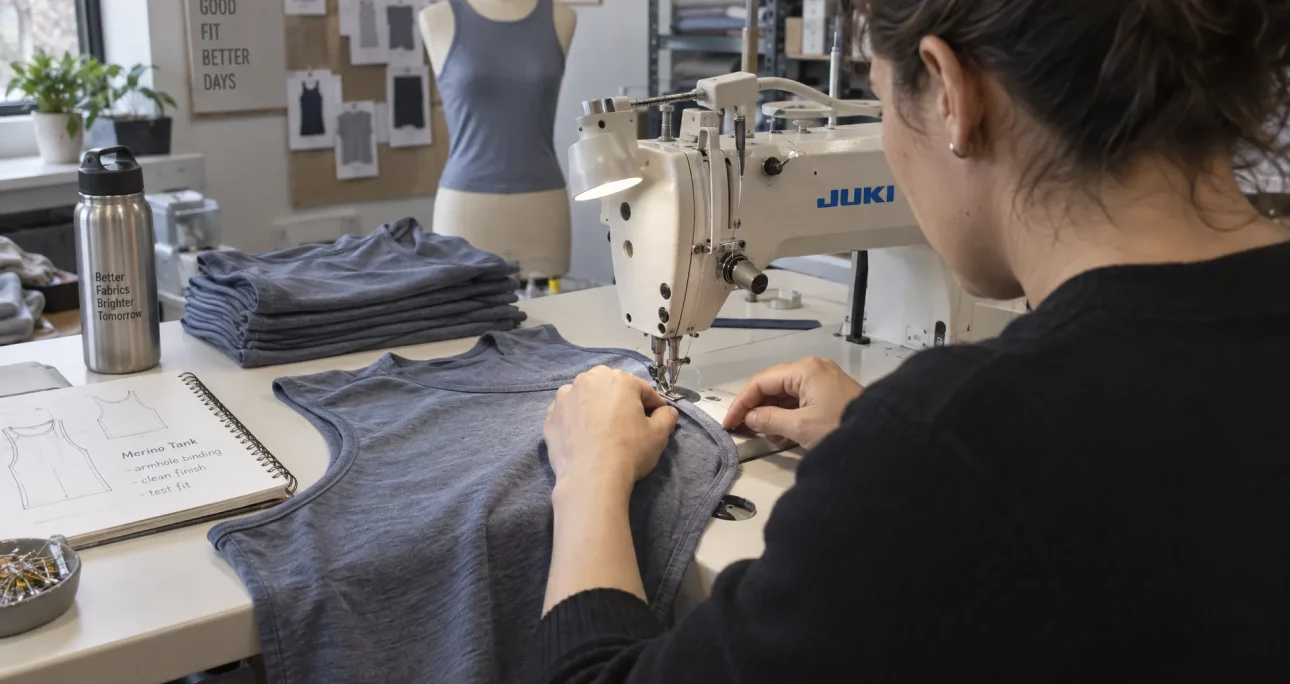
A merino tank top for warm-weather performance needs more than lightweight fabric and a sleeveless silhouette. The garment must release heat, remain comfortable when damp and hold its shape around openings that have little structural support. For apparel brands, the development challenge is balancing those requirements without creating a sheer, fragile or overly clingy product.
Start with the activity and climate, then develop the fabric, fit and finishing together. A tank intended for humid-weather running needs different priorities from one designed for travel or low-intensity studio sessions. The following framework turns those differences into specifications you can sample, test and carry into production.
Set the merino tank top performance brief
Define the garment’s primary use before choosing a fabric. “Summer performance” is too broad to guide decisions about coverage, drying behavior or armhole shape.
For running, prioritize unrestricted arm movement, low-friction edges and comfort under sustained sweat. For hiking, consider pack-strap contact and shoulder coverage. A travel style may place greater emphasis on opacity, repeat wear and a silhouette that works outside exercise.
Climate changes the brief as well. In humid conditions, evaporation is constrained, so a fabric that feels comfortable during a short indoor fitting may become heavy or clingy during extended activity. In dry conditions, airflow and exposed skin can support cooling, but a tank provides less sun coverage than a sleeved garment.
Give each requirement a way to be evaluated. Instead of specifying “breathable,” request comparable air-permeability results for candidate fabrics and field testing in the intended conditions. A merino tank top brief should identify the intended wearer, activity, climate and acceptable coverage before development begins.
Choose fabric by construction, not weight alone
Use fabric weight as a sampling variable
Fabric weight, expressed in grams per square meter (GSM), is useful for narrowing options, but it does not establish breathability or drying speed by itself. Knit density, yarn construction, finishing and fiber composition all affect performance.
As an illustrative sampling range, not a universal specification, a brand might compare fabrics around 120-170 GSM for a lightweight summer style. The lighter option may reduce garment mass but require closer examination of transparency, snagging and edge stability. A denser option may improve coverage while feeling less airy.
Compare candidates in the intended color and finish. Pale colors can reveal coverage problems that are less noticeable in darker versions. A swatch that looks opaque when relaxed may become transparent when stretched across the chest or upper back.
For a merino tank top, the best starting fabric is the lightest construction that still meets the product’s coverage, durability and shape-retention requirements. Arcus’s guide to fabric weight and fit in merino wool T-shirts provides related context, but sleeveless styles need additional scrutiny at their exposed edges.
Evaluate fiber fineness and blends separately
Fiber diameter influences next-to-skin feel, but softness alone is not a sufficient selection criterion. Request the supplier’s micron specification, then assess the actual finished fabric against the chest, underarm and shoulder. Yarn structure and finishing can change how two fabrics with similar fiber specifications feel.
A 100% merino fabric may suit a wool-focused collection, but its recovery and durability depend on the construction. Nylon blends or reinforced yarns can be considered where abrasion resistance matters. Polyester blends may change drying behavior, while elastane can support recovery in close-fitting styles. None of these additions guarantees the desired result without testing.
Merino can absorb moisture vapor and may retain less noticeable odor than some synthetic fabrics in certain wear conditions. That does not make every wool fabric fast-drying, antibacterial or suitable for repeated wear without washing.
Select the composition for the merino tank top around its intended failure risks, such as backpack abrasion, stretched openings or persistent wet cling. Avoid choosing a blend solely because its percentage sounds performance-oriented.
Engineer the armholes and neckline together
Balance ventilation, coverage and movement
Armhole geometry determines much of a tank’s comfort. A deep opening can increase exposure and freedom of movement, but it can also reveal undergarments or allow the side panel to shift during exercise. A higher opening provides coverage but may rub against the underarm if the pattern or binding is too restrictive.
Assess the front and back armhole separately. The front must accommodate the chest without cutting inward during forward reach. The back must allow shoulder-blade movement without pulling the neckline backward. Shoulder width also affects how the garment sits beneath pack straps or over a sports bra.
Fit the sample with the undergarments intended for its audience. Ask wear testers to reach overhead, swing their arms, bend forward and wear a loaded pack when relevant. Check whether the neckline lifts, the side seam rotates or an opening exposes more than intended.
A merino tank top should retain its intended coverage during movement, not just while the fit model stands still. Include these movement checks in the fit approval record so later samples are assessed consistently.
Grade openings deliberately across sizes
Do not assume that increasing chest circumference will produce a satisfactory armhole in every size. Opening depth, shoulder position and front coverage need deliberate grading, especially in close-fitting styles.
Review at least a smaller and larger size in addition to the development sample. Look for gaping at the front armhole, tension across the upper back and shoulder straps that move outward or collapse inward. Where the collection includes different body-shape blocks, validate each block rather than treating one fit session as representative of all wearers.
Hem length also deserves a movement check. An otherwise comfortable tank can ride upward during overhead activity or gather beneath a hip belt. Record the intended finished length and the acceptable behavior during use, not just a flat measurement.
Stabilize edges without making them restrictive
Neck and armhole bindings are small components with an outsized effect on comfort. A binding that is too short can draw an opening inward and create puckering. One that is too long may flare or lose contact with the body.
Develop the binding ratio using the actual body fabric, binding material and stitch construction. A ratio that works on one knit may behave differently after a change in yarn, finish or stretch direction. Measure the finished opening before and after laundering, not only the cut components.
For a merino tank top, evaluate the edge against damp skin as well as dry skin. Bulky joins, stiff labels and rough seam allowances can become more noticeable during repeated arm movement. Flat seams may help in some locations, but they are not automatically the best choice if they add bulk or distort a lightweight knit.
Agree on needle selection, stitch density and differential feed with the production team. If a sample shows waviness or small holes near seams, resolve the cause before approving it. Do not rely on pressing to conceal an unstable construction.
Validate performance on fabric and finished garments
Separate moisture absorption from drying performance
Moisture buffering, liquid transport and drying are different properties. A fabric may feel comfortable during the early stages of activity yet remain wet after prolonged sweating. Similarly, a fabric can spread liquid effectively without drying quickly in humid air.
Ask a textile laboratory to recommend appropriate methods for the claims you intend to make. Compare fabrics under the same test conditions and use finished garments for wear evaluation. Laboratory results help isolate material behavior; wear trials reveal interactions between fabric, fit and openings.
Test a merino tank top against a relevant benchmark, such as the brand’s existing summer style, rather than judging it only in isolation. Record the environment, activity duration, undergarments and laundering history so feedback is interpretable.
The broader principles in Arcus’s discussion of merino wool workout-clothing performance are useful here, but the tank’s specific risks include underarm friction, exposed-edge growth and coverage during movement.
Build a practical validation matrix
Set acceptance criteria before testing. The table below identifies useful checks, but it does not prescribe universal pass thresholds. Those should reflect the product’s use, price positioning and care instructions.
| Development risk | Useful check | What to document |
|---|---|---|
| Heat and moisture discomfort | Comparable fabric tests plus activity-specific wear trials | Airflow results, wet cling and perceived comfort |
| Transparency | Dry and damp coverage checks under consistent lighting | Color, stretch level and areas of concern |
| Opening distortion | Measurement before and after repeated laundering | Neckline growth, armhole growth and puckering |
| Restricted movement | Overhead reach, forward reach and activity simulation | Pulling, exposure and garment displacement |
| Surface damage | Abrasion and pilling evaluation appropriate to the use | Changes at straps, side panels and contact points |
| Seam weakness | Relevant seam-strength and fabric-damage checks | Failure location, stitch behavior and needle damage |
Recheck after laundering and prolonged wear
A first fitting is not a release decision. Wash and dry samples according to the proposed care instructions, then repeat dimensional and movement checks. Evaluate several cycles appropriate to the development plan rather than relying on a single wash.
Watch for body shrinkage combined with binding growth, side-seam twisting and changes in hand feel. These problems can appear separately: the garment may still fit through the chest while the neckline becomes loose or the hem rotates.
Include a sustained activity session, not only a short try-on. Ask wear testers to identify when discomfort begins and where it occurs. “Feels hot” is less actionable than “the center-back panel stayed wet beneath the pack.”
Approve the merino tank top only after the revised sample resolves the agreed failure points. If a fabric or construction changes during development, repeat the checks affected by that change instead of assuming earlier results still apply.
Translate the approved sample into production controls
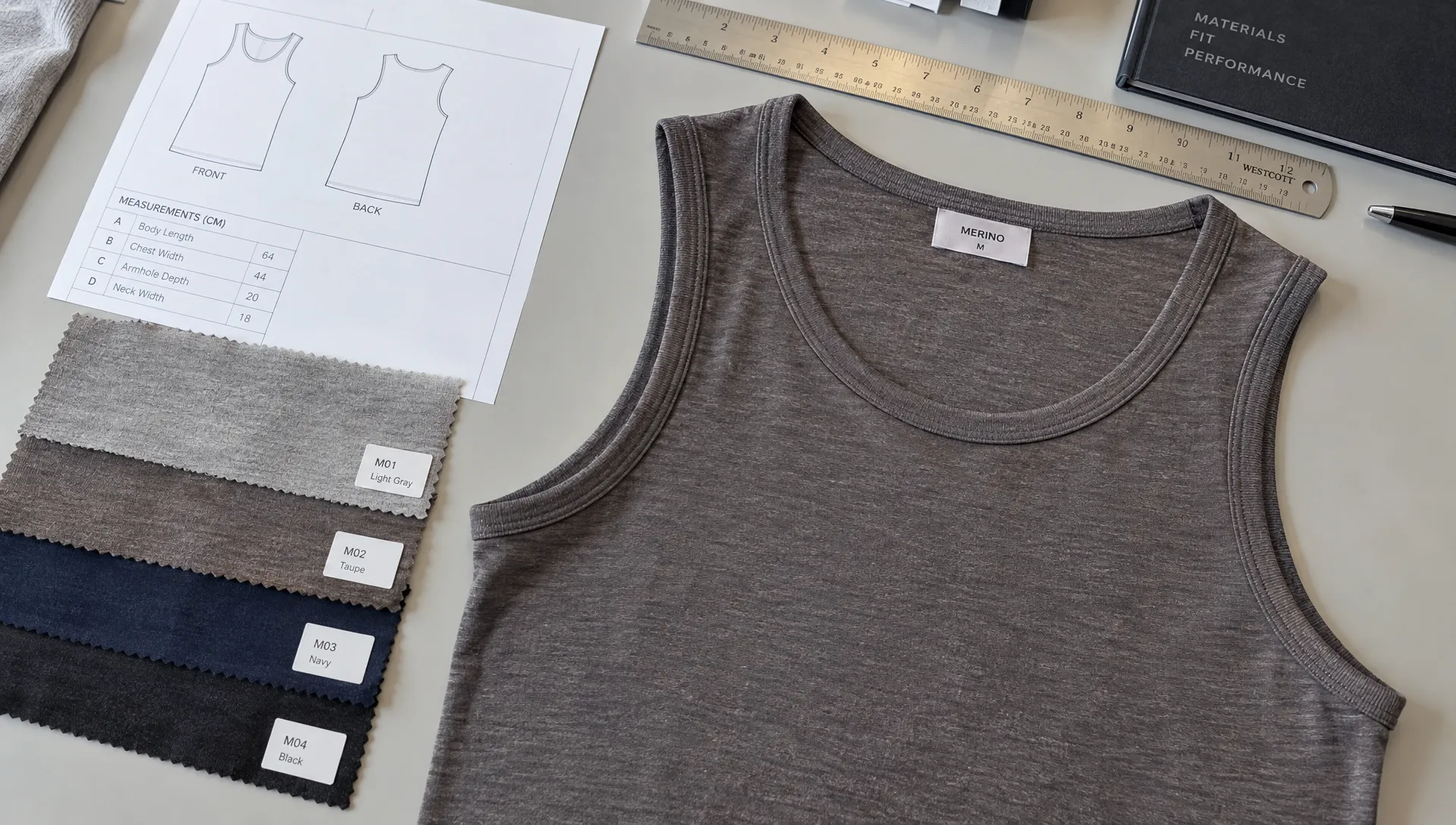
The production package should capture what made the sample work. Alongside the pattern and measurement chart, specify fabric composition, weight tolerance, finish, stretch direction and the approved binding construction.
Document neckline and armhole measurements, seam allowances, stitch requirements and grading rules. Include photographs of acceptable edge appearance and any defects that caused earlier samples to fail. An approved physical sample remains valuable because measurements alone do not communicate hand feel or drape.
For a merino tank top, confirm fabric availability before finalizing launch quantities. Fabric, dyeing and trim minimums can differ from garment-sewing minimums. Ask which requirements drive the order quantity and whether an initial small batch can use the same material and finish planned for later production.
For US sales, review the FTC’s textile and wool labeling requirements, along with applicable care-label obligations. Confirm fiber-content wording, country of origin and responsible business identification. Keep performance claims tied to evidence: merino content alone does not establish a UPF rating, a drying-speed claim or a verified environmental benefit.
Frequently asked questions
Is 100% merino better than a blend for a summer tank? Neither is universally better. A 100% wool construction may suit the collection’s material positioning, while a blend may help meet specific recovery or durability requirements. Compare the finished fabrics and garments rather than deciding from composition alone.
What fabric weight should a summer tank use? There is no single ideal weight. A merino tank top can begin development with lightweight candidates, but opacity, knit structure, fit and durability determine which option is viable. Treat any proposed GSM range as a sampling starting point, not a performance guarantee.
Can merino feel uncomfortable in hot, humid conditions? Yes. A dense construction, close fit or prolonged saturation can reduce comfort. Merino’s moisture-related properties do not override high humidity or unsuitable garment design, so test in conditions that match the intended use.
How can a brand reduce armhole stretching? Develop the opening shape, binding material and binding ratio together. Validate recovery after movement and laundering, then control those specifications in production. Simply tightening the binding may create pressure or puckering rather than solve the problem.
Develop a summer tank with a production-ready specification
Arcus Apparel Group supports custom apparel development, material sourcing, pattern development and manufacturing, with small-batch options, low minimum order quantities and in-house production management. Its domestic and international production considerations should be discussed against the needs of the specific project, rather than assumed from the design alone.
Bring your activity brief, target fit, coverage requirements and initial volume to Arcus Apparel Group. Use those inputs to discuss material options, sampling priorities and the quality controls needed to move an approved warm-weather tank into production.



