
A merino polo shirt can feel exceptional at first wear and still lose its shape after laundering. The collar may curl, the placket may ripple or the body may shorten while the sleeves stay unchanged. For apparel brands, preventing those failures requires more than choosing soft wool. Fabric stability, trim construction, pattern balance and finishing must work together, then prove themselves in garment-level testing.
Specify a merino polo shirt by measurable outcomes
Before sourcing fabric, define what “holds its shape” means for your product. A relaxed resort polo and a fitted performance polo need different silhouettes, but both need repeatable dimensions and controlled distortion.
Separate intentional design features from defects. A soft collar roll may be desirable; uneven collar points are not. A relaxed hem may suit the design; a twisted side seam usually does not.
| Area | What to specify | What to inspect after wear and washing |
|---|---|---|
| Body | Chest width, body length and hem width | Shortening, widening and side-seam twist |
| Collar | Attachment length, height and point shape | Curling, stretching and asymmetry |
| Placket | Length, width and overlap | Rippling, gaping and distortion at the base |
| Sleeves | Sleeve length and opening | Bagging, cuff flare and uneven recovery |
Set tolerances around the intended fit rather than copying another brand’s specification. Small dimensional changes can be conspicuous on a close-fitting garment, especially around the neck and upper chest.
Choose the construction before the fabric specification
The development route for a merino polo shirt should reflect its intended appearance and production method. Two common approaches are cut-and-sew construction from knitted yardage and flat-knit construction using shaped or fully fashioned components.
Neither route automatically produces a more stable garment. Each introduces different variables that belong in the technical package.
Cut-and-sew versus flat-knit construction
For a cut-and-sew polo, evaluate the body fabric and collar as a system. A stable body can still look distorted if its separately knitted collar contracts more during washing. Fabric relaxation before cutting, cutting alignment and sewing-machine settings all influence the finished result.
For a flat-knit polo, specify stitch structure, knitting gauge, yarn and finished dimensions together. Collar attachment, placket construction and panel shaping still require development; knitting the components does not eliminate differential shrinkage.
If your range includes coordinating basics, the principles in our guide to merino wool T-shirt fabric weight and fit can help establish a starting body fabric. A polo then needs additional validation around its collar and button opening.
Yarn and finishing matter as much as softness
Fiber micron count helps inform next-to-skin comfort, but it is not a shape-retention specification. Yarn twist, ply, stitch density and finishing also affect how the fabric stretches, relaxes and recovers.
For a merino polo shirt, request the yarn and finishing details behind a promising swatch rather than approving it by hand feel alone. Ask whether the wool has a shrink-resistance treatment and what laundering conditions the supplier supports.
A blend may improve durability or recovery, depending on its composition and construction. However, adding synthetic fiber does not guarantee dimensional stability. Elastane can support stretch recovery, but it does not by itself prevent wool felting or correct an unstable collar.
Distinguish relaxation shrinkage from felting shrinkage. A knit can change dimensions as manufacturing stresses relax; wool can also felt under unsuitable laundering. Those mechanisms require different development decisions.
Evaluate knit structure, not GSM alone
Fabric weight is useful for positioning a product, but it does not tell you whether the knit will twist or the collar will hold its edge. Two fabrics with similar GSM can behave differently because of their yarn, loop geometry and finishing.
Compare candidate fabrics for extension and recovery, skew, surface appearance and dimensional change after the intended care process. Single jersey, piqué and double-knit structures each offer different aesthetics, but none should be approved on the structure name alone.
Engineer the collar and placket as one assembly
The collar and front opening concentrate several materials and sewing operations into a small area. Their interaction often determines whether the finished polo looks crisp or unstable.
Give the collar its own specification
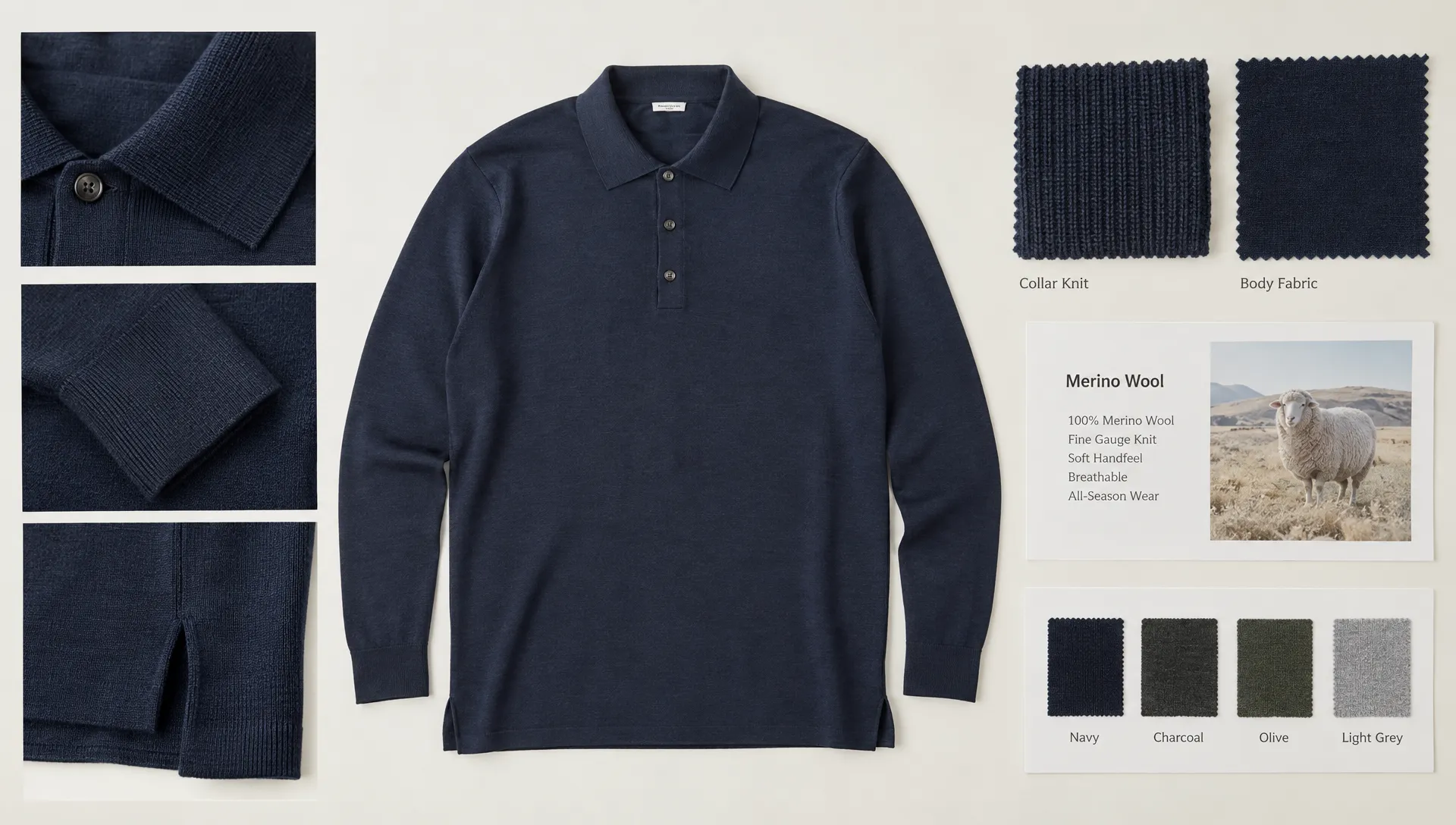
A merino polo shirt needs a collar specification beyond “matching rib.” Record collar height, attachment-edge length, point geometry, stitch structure and the intended relationship to the neckline.
The attachment edge and free edge have different jobs. The attachment edge must join the neckline without stretching it out or drawing it inward. The free edge must maintain the intended roll and point shape without excessive curl.
Test the actual collar construction. Rib, tubular construction or other knitted structures can produce different edge behavior, but stitch choice alone does not guarantee stability. Yarn, density and finishing remain important.
Compare the collar and body after identical care cycles. If the body and collar change dimensions differently, the seam can pucker even when each component appears acceptable separately.
Inspect the garment both buttoned and open. The collar should sit evenly in both configurations, without one point lifting or the neckline pulling backward.
Stabilize the placket without making it rigid
The placket introduces additional layers, buttonholes and concentrated handling stress. Excessive reinforcement can make it feel board-like; insufficient support can allow the opening to stretch and wave.
On a merino polo shirt, trial the complete placket assembly, including the intended thread, buttons, buttonholes and any interlining or stay material. A fabric-only test cannot reveal how those components interact.
If using fusible interlining, assess bonding compatibility, appearance and durability after laundering. Heat, pressure and dwell time must suit the wool fabric and adhesive system. If using sew-in support, check bulk and whether the support changes dimensions differently from the outer fabric.
Pay particular attention to the placket base. Reinforcement should distribute stress without creating a hard lump or a visible dent in the chest. Buttonholes should function without excessive stretching, while button attachment should not distort the surrounding knit.
Balance the sleeve opening and hem
Rib cuffs need their own finished measurements and attachment relationship. An overly tight cuff can gather the sleeve; an unstable cuff can flare or remain stretched after wear.
For a hemmed sleeve, check whether the stitching restricts stretch or encourages tunneling. On the body, assess hem curl, side-slit reinforcement and puckering where folded fabric creates extra thickness.
Avoid treating a sewing operation as approved merely because the seam stays intact. It must also preserve the silhouette and remain comfortable during movement.
Develop the pattern around finished dimensions
The pattern for a merino polo shirt should be based on the intended finished fit, supported by measured behavior from the actual fabric and trim combination.
Start with properly relaxed material. Establish a repeatable handling process before cutting so one sample is not made from newly unrolled fabric while another is cut after extended relaxation.
Keep cutting alignment controlled. In cut-and-sew production, poorly aligned pieces or an unstable fabric can contribute to side-seam twist. Do not try to solve every distortion by changing the pattern; first identify whether it originates in the fabric, cutting or sewing.
Map dimensional changes by direction and component. A single shrinkage allowance applied everywhere is unlikely to address a body, collar and placket that behave differently.
Check shoulder slope, neckline position and front-to-back balance on a fit model. A collar that pulls backward may be responding to garment balance rather than a defective collar knit.
Finally, validate grading. The collar, neckline and placket should not simply increase by the same amount in every size. Their proportions and attachment relationships must remain intentional across the range.
Use samples to isolate the cause of distortion
A useful sampling process changes one major variable at a time. If you change the yarn, collar density, interlining and sewing tension simultaneously, an improved sample will not explain which adjustment worked.
For each merino polo shirt prototype, retain the component specifications and processing conditions alongside the garment measurements. Photograph the collar and placket before testing so subtle changes are easier to compare.
A practical development sequence is:
- Material trial: Compare body fabric, collar and support materials after the proposed care process.
- Construction trial: Evaluate collar attachment, placket assembly and sleeve finishes using representative materials.
- Fit sample: Assess proportions and movement before and after laundering.
- Preproduction sample: Confirm the approved design using production-intent materials and processes.
Do not approve collar stability from a photograph alone. Handle the garment, fasten the buttons and examine the opening from the front and side.
For flat-knit projects, our guide to premium merino sweater construction provides additional context on shaped components and assembly. The polo still needs its own collar and short-placket trials.
Test the complete garment, not just the fabric
Swatch testing helps eliminate poor candidates, but it cannot predict every interaction in an assembled garment. Different layer counts, seams and trim materials can create local distortion that does not appear in fabric testing.
Establish repeatable measurement conditions
Condition and measure each sample consistently before and after testing. Let garments rest flat, use the same measurement method and avoid stretching the knit to recover the original dimensions.
For a merino polo shirt, record body length, chest width, hem width, sleeve length, sleeve opening, collar attachment length and placket dimensions. Add photographs of collar points, side seams and the placket base.
Calculate dimensional change as:
Dimensional change (%) = ((after measurement − before measurement) ÷ before measurement) × 100.
For example, a body length changing from 70 cm to 68.6 cm has decreased by 2%. This is an illustrative calculation, not a recommended acceptance limit. Whether that change is acceptable depends on the fit and specification.
Formal testing should follow an agreed method. AATCC’s textile test methods include TM150 for dimensional changes of garments after home laundering and TM179 for skewness change. Ask the laboratory to confirm the appropriate method and conditions for the product.
Match laundering to the proposed care label
Test the care process you intend to communicate to customers, including drying. A sample washed gently and dried flat does not validate a machine-wash-and-tumble-dry claim.
The Woolmark wool-care guidance is a useful reference for understanding why washing and drying instructions matter. Your final label must still reflect the behavior of the finished garment, including its trims and support materials.
Use repeated laundering checkpoints rather than stopping after one wash. For development screening, a team might inspect after one, three and five cycles, then choose further testing based on product requirements. Those checkpoints are a development example, not proof of lifetime durability.
After each checkpoint, evaluate the merino polo shirt for dimensions and appearance. Inspect collar curl, placket waviness, seam puckering, surface change and differential shrinkage.
Add controlled wear trials where relevant. Repeated button use, sleeve stretching and movement can expose problems that laundering alone misses. Keep the trial conditions consistent enough to compare samples meaningfully.
Approve production against a retained reference
Keep an approved preproduction sample and its measurement record as the production reference. A specification sheet without a physical reference may leave collar roll, placket softness and appearance open to interpretation.
Confirm that production uses the approved yarn or fabric, collar construction, support materials and finishing process. Review representative garments from the production run rather than assuming the development sample covers every manufacturing variation.
If a material or process changes, determine which tests need repeating. Substituting an apparently similar interlining or collar yarn can affect the finished garment enough to require renewed approval.
Frequently asked questions
Is 100% merino less stable than a blend? Not necessarily. Shape retention depends on yarn, knit structure, finishing and garment construction as well as composition. Compare finished samples under the same conditions rather than treating fiber content as a performance guarantee.
Why does the collar curl when the body looks fine? The collar may have different stitch behavior, finishing or dimensional change from the body. Attachment tension and neckline geometry can also contribute. Test the collar material and the sewn assembly separately to identify the cause.
Can a heavier merino polo shirt solve shape-retention problems? Extra weight may change drape and opacity, but it does not automatically correct collar curl, placket distortion or seam twist. Diagnose the failed component before increasing GSM.
Should the care label be decided before sampling? Define the intended care process early, then validate it through testing. If the garment cannot meet that process, change the construction or revise the care instructions before production approval.
Develop the specifications before placing the order
A stable polo starts with a clear brief: finished measurements, collar geometry, placket support, material specifications and an agreed testing plan.
Arcus Apparel Group’s apparel development and manufacturing services include material sourcing, pattern development, small-batch manufacturing and production management. Bring your intended fit, care expectations and sample acceptance criteria into the development conversation so the garment is evaluated against defined requirements before production.



