
A merino dress shirt has to do two jobs at once: look polished under a jacket and remain comfortable through a full day of movement. Soft fabric alone will not deliver that balance. The pattern, collar support, sleeve geometry and laundering performance all influence whether the finished garment feels refined or simply resembles a button-front base layer.
For apparel brands, the development challenge is to preserve a clean silhouette without restricting the wearer. This guide focuses on the decisions that make that possible, from selecting a stable fabric platform to approving a production-ready fit.
Define what “refined performance” means for your customer
Start with the wearing occasion, not a generic promise of versatility. A shirt intended for office wear with a tie needs different collar behavior and body proportions from one designed for open-neck travel.
Write a short product brief that identifies the intended wearer, typical activities, layering requirements and care expectations. Specify whether the shirt should stay tucked during seated work, fit beneath a close-cut jacket or look finished when worn untucked.
Translate broad claims into observable requirements. “Comfortable movement” can mean reaching forward without excessive cuff retreat or front-placket tension. “Polished appearance” can mean a collar that maintains its shape and a hem that remains level after laundering.
Performance should be demonstrated on the finished garment. Fiber properties do not establish that a particular shirt dries quickly, resists wrinkles or remains presentable after repeated wear. Those outcomes also depend on construction, finishing and care.
Choose a stable fabric for a merino dress shirt
Decide first whether the product is fundamentally a woven dress shirt or a knit shirt with dress-shirt styling. Both can work, but they require different pattern and construction strategies.
| Fabric platform | Potential advantage | Development concern |
|---|---|---|
| Woven merino fabric | A crisp visual structure suited to traditional shirting | Limited mechanical stretch, seam slippage and pressing response |
| Stable merino knit | More movement through fabric extension | Growth, edge curl and compatibility with structured components |
| Merino blend | An opportunity to adjust strength, recovery or care performance | Results depend on the companion fiber, construction and finishing |
These are development considerations, not guaranteed outcomes. Test the actual fabric rather than assuming that every woven cloth is stable or every knit recovers well.
Evaluate drape, surface texture and opacity alongside comfort. A fabric can feel excellent in a swatch yet look too clingy across the chest or too bulky at a folded placket. Assess light colors over the underwear your customer is likely to wear.
Request the fiber composition, fabric construction, weight, usable width and care recommendations from the supplier. Also ask about finishing treatments and available dimensional-change data. Use those details to shortlist fabrics, then confirm behavior in sewn samples.
Establish the body shape before chasing a slimmer silhouette
A merino dress shirt should be developed around a defined body profile and fit intention, not a stock pattern narrowed at the side seams. Start with a relevant block and evaluate how the selected fabric changes its behavior.
Balance chest, waist and seat ease
Record both the target body measurements and finished garment measurements. The difference represents ease, but circumference alone does not explain how the shirt fits. Its distribution between the front and back matters just as much.
For example, an illustrative woven prototype for a 40-inch chest might use a 44-inch finished chest circumference. That provides 4 inches of total ease, but it is not a universal recommendation. Posture, fabric mobility, body shape and the desired silhouette may require a different starting point.
Check the upper back during forward reach, the abdomen when seated and the lower shirt over the seat. Do not remove necessary movement allowance simply to make a standing photograph look cleaner.
Placket gaping can indicate insufficient circumference, inadequate front length or poor shaping distribution. Moving buttons closer together may reduce a visible opening, but it does not resolve the underlying pattern problem.
For fuller-bust fits, assess front length, shaping and button placement together. For prominent abdomens, review front balance rather than adding equal width everywhere. Fit corrections should address the body the garment is intended to serve.
Engineer shoulder position, armholes and sleeve pitch
The sleeve is central to how a merino dress shirt performs at a desk, behind a steering wheel or beneath a jacket. A comfortable standing pose is not enough to approve it.
Locate the shoulder seam according to the intended silhouette and wearer. Then evaluate the armhole, sleeve cap and upper-arm width as a connected system. Lowering the armhole to create room can increase body lift when the wearer raises an arm. A closer armhole may improve movement, but only if its shape and the sleeve provide adequate clearance.
Sleeve pitch describes the sleeve’s orientation relative to the body. If that orientation does not suit the wearer’s resting posture, twisting and drag lines may appear even when sleeve circumference is sufficient.
Ask the fit model to reach forward, cross their arms and bend their elbows. Observe sleeve rotation, pressure at the front armhole and how far the cuff retreats. A back pleat or additional back width may help, but each solution should be tested rather than treated as an automatic performance feature.
Document the cause of each correction. “Add room” is less useful than “increase upper-back allowance because forward reach pulls the side seams toward the back.”
Set hem length and cuff placement around actual use
For a merino dress shirt intended to stay tucked, evaluate hem coverage during sitting, reaching and bending. Extra length can help, but excessive fabric below the waist creates bulk inside trousers.
An untucked version needs a deliberate hem profile and balanced front and back lengths. Do not simply shorten a tucked pattern without checking side-seam proportions, the lowest button position and coverage during movement.
Assess sleeve length with the cuff fastened at its intended circumference. An oversized cuff may fall too far over the hand and create the impression of an overlong sleeve. Conversely, a tight cuff can conceal insufficient sleeve length until the wearer reaches forward.
Test the garment beneath a representative jacket. Look for sleeve bunching, collar crowding and excess fabric collecting above the waistband. A shirt can fit well on its own while becoming uncomfortable as part of a tailored outfit.
Approve front, side and back balance before making cosmetic reductions. A level hem, controlled drape and comfortable posture usually produce a more convincing refined fit than aggressive waist suppression.
Give collars, cuffs and plackets controlled structure
The collar often determines whether a merino dress shirt reads as businesswear or casual knitwear. Its support must suit both the fabric and the intended styling.
For tie wear, evaluate the collar stand, closure circumference and space available for the tie knot. For open-neck wear, assess how the collar falls when the top button is undone. Check both conditions on the wearer, not only on a hanger.
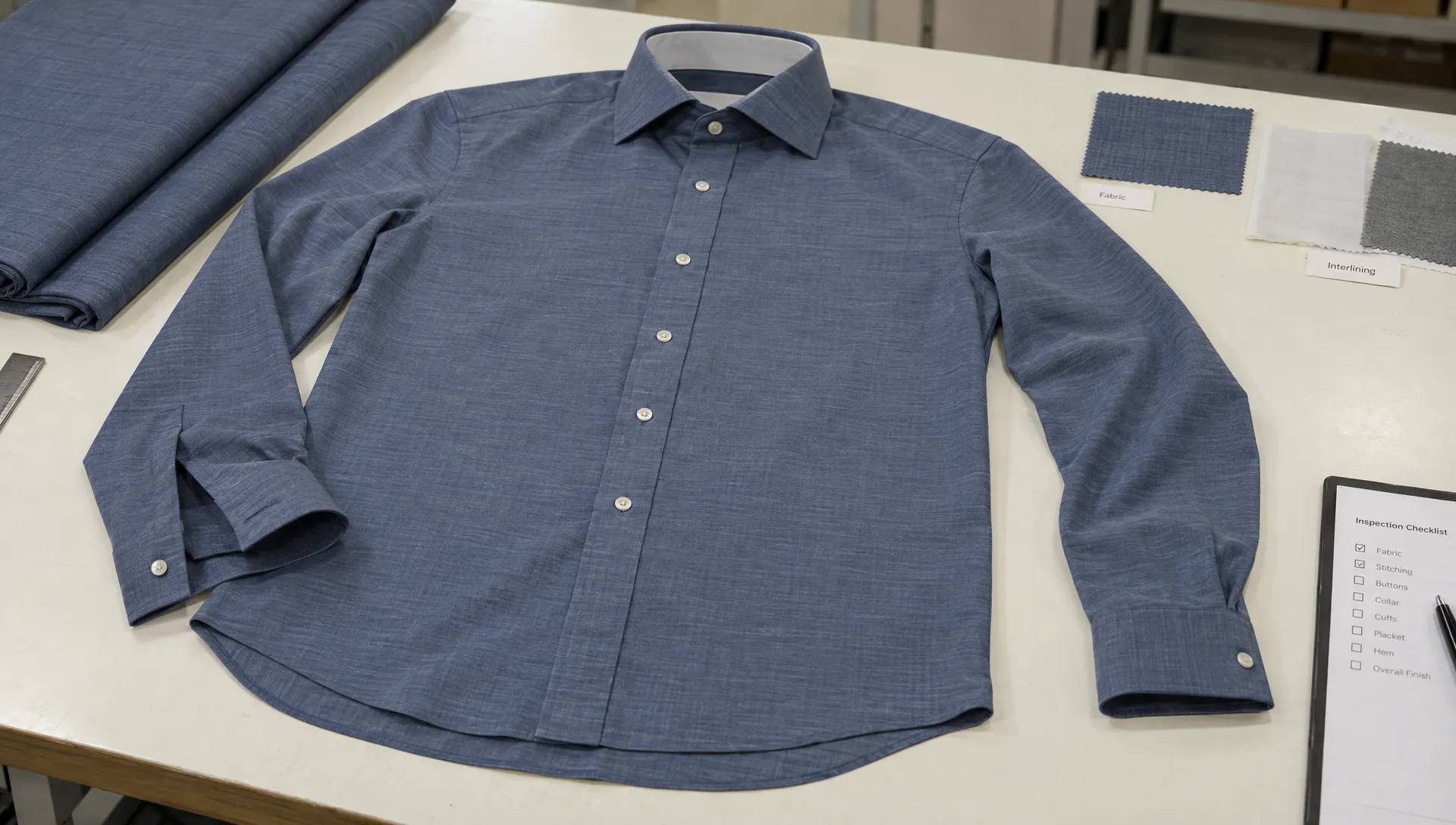
Interlining selection requires sewn trials. A very firm interlining can overpower a soft shell, while insufficient support can allow the collar or cuff to collapse. Test fusing compatibility, pressing response and appearance after the proposed care cycle. A sew-in construction is another option, but it also needs validation.
The placket must remain straight without becoming noticeably stiffer than the body. On knit fabrics, differential stretch between the body and reinforcement can produce rippling. Buttonholes also need enough local support to avoid distortion.
Related component issues appear in merino polo shirt development, although a dress shirt needs its own collar geometry and closure specifications.
Keep seam bulk under control at collar points, cuff corners and placket intersections. Review these areas after laundering as well as immediately after pressing.
Validate fit through wear and care testing
Separate fit approval from appearance approval. A neatly pressed sample can conceal dimensional instability, weak recovery or construction problems that become visible during wear.
Use a consistent fit model, record relevant body measurements and photograph samples in the same poses. Record the fabric lot and sample revision so the team can distinguish a pattern change from a material change.
Run a repeatable movement assessment
Test each merino dress shirt prototype through the same sequence: seated work, forward reach, crossed arms, overhead reach and normal walking. Include jacket wear when that is part of the product brief.
Record specific observations rather than a single comfort score. Useful findings include front-button tension while seated, cuff retreat during reach, collar pressure when closed and hem movement above the waistband.
Check appearance again after the wearer has moved. Does the placket return to a straight line? Does the back remain caught above the waist? Does the sleeve retain a twisted position? Recovery matters as well as initial freedom of movement.
Confirm important changes on additional wearers within the target size range. One fit model can establish a consistent reference, but cannot represent every shoulder slope, posture or torso proportion.
Measure the garment before and after laundering
Follow the intended care instructions when testing. Do not assume that all merino fabrics tolerate the same wash cycle or drying method. Woolmark’s wool care guidance provides useful context, but the care label must reflect the actual garment and its components.
Measure conditioned samples before laundering and again after the defined wash, drying and conditioning sequence. Record the number of cycles and the measurement method. If formal laboratory testing is needed, discuss a suitable garment dimensional-change procedure, such as AATCC TM150, with the testing provider.
Track chest width, body length, sleeve length and collar dimensions. Also inspect placket waviness, seam puckering, collar bubbling, buttonhole distortion and changes in surface appearance.
A merino dress shirt is not ready for approval simply because its chest measurement remains acceptable. Uneven shrinkage between the body, reinforcement and stitching can compromise the appearance even when overall size change is modest.
Set acceptance criteria before testing. Use results to revise the fabric, reinforcement, pattern or care instructions rather than adjusting the label to fit an unverified assumption.
Convert the approved sample into production controls
Once the prototype works, document what made it work. A strong tech pack connects the approved appearance to measurable specifications and repeatable construction.
Include the following essentials:
- Measurement definitions: Identify each point of measure, the measuring method and its tolerance.
- Component specifications: Record approved fabric, interlining, thread, buttons and reinforcement materials.
- Construction details: Specify seam types, stitch requirements, collar assembly and placket treatment.
- Care-test requirements: Define the procedure, inspection points and acceptance criteria.
- Reference samples: Identify the approved fit sample and any approved post-laundering comparison sample.
For a merino dress shirt, grading deserves particular attention at the collar, shoulder, armhole and sleeve. A larger chest size does not automatically require the same proportional increase in every component. Review representative sizes before releasing the complete range.
During pilot production, check material variation and construction consistency. Woven fabrics may require seam-slippage evaluation, while knit versions may need particular attention to feeding, stretching and reinforcement attachment. Both require careful pressing controls.
Bulk approval should reflect repeatability, not just one excellent sample. Confirm that production garments match the approved measurements and appearance, including after the agreed care test.
Frequently asked questions
Is woven or knit merino better for a dress shirt? Woven fabric generally provides a more traditional shirting structure, while a stable knit can offer additional movement. The better choice depends on the intended appearance, fit and tested garment performance.
Should the shirt use 100% merino or a blend? Neither is automatically superior. A blend can change strength, recovery or care behavior, but those effects depend on the companion fiber and fabric construction. Compare sewn samples against the same requirements.
How can a brand reduce button gaping without making the shirt oversized? Check front length, shaping distribution and circumference at the point of tension. Adjust button placement only after evaluating the pattern. Additional room may be needed locally rather than throughout the garment.
Can a wool dress shirt be machine washable? Some can, provided the fabric, interlining and complete garment are suitable for the specified process. Confirm that capability through laundering tests before making a claim or assigning care instructions.
Develop a production-ready shirt with Arcus Apparel Group
Building a merino dress shirt requires fabric sourcing, pattern development and quality control to work together. Arcus Apparel Group offers end-to-end custom apparel development and manufacturing, including material sourcing, small-batch production and flexible scaling options.
Bring your target customer profile, fit objectives and preliminary fabric requirements to Arcus Apparel Group to discuss a development approach. Confirm material availability, minimums and testing responsibilities before committing to production.



