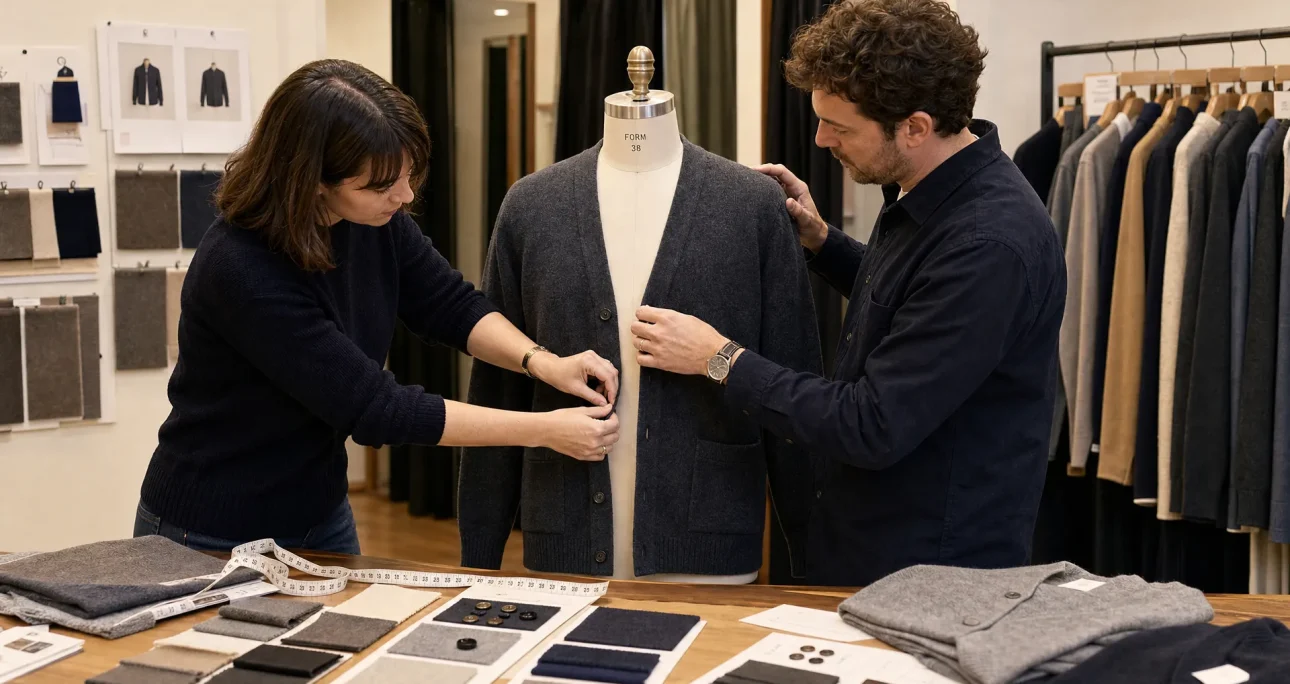
A men’s merino wool cardigan is more than a soft layering piece. It is an open-front knit garment that must hold its shape through gravity, movement, buttoning, unbuttoning and repeated wear. That makes development more demanding than a simple pullover.
For apparel brands, developing men’s merino wool cardigans means balancing three decisions early: yarn, fit and finishing. If the yarn is too weak, the front edge can stretch. If the fit is copied from a pullover, the garment may gape at the chest or collapse at the shoulder. If finishing is rushed, the cardigan can look uneven even when the knitting itself is good.
This guide breaks down the product development decisions that define a premium cardigan, from fiber and gauge to plackets, pockets, blocking and quality control.
Why Cardigans Need a Different Development Approach
A pullover distributes tension around the body. A cardigan has an opening down the center front, so the garment behaves differently on the hanger and on the wearer. The front panels can droop, twist or pull away from the body if the knit structure, placket construction and trim weight are not engineered together.
That is why a premium men’s merino wool cardigan should be developed as its own product block, not as a sweater with buttons added later. The neckline, shoulder slope, front panel width, hem tension and button placement all affect how the piece hangs.
The best cardigans usually start with a clear use case. A fine-gauge office cardigan worn over a shirt needs a smooth surface, stable front edge and controlled sleeve width. A chunky shawl-collar cardigan can carry more weight, texture and ease. A travel cardigan may need better shape recovery, lower bulk and a care routine the customer can realistically follow.
If your team is also building other knitwear silhouettes, Arcus Apparel Group’s guide to men’s merino wool sweater construction is a useful companion to this cardigan-specific framework.
Yarn Selection: Softness, Strength and Recovery
Merino wool is valued because it can feel soft against the skin while offering warmth, breathability and natural odor resistance. The Woolmark Company describes Merino as a fine wool fiber known for softness and comfort, which is why it works well in garments worn close to the body.
For a cardigan, softness is only one part of the decision. The yarn also has to support the garment’s weight, especially along the front panels, neckline and hem. A very fine yarn can create a refined hand feel, but if the construction lacks stability the cardigan may stretch out faster than expected.
Micron count affects comfort. Lower micron Merino generally feels softer, which can matter for cardigans worn over T-shirts. Ply and twist affect strength, surface appearance and pilling behavior. A looser yarn can feel plush but may pill sooner. A higher twist can improve durability but may feel drier or less lofty.
Many brands choose 100% Merino for a premium natural fiber story. Others use blends with nylon, recycled nylon or other fibers to improve durability, recovery or cost structure. Blends are not automatically lower quality, but they should be chosen for a clear performance reason rather than as a late cost reduction.
| Yarn direction | Best suited for | Development watchout |
|---|---|---|
| Fine 100% Merino | Elevated office and lifestyle cardigans | Needs strong construction control to avoid stretching |
| Multi-ply Merino | Midweight cardigans with better body | Watch bulk at seams, plackets and cuffs |
| Merino blend yarn | Travel, daily wear and performance-influenced styles | Confirm hand feel, care claims and brand positioning |
| Woolen-spun Merino | Lofty, warm and textured cardigans | May require stronger pilling review |
| Worsted-spun Merino | Smoother, cleaner and more polished surfaces | Can feel less lofty depending on yarn and gauge |
Yarn decisions should be tested in the intended stitch structure, not judged only from a yarn cone or small swatch. For more background on yarn, gauge and care behavior, Arcus Apparel Group’s guide to Merino sweater yarn and gauge basics gives a broader foundation.
Gauge and Stitch Structure Shape the Cardigan
Gauge controls the density and scale of the knit. A lower gauge produces a chunkier fabric, while a higher gauge creates a finer surface. Cardigans can work across a wide range, but the choice should match the intended retail position and wearing occasion.
A 5 to 7 gauge cardigan often reads as casual, warm and substantial. It can support shawl collars, cable textures and heavier ribs. A 12 to 14 gauge cardigan feels cleaner and more refined, making it suitable for office layering or minimal lifestyle collections. Mid gauges often deliver the most commercial balance of warmth, drape and versatility.
Stitch structure matters as much as gauge. Jersey can look clean but may curl at edges if not controlled. Rib structures improve recovery but change the fit and visual texture. Milano, half-cardigan, links-links and plated structures can add stability or surface interest depending on the machine capability and design goal.
| Gauge direction | Product impression | Common cardigan application |
|---|---|---|
| 5 to 7 gauge | Chunky, textured and warm | Shawl collars, casual outer layers and heritage styles |
| 7 to 10 gauge | Balanced weight and structure | Everyday cardigans, zip cardigans and transitional layers |
| 12 to 14 gauge | Fine, smooth and polished | Office cardigans, lightweight layering and refined basics |
| 16 gauge and finer | Very light and clean | Dressier cardigans where drape and delicacy are priorities |
The key is to avoid choosing gauge in isolation. A fine gauge with a weak placket can look elegant at sample stage but fail after wear testing. A chunky gauge with excessive trim tension can feel stiff and distort the front opening.
Fit: Cardigans Need Ease Without Sloppiness
A men’s merino wool cardigan usually needs more layering allowance than a crewneck sweater, but too much ease can make the garment look tired. The goal is controlled comfort. The customer should be able to wear it over a T-shirt, shirt or light base layer without the shoulder seam dropping unintentionally or the sleeve twisting.
The shoulder is one of the most important fit points. A classic cardigan often looks best with a shoulder seam sitting close to the natural shoulder. A relaxed cardigan can use a dropped shoulder, but that should be designed deliberately with sleeve width, armhole depth and body length adjusted together.
Chest ease should be checked both open and buttoned. A cardigan that looks good open may pull between buttons when closed. This is especially common when the button stance is too narrow, the placket is too soft or the grading does not account for larger chest and waist measurements.
Body length depends on category. A refined cardigan may sit near the high hip for clean layering under coats. A heavier casual cardigan can run longer, especially with a shawl collar or patch pockets. Sleeve length should be assessed after washing, steaming and wearing because Merino knits can relax or draw in depending on yarn and finishing.
Plackets, Closures and Front Edge Stability
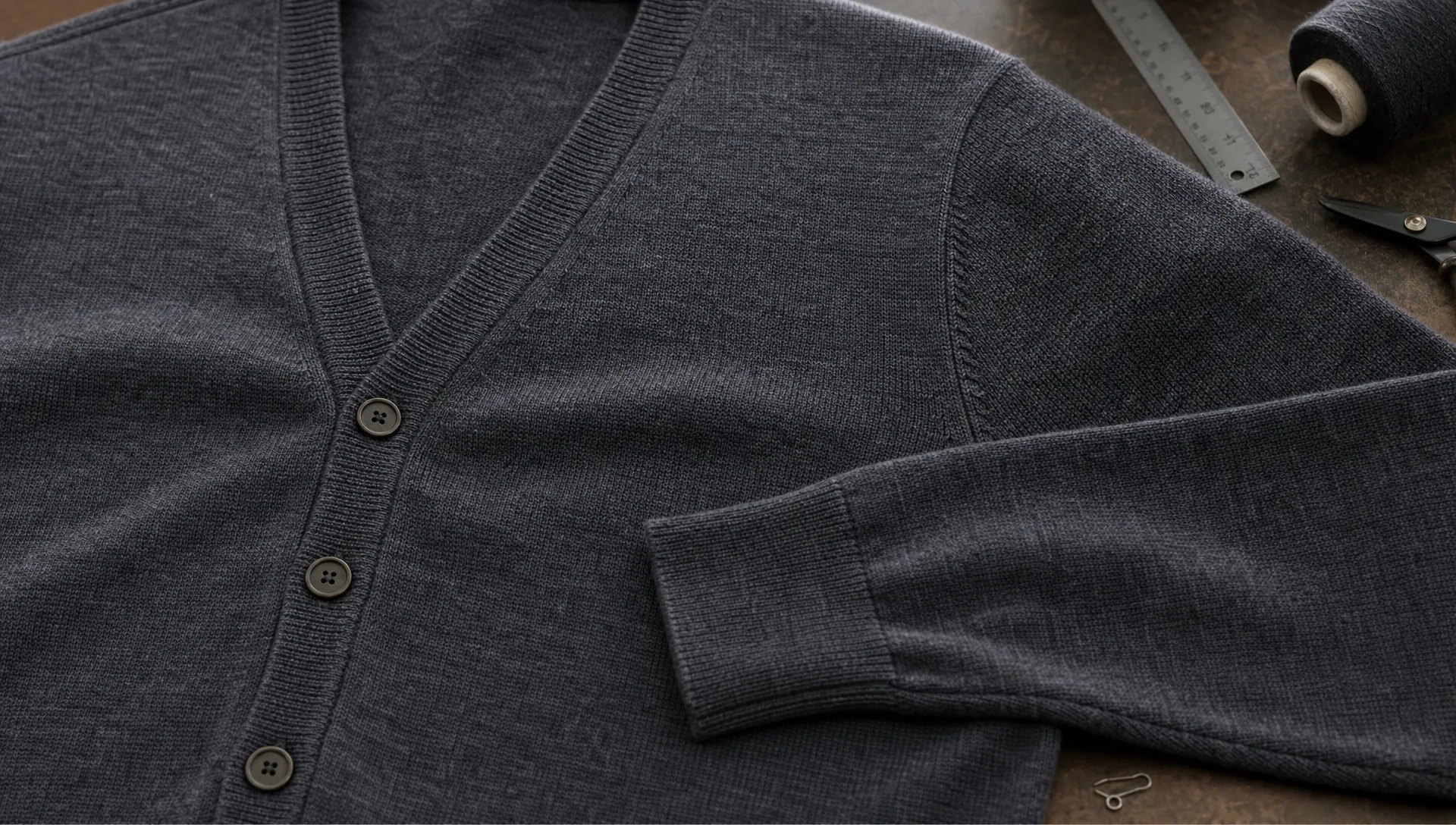
The center-front opening is where many cardigan quality issues appear first. A stable placket should support buttons or a zipper without pulling the front panel out of alignment. It should also recover after being stretched during dressing.
Common placket options include knitted rib plackets, tubular trims, full-needle trims and attached bands. Each has tradeoffs. Rib plackets offer recovery but can pull inward if tension is too high. A clean tubular edge can look premium but must be balanced carefully so it does not roll. Attached bands can add structure, but bulky seams may reduce comfort on lighter gauges.
Button choice also affects performance. Larger buttons create more visual impact but add weight. Heavy horn, metal or thick corozo buttons can pull on a fine-gauge front unless the placket is reinforced. Smaller buttons may suit lightweight cardigans but can feel less substantial on chunky styles. Buttonholes should be tested after wash and wear simulation because they can stretch, curl or become uneven if the structure is not stable.
Zipper cardigans need their own development review. The zipper tape can be less flexible than the knit, which may create waviness along the front. The best results usually come from aligning zipper weight, tape width, garment gauge and sewing tension before bulk production.
Pocket placement needs equal attention. Patch pockets can drag the front panels down if they are too large or too heavy. Welt or inseam pockets may look cleaner but add construction complexity. Pocket bags should be evaluated when loaded with common items like a phone, since real wear often reveals sagging that a flat sample does not show.
Finishing: Blocking, Washing and Hand Feel
Finishing determines whether the finished garment looks premium or merely acceptable. Merino knitwear typically needs controlled washing, drying, blocking and pressing to reach the intended measurements and hand feel. A good sample should not be approved only because it looks right when freshly steamed. It should be checked after the expected care process.
Blocking sets the garment shape. If the cardigan is blocked too aggressively, it may look good on the spec sheet but relax after wear. If it is under-blocked, the garment can shrink or torque after the customer washes it. Finishing must be repeatable, especially when scaling from sample to production.
The hand feel should match the product promise. A soft wash can improve comfort, but excessive softening may reduce structure and recovery. For cardigans, this balance is critical because the garment needs both drape and stability. The front edge, hem and cuffs should be reviewed after finishing to confirm they still sit correctly.
Care labeling should be based on actual testing, not preference. If a brand wants to claim machine washability, the yarn, construction, trims and labels need to support that claim. Dimensional change, spirality, pilling, colorfastness and button durability should all be reviewed before final approval.
| Quality issue | Likely development cause | Control point |
|---|---|---|
| Front panels stretch downward | Yarn too soft, weak placket or heavy trims | Test hang, wear and post-wash measurements |
| Button gaping | Incorrect chest ease or button spacing | Fit review with garment open and closed |
| Wavy zipper front | Zipper and knit tension mismatch | Pre-production sewing trial |
| Hem flares or pulls inward | Rib tension imbalance | Compare relaxed and worn measurements |
| Pilling at front and cuffs | Yarn structure, loose twist or abrasion zones | Abrasion and wear testing |
| Uneven shade between panels | Yarn lot or dye control issue | Lot tracking and panel inspection |
Sampling for Production Consistency
A men’s merino wool cardigan should move through a disciplined sample path. The first prototype confirms silhouette, gauge and construction direction. The fit sample refines measurements and grading logic. The pre-production sample should reflect bulk yarn, final trims, final labels, approved finishing and the actual production method.
A strong technical package should define more than flat measurements. It should include yarn composition, gauge, stitch maps, placket construction, button size, pocket placement, linking method, finishing process, tolerance rules and care requirements. Without that level of detail, factories may produce a visually similar garment that behaves differently in wear.
Small batch production can be especially useful for new cardigan programs because it allows a brand to validate fit, customer response and quality performance before scaling. Once the product direction is proven, production can expand with more confidence because the yarn, trim and finishing standards are already documented.
This is where working with an apparel development partner can reduce costly revisions. Arcus Apparel Group supports brands with custom apparel development, material sourcing, pattern development, small batch manufacturing and quality control throughout the process. For brands building premium knitwear, that end-to-end structure helps keep design intent aligned with production reality.
Frequently Asked Questions
What makes a men’s Merino cardigan different from a Merino sweater? A cardigan has an open front, so it needs more engineering around the placket, buttons, neckline and front edge. Those areas must stay stable while the garment is worn open or closed.
Is 100% Merino always better for cardigans? Not always. 100% Merino offers a strong natural fiber story and a premium hand feel, but blends can improve durability, recovery or care performance. The right choice depends on the product’s use case and brand positioning.
What gauge is best for a men’s merino wool cardigan? There is no single best gauge. Fine gauges work well for polished layering, mid gauges are versatile for everyday wear and lower gauges suit heavier casual cardigans. The gauge should match the yarn, fit and closure system.
How should cardigan fit be tested? Fit should be reviewed open, buttoned and layered over the intended base garment. The sample should also be checked after washing or finishing because Merino knits can relax, shrink or change hand feel.
Why do cardigan plackets stretch or wave? Placket issues often come from mismatched yarn, stitch tension, trim weight or finishing. Buttons and zippers add stress to the front edge, so they need to be tested with the actual bulk construction.
Build Better Merino Cardigans With the Right Development Partner
A premium cardigan depends on decisions that happen long before production starts. Yarn, gauge, fit, trims and finishing all need to work together so the final garment looks refined, wears comfortably and holds its shape.
If your brand is developing men’s merino wool cardigans or expanding a knitwear line, Arcus Apparel Group can help guide the process from concept through sourcing, sampling and production. With full-service apparel development and flexible manufacturing support, your team can move from idea to finished product with clearer standards at every stage.



