
Most apparel brands do not fail because the idea is bad. They fail because execution breaks down across too many handoffs: a designer here, a patternmaker there, fabric from one supplier, sewing in another country, printing somewhere else, and no single owner for timelines or quality.
Arcus Apparel Group is built to solve that problem. As a full-service custom clothing manufacturer, Arcus supports brands with end-to-end apparel development and production, keeping critical steps connected so you can move from concept to consistent, repeatable manufacturing.
What “full service” should actually mean for a brand
“Full service” gets used loosely in apparel. In practice, a true full-service partner helps you manage the entire product lifecycle, not just cut-and-sew labor.
A modern full-service workflow typically includes:
- Product development support (turning ideas into manufacturable styles)
- Material sourcing (fabrics, trims, elastics, labels)
- Pattern development and fit
- Sampling and revisions
- Small-batch manufacturing and scalable production planning
- Print and decoration options (when relevant)
- Quality control at multiple points
When those pieces live in different places, the brand becomes the project manager. That can work if you have production experience and time, but it often creates hidden costs: rework, inconsistent fit, mismatched materials, and delays that eat your selling season.
Here’s a simple way to look at the difference.
| Approach | What it looks like | Common risk | What you gain when it works |
|---|---|---|---|
| Fragmented vendor stack | Separate sourcing, patterns, sampling, sewing, printing | Miscommunication, mismatched specs, inconsistent quality | Potentially lowest cost if you manage it perfectly |
| Full-service partner | One team coordinating development through production | Less control if the partner is not transparent | Faster iteration, fewer handoffs, more predictable outcomes |
Why Arcus Apparel Group works as a full-service partner
Arcus Apparel Group positions itself as a one stop shop for apparel development and manufacturing, and the difference is not just convenience. It is operational.
1) Development that is tied to manufacturing reality
Designing clothing is one skill. Designing clothing that can be produced consistently (and profitably) is another.
A full-service partner helps you pressure-test a style early:
- Is the fabric available in the colors and quantities you need?
- Will the construction hold up in wear and wash?
- Are there features (pockets, bonding, mesh panels, elastics) that change lead time or complexity?
- Does the pattern and grading strategy align with your size range and target fit?
If you are still building your documentation, Arcus also publishes helpful resources on fundamentals like what a tech pack is, which is often the difference between “close enough” samples and production-ready consistency.
2) Material sourcing and trim coordination
Sourcing is where a lot of timelines quietly break.
A full-service manufacturer that supports material sourcing can reduce the back-and-forth between mills, trim vendors, and your production schedule. It also improves continuity between samples and bulk production, because the inputs are managed as part of the same plan.
If you are developing performance products (activewear, swimwear, underwear), sourcing is even more critical because fabric composition, stretch, recovery, and dye behavior directly affect fit and durability.
3) Pattern development and fit that stays consistent across runs
Patterns are not a one-time file you “get done” and move on. They are the foundation of repeatable production.
Arcus supports pattern development as part of the end-to-end process, which matters for:
- Fit consistency when you reorder
- Size grading that aligns to your customer base
- Construction details that reduce defects (and returns)
When pattern work and production are disconnected, factories often “interpret” construction to make it sewable on their line. That interpretation is where brands lose control of fit.
4) Small-batch manufacturing and low minimum order quantities
Most brands do not need 5,000 units per style to learn what sells. They need a controlled launch.
Arcus offers small batch manufacturing with low minimum order quantities, which is particularly valuable if you are:
- Testing a new product category
- Launching limited drops
- Building wholesale proof before scaling
- Refining fit before committing to large inventory
If you are new to this model, Arcus also has a practical overview in its beginner’s guide to small-batch clothing manufacturers.
5) In-house production management and quality control at every stage
Quality problems are rarely “mystery” problems. They are process problems.
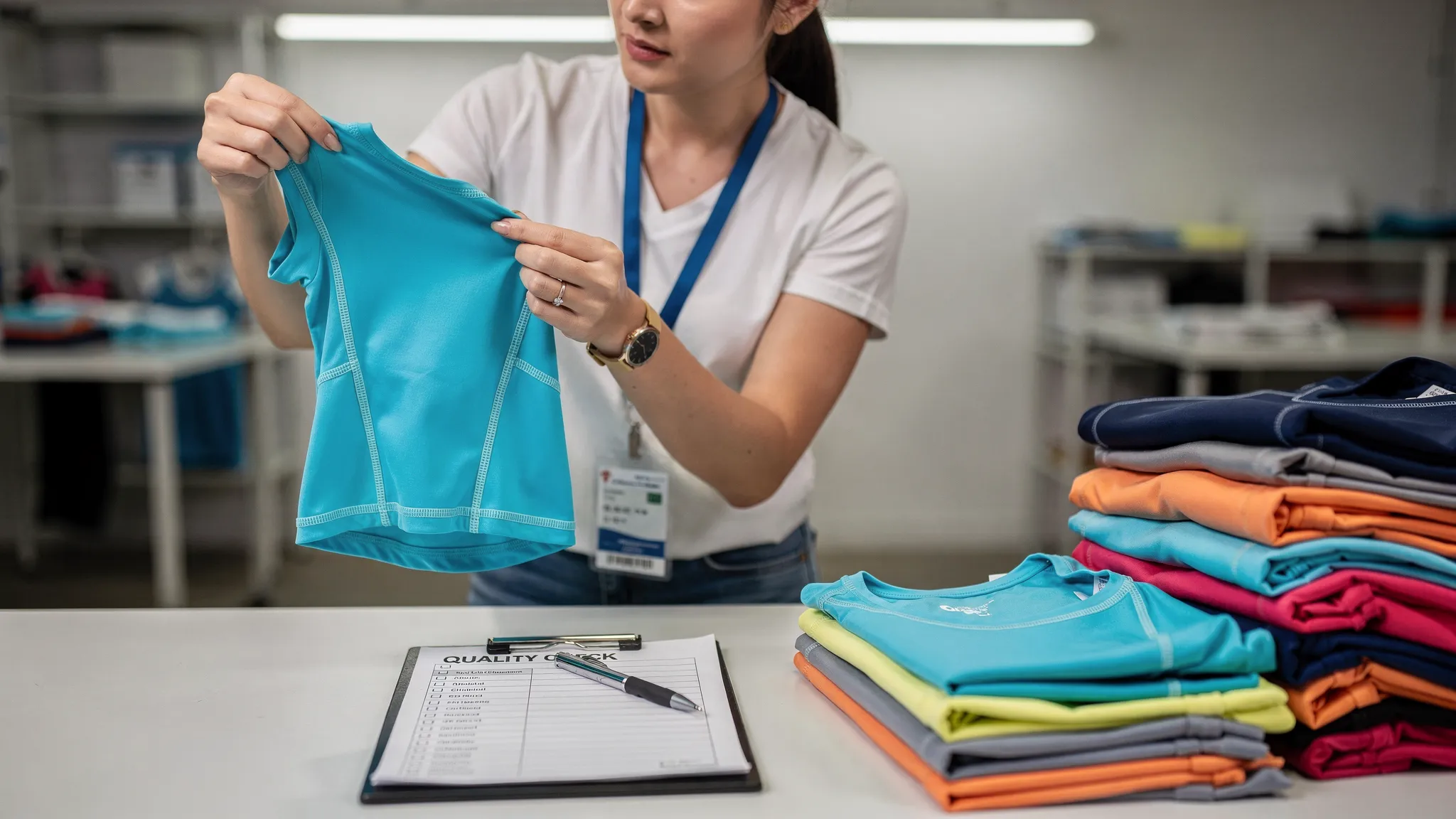
Arcus highlights in-house production management and quality control at every stage. For brands, that translates into fewer surprises, because quality is checked as the product is built, not only after it is finished.
A strong production management approach typically includes:
- Clear approvals for pre-production samples
- Defined measurement tolerances and construction standards
- Checkpoints for cutting, sewing, and finishing
- Documentation of changes so repeats match prior runs

6) International manufacturing options with flexible scaling
Many brands eventually need options, not just a single factory path.
Arcus offers international manufacturing options and flexible scaling solutions, which can help when you are balancing:
- Unit economics at higher volumes
- Lead times and capacity constraints
- Material availability by region
The key is keeping your specifications, patterns, and quality expectations consistent as you scale. A full-service partner can help maintain that continuity so you do not “start over” when you grow.
7) Dye sublimation printing for performance and all-over designs
If your product relies on vibrant, permanent prints (common in sportswear and swimwear), sublimation can be a strong fit because the ink becomes part of the fabric rather than sitting on top.
Arcus offers dye sublimation printing, and the company also provides a deeper explainer in its benefits of sublimation for apparel article, including where sublimation shines and where it is not the best method.
What the Arcus end-to-end process can look like (from idea to production)
Every brand’s workflow is different, but full-service partnerships generally follow a similar path. Here is a high-level map of how Arcus’s capabilities align to key milestones.
| Stage | Your goal | How a full-service partner helps (Arcus capabilities) |
|---|---|---|
| Concept and planning | Define the product and target customer | Product development guidance, manufacturability alignment |
| Design documentation | Create specs a factory can execute | Tech pack support, pattern planning, construction details |
| Sourcing | Choose fabrics and trims that perform | Material sourcing coordination |
| Fit and sampling | Validate fit, function, and finishes | Pattern development, sampling cycles |
| Production launch | Manufacture with repeatable standards | Small batch manufacturing, in-house production management |
| Branding and finish | Deliver a sellable, consistent product | Labels and packaging coordination (as part of production flow) |
| Scale and repeat | Reorder without quality drift | Flexible scaling, international manufacturing options, QC discipline |
A practical advantage: fewer handoffs means fewer expensive mistakes
In apparel, delays and defects often come from small gaps:
- The fabric approved for sampling is not the fabric used in bulk.
- A pattern change is made, but the spec sheet is not updated.
- A print file is scaled incorrectly, so placement shifts by size.
- A sewing line uses a different stitch type because the construction notes were unclear.
A full-service partner reduces those gaps by keeping development and production connected. It is not just faster, it is more controlled.
Compliance, labeling, and consistency (the unglamorous part that protects your brand)
If you sell in the United States, labeling is not optional. The FTC enforces requirements around fiber content, country of origin, and manufacturer or dealer identification under the Textile Fiber Products Identification Act and the Care Labeling Rule.
A manufacturing partner cannot replace legal counsel, but a strong full-service team can help make sure labeling and packaging are integrated into production planning, rather than treated as an afterthought right before shipping.
Who Arcus Apparel Group is a strong fit for
Arcus is typically a fit when you value coordination and quality control as much as sewing capacity.
That includes:
- Startups launching with small runs who need guidance and low minimum order quantities
- Growing DTC brands that need repeatable fit and consistent reorders
- Performance categories that depend on material behavior (activewear, swimwear, underwear)
- Brands that want access to both small-batch and scalable production paths
- Teams developing print-heavy products where dye sublimation is relevant
If you are still comparing options, Arcus also has helpful context pieces on topics like how to find a clothing manufacturer and broader evaluation criteria for clothing manufacturers.
Choosing a full-service partner: what to ask before you commit
Even when a company offers end-to-end services, your experience depends on process clarity. Before you begin sampling, ask:
- Who owns the production timeline and communicates updates?
- How are pattern and spec changes documented and approved?
- Where are quality checks performed, and what happens when issues are found?
- Can the same patterns and standards be maintained as you scale?
- How does sourcing work for fabrics and trims, and what are typical lead times?
A full-service partnership should feel like shared execution, not a black box.
Next step: build with a partner, not a patchwork of vendors
If you want a manufacturing relationship that can support both launch and growth, Arcus Apparel Group is positioned as a full-service custom clothing manufacturer with the capabilities brands usually have to piece together: custom apparel development, material sourcing, pattern development, small batch manufacturing with low minimums, dye sublimation printing, international manufacturing options, and quality control throughout the process.
To explore whether Arcus is the right fit for your next collection, visit the Arcus Apparel Group homepage and start a conversation about your product, timeline, and production goals.



