
If you are planning your first production run or auditing a current supplier, knowing what actually happens inside a clothing factory is the fastest way to avoid delays, quality failures, and surprise charges. This guide walks through the factory workflow step by step, explains the standards top plants follow, and breaks down how costs are built so you can quote, negotiate, and scale with confidence.
The clothing factory workflow, from brief to delivery
- Product brief and tech pack: Your factory relies on a clear brief plus a complete tech pack, the blueprint that specifies construction, measurements, tolerances, BOM, artwork placement, labels, and packaging. If you are new to this, start with this primer on what a tech pack is.
- Material sourcing and development: Fabrics, trims, and components are identified, then lab dips, strike offs, and hand looms are approved. For performance lines, mills may provide test reports such as colorfastness and pilling.
- Pattern making and grading: Blocks are created or adapted, then graded across the size range. Digital patterns allow efficient markers that improve fabric yield.
- Sampling and fit: Prototype, fit, and size set samples validate construction and grading. A pre production sample is made on the production line to validate workmanship before bulk.
- Costing and capacity booking: The factory calculates consumption, labor minutes, and overhead, then holds a production window when you approve the quote and place a deposit.
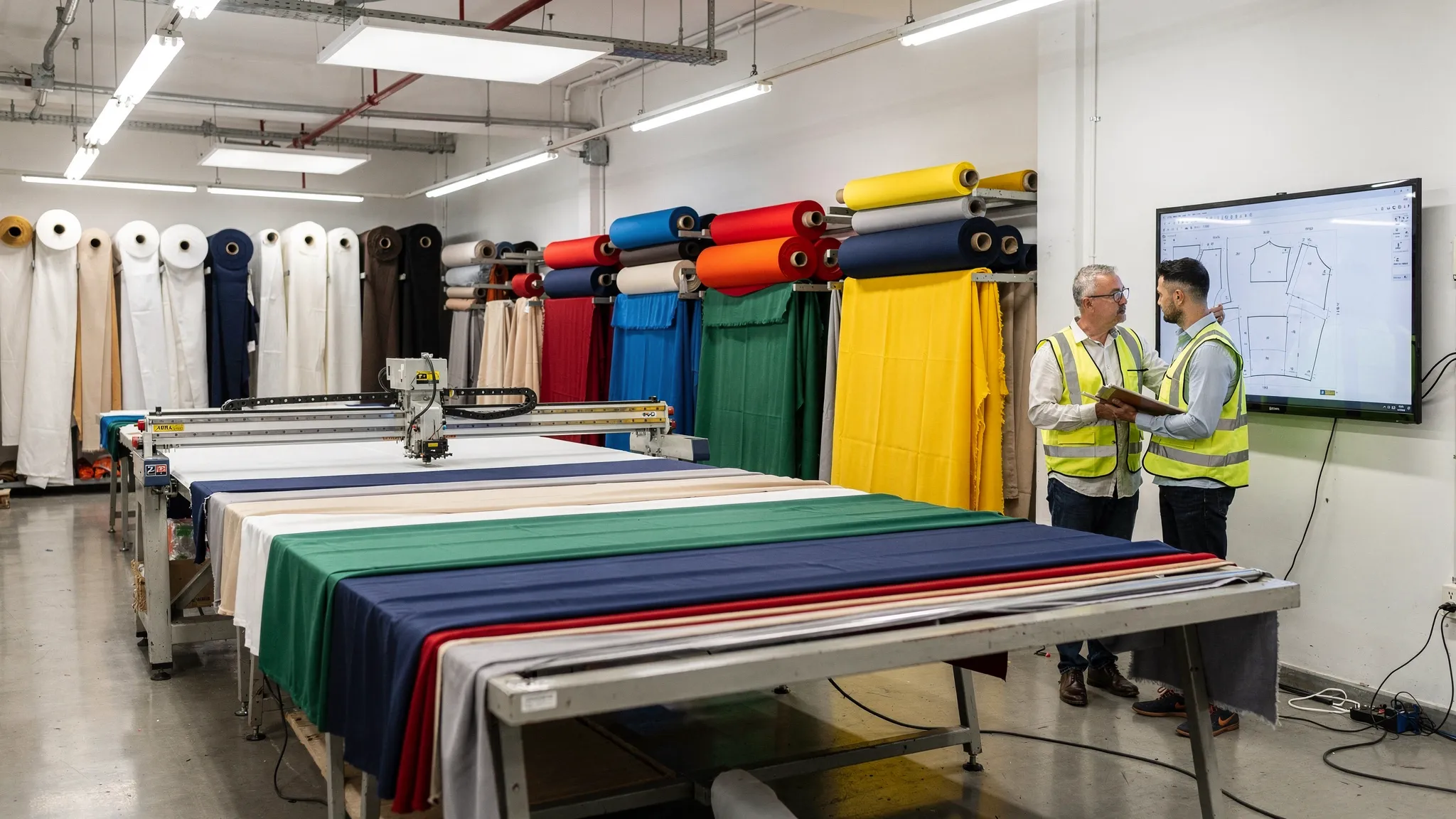
- Marker making and cut planning: Optimized markers minimize waste. Shade grouping ensures panels from the same roll are cut together for consistent color.
- Cutting and bundling: Fabric is relaxed, spread, cut, and bundled by size and operation sequence, then ticketed to maintain traceability.
- Sewing line setup: Machines are tooled, attachments installed, and a line is balanced to reach the target pieces per hour. Inline quality checkpoints begin here.
- Embellishment: Screen print, embroidery, heat transfer, or dye sublimation are applied per the tech pack. If you are exploring all over prints on polyester-rich fabrics, see the benefits of sublimation for apparel.
- Finishing and quality control: Threads are trimmed, garments are pressed or steamed, measurements are checked against tolerances, and defects are repaired. End line AQL inspection is performed before packing.
- Packing and shipment: Labels and care instructions are applied, pieces are poly bagged or eco packed, cartons are sealed and barcoded, then shipped under EXW, FOB, or DDP terms as contracted.
Standards great clothing factories follow
High performing factories do not just sew well, they operate to documented standards that protect your schedule, your customers, and your brand.
Quality systems you can verify
- Document control and ISO style processes: Many leading plants align to frameworks like ISO 9001 quality management, even if they are not certified. Ask for SOPs covering cutting, in process inspections, and final audits.
- AQL based inspections: Final inspections typically follow AQL per ISO 2859 or ANSI Z1.4. You choose the inspection level and allowable defect rates in your PO or quality agreement.
- Performance metrics: Factories should track and share DHU, first pass yield, right first time, and rework rates. Trend lines matter more than one off numbers.
Social compliance and worker safety
Ask about third party audits such as WRAP, SA8000, or amfori BSCI. Verify wage compliance, overtime policies, and building safety. Needle policies, machine guarding, and broken needle logs are standard in cut and sew operations.
Chemical and material safety
For skin contact goods, require compliant inputs. Certifications like OEKO TEX Standard 100 and GOTS for organic programs are common. If you run wet processing, confirm ZDHC MRSL alignment, wastewater testing, and sludge disposal records.
Traceability and data integrity
From roll to carton, garments should be traceable. Work travelers, barcoded bundles, and ERP or PLM records reduce mix ups, help manage recalls, and speed root cause analysis when issues occur.
Operational reliability and transparent communication are not unique to apparel. Many brands benchmark responsiveness against other trades that publish clear lead times and pricing, for example, residential garage door specialists that advertise same day service and free estimates. Expect similar clarity from your clothing factory around sampling queues, capacity, and change order impacts.
What it really costs to make a garment
Two common pricing models are used:
- CMT, you supply fabric and trims, the factory charges for cut, make, and trim only.
- FOB, the factory sources materials and delivers finished goods ready to ship from port or factory gate.
A simplified FOB equation looks like this:
FOB unit price equals fabric consumption times fabric cost plus trims, labels, and packaging plus CMT labor plus overhead and admin plus testing and compliance plus margin.
The largest levers are fabric consumption and labor minutes. Here is how the typical components stack up by influence. Ranges vary by category and region.
| Cost component | What it includes | Biggest drivers | Typical share of FOB |
|---|---|---|---|
| Fabric | Shell, linings, interlinings, wastage allowance | Fiber type, gsm, knit vs woven, dye or print method, yield | Often the largest single portion, frequently more than half |
| Trims and packaging | Threads, elastic, zippers, snaps, labels, poly or recyclable bags, cartons | Quality grade, sourcing region, MOQs, branding complexity | Small to moderate |
| CMT labor | Sewing, line setup, in process QC, finishing | Standard allowed minutes, line efficiency, seam count, operator skill and wage rates | Moderate to high depending on product |
| Overhead and admin | Cutting room, utilities, depreciation, planning, maintenance | Factory scale, automation level, country costs | Small to moderate |
| Testing and compliance | Lab tests, audits, certifications, inspection fees | Brand requirements, markets sold, fabric category | Small |
| Freight to FOB point | Inland transport to port or handoff point | Distance, fuel, cartonization, cube efficiency | Small |
How factories calculate labor
Factories estimate labor using SAM, standard allowed minutes, multiplied by the labor rate and adjusted for line efficiency. A jacket with complex seam construction, pockets, and topstitching may run two to three times the SAM of a simple tee. Attachments and better line balancing reduce SAM and rework, which lowers cost and raises capacity.
Cost engineering without hurting quality
- Optimize yield, tighten markers, align graphics to reduce reject rates.
- Reduce seam count and operations where possible, for example, replace a panel seam with a dart, consolidate labels, standardize trims across styles.
- Choose prints and decorations that fit the fabric and run length. For all over polyester prints, sublimation can be cost effective on small and mid runs due to lower setup compared to rotary screens.
- Confirm tolerances are realistic. Overly tight specs increase rejects and price.
If you are piloting a line, small batch production allows you to learn quickly. Unit costs are higher at low quantities because set up and sourcing MOQs are spread across fewer pieces. This is normal and can be planned for. Read the beginner’s guide to small batch manufacturers to see how brands navigate this phase.
Lead times and MOQs to expect
- Development and sampling: two to eight weeks, depending on how complete your tech pack is and whether fabrics are custom.
- Bulk production: four to twelve weeks once all inputs are in house and PP samples are approved. Add time for fabric knitting, dyeing, or printing, and for peak season capacity.
- Logistics: domestic trucking is usually days to a week, ocean freight commonly four to six weeks port to port depending on trade lane, air freight typically three to seven days door to door.
MOQs vary by factory and process. Knits and cut and sew programs may start in the low hundreds per color, per style, while custom dyed or woven fabrics often carry higher MOQs. If you need low MOQs with professional controls, a full service shop that offers small batch manufacturing, like Arcus Apparel Group, can help you stage growth without overbuying.

How to evaluate a clothing factory before you commit
- Ask for a process map and production calendar showing critical path steps, including fabric in house date and PP approval.
- Request quality metrics for the last three months, DHU, first pass yield, and rework rate, plus an example AQL report.
- Review sample quality. Insist on a PP sample made on the production line with production fabrics and trims.
- Confirm compliance. Ask for recent social audits, chemical compliance declarations, and a list of third party lab tests they support.
- Check communication. You want a single point of contact, clear email summaries of decisions, and fast acknowledgement of changes.
- Start with a pilot PO. Prove fit, shrinkage, colorfastness, packaging, and carton specs at a manageable quantity before you scale.
For a full checklist of selection criteria, see this deep dive on how to choose clothing manufacturers and this guide on how to find a clothing manufacturer.
Sample types you will approve along the way
| Sample type | Purpose | When it occurs |
|---|---|---|
| Prototype | Proves basic construction and style intent using available materials | Early, before costing |
| Fit sample | Confirms measurements, grading, and comfort on body | After initial pattern and grading |
| Size set | Verifies each size against the graded spec | Before PP sample |
| Pre production, PP | Golden sample made on the production line with production materials | Before bulk cut is authorized |
| Top of production, TOP | Confirms bulk matches the PP sample and approved standards | Early in bulk run |
Frequently asked questions
What is the most common reason clothing factory schedules slip? Late fabric or trim arrivals, not sewing. Lock down approvals early and set realistic in house dates for all inputs.
How do AQL levels translate into acceptable quality? AQL is a statistical sampling plan. You select the AQL level and sample size, then the number of allowable defects is calculated. Lower AQL numbers mean tighter quality acceptance.
What is the difference between CMT and FOB pricing? CMT means the factory charges only for labor and finishing while you supply all materials. FOB includes materials, labor, and overhead, and the factory delivers finished goods ready to ship from a defined handoff point.
How can I reduce my unit cost without hurting perceived quality? Improve fabric yield, simplify construction, standardize trims, and align decoration methods to the fabric and order size. Validate with a PP sample to ensure aesthetic standards are kept.
Is domestic manufacturing always more expensive? Not always. When you factor speed, lower MOQs, reduced freight and duty exposure, and better quality control, domestic can be competitive. Learn more in this overview of reasons to manufacture in the USA.
Bring your concept to life with a full service partner
Arcus Apparel Group is a one stop shop for apparel development and manufacturing. We handle design support, material sourcing, pattern development, small batch runs with low MOQs, and scale up across domestic and international facilities, with in house production management and quality control at every stage. If you are ready to quote a new style or want to stabilize an existing program, visit Arcus Apparel Group to start a conversation.



