
If you are building or scaling a clothing brand in 2026, the biggest advantage you can create is not “predicting the future.” It is building a product and production system that can respond faster than your competitors when demand, costs, or consumer preferences shift.
The apparel market is being reshaped by three forces happening at the same time:
- More volatile demand (micro-trends, shorter product life cycles, and social commerce).
- More complex compliance expectations (from fiber claims to traceability and durability).
- More pressure on margins (labor, freight, tariffs, and returns).
Below are the key apparel market trends for 2026, plus concrete moves brands can make now to turn those trends into product decisions, sourcing decisions, and manufacturing advantages.
The apparel market in 2026 (what’s different this cycle)
In prior years, many brands could “win” with a strong aesthetic and a decent supply chain. In 2026, the winners tend to have tighter operational fundamentals: cleaner product specs, faster sampling, more flexible minimums, and fewer surprises after bulk production starts.
Industry reports continue to highlight uncertainty around consumer spending and input costs, along with increased focus on supply chain resilience and sustainability proof. If you want a high-level pulse on macro themes, start with McKinsey’s State of Fashion and The Business of Fashion coverage of sourcing and retail dynamics.
That context matters because most 2026 “trends” are not just style trends. They are operating model trends.
8 apparel market trends in 2026 (and how to act on them)
1) Small-batch, fast replenishment is becoming the default, not the exception
Shorter trend cycles and more fragmented channels (TikTok Shop, Instagram, marketplaces, brand sites, pop-ups) are pushing brands toward tighter first buys and faster reorders. The operational play is to reduce risk up front, then scale what sells.
Act on it now
- Build a launch plan around smaller initial quantities, then design replenishment triggers (sell-through thresholds, waitlists, or preorders).
- Engineer your product line so the “core body” can repeat, while colors, trims, or prints change quickly.
- Make sure your vendor can handle both development (patterns, samples) and scaled production without rework.
If you are still learning how small-batch production works (and the trade-offs), Arcus has a practical primer here: Beginner’s Guide to Small Batch Production Clothing Manufacturers.
2) “Fewer, better products” is replacing endless SKU expansion
Many brands are rationalizing SKUs because inventory carrying costs and returns can quietly kill margins. At the same time, consumers are increasingly responsive to quality cues (fabric hand-feel, fit consistency, and durability).
This does not mean boring collections. It means your assortment strategy is more intentional: fewer SKUs that are easier to reorder, easier to QC, and easier to explain.
Act on it now
- Identify 1 to 3 hero products that you can improve and iterate (fit, fabric, stitching, and finishing).
- Reduce option complexity in your first production runs (limit excessive colorways, custom trims, and unique fabrics per style).
- Invest in fit and specs so every subsequent run is consistent.
This is where solid documentation becomes a growth lever. A strong tech pack reduces back-and-forth and protects fit consistency across production runs. If you want a refresher, see: What is a tech pack?
3) Traceability and “proof-based sustainability” are accelerating
The market is moving away from vague sustainability claims and toward evidence, traceability, and product-level documentation. Regulation is one reason, but consumer trust is another.
Even if you do not market your brand as “sustainable,” your wholesale partners, customers, or future investors may eventually ask for supporting documentation: fiber content, country of origin, mill details, and care and durability expectations.
Act on it now
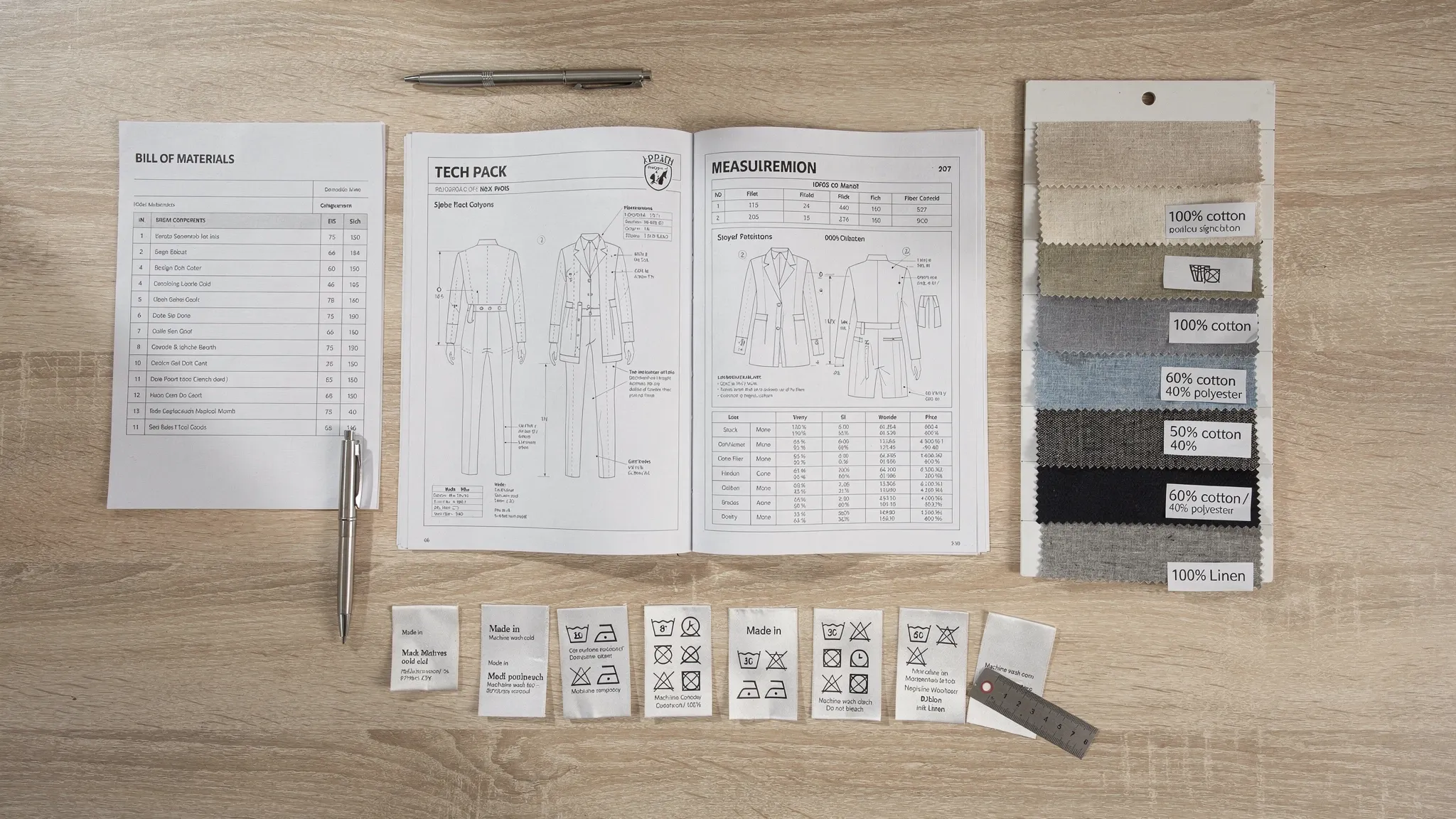
- Keep a clean bill of materials (BOM) and maintain records of fabric composition and supplier details.
- Avoid marketing claims you cannot substantiate (especially “eco,” “green,” “non-toxic,” “carbon neutral”).
- Build a simple compliance folder for each style: tech pack, test results if applicable, labeling details, and supplier documentation.
If you want to pressure-test your marketing language, this guide is a useful checklist: 11 Signs You’re Dealing with a Greenwashed Company.
4) Nearshoring, dual-sourcing, and “risk budgeting” are becoming normal
Sourcing decisions in 2026 are not only about cost per unit. Brands are building resiliency against lead time shocks (port delays, raw material shortages), trade policy shifts, and demand swings.
That is pushing more brands to consider a blended model:
- A closer-to-market option for speed, sampling, and smaller runs.
- An international option for scale and cost engineering when demand is proven.
Act on it now
- Decide what you are optimizing for by product (speed, margin, flexibility, or complexity).
- Build at least one backup option for fabrics or trims that are likely to go out of stock.
- Treat production capacity like a portfolio, not a single bet.
Arcus covers the domestic manufacturing rationale here: Reasons to Manufacture in the USA.
5) Performance and “everyday technical” apparel keeps expanding
The line between activewear, workwear, and everyday basics is still blurring. Consumers want comfort, stretch, and easy care, but they also want the product to look good in real life.
This trend shows up in fabric choices (stretch wovens, performance knits, compression blends), construction details (flatlock, bonded seams where appropriate), and fit expectations (supportive but not restrictive).
Act on it now
- Audit your fabric library for performance, recovery, opacity, and pilling risk.
- Treat fit as a product feature, not a last step.
- Use print and decoration methods that hold up (wash durability matters in performance categories).
If your line depends on all-over prints or high-durability color, dye sublimation can be a strong fit for specific product types (especially polyester-based). See: Benefits of Sublimation for Apparel.
6) Digital product development is reducing sampling cycles (for brands that implement it correctly)
3D tools and digital workflows can speed up iteration, but the main 2026 advantage is not the software itself. The advantage is fewer decision loops.
Brands that win with digital development typically:
- Standardize measurement specs.
- Use repeatable blocks and graded patterns.
- Align early on construction and finish standards.
Act on it now
- Build a “spec standard” doc for your brand (tolerances, stitch types, seam allowances, label placement standards).
- Create a base block per category (tee, hoodie, legging, bra, swim top) to reduce future development cost.
- Ask your manufacturer how they handle pattern development, revisions, and fit feedback.
7) Branding is shifting from loud logos to craftsmanship cues
In a crowded apparel market, consumers often use proxy signals to judge quality:
- Fabric hand-feel and weight
- Stitching and seam finishing
- Hardware and trims
- Packaging and labeling clarity
This pushes brands to invest in details that are invisible on a product page but obvious when the garment arrives.
Act on it now
- Review your garment at “unboxing distance,” then at “closet distance,” then up close (seams, labels, hem finishes).
- Standardize labeling and packaging so it feels consistent across SKUs.
- Make sure decoration methods match the category (for example, performance garments may need decoration that stretches and resists cracking).
8) The “manufacturing partner” decision matters more than ever
When the apparel market is volatile, execution risk rises. Miscommunication, unclear specs, late raw materials, and inconsistent QC are the hidden costs that drain time and cash.
In 2026, brands increasingly prefer partners that can manage more of the process end-to-end: development, sourcing, pattern work, sampling, and production management.
Act on it now
- Choose partners based on process strength, not just price.
- Validate their QC checkpoints (not just final inspection).
- Confirm they can support your growth path, from small runs to scaling.
If you want a structured way to evaluate options, Arcus has a thorough guide here: How to Choose the Best Clothing Manufacturers for Your Brand.
Quick decision table: Trend to action in the apparel market (2026)
Use this as a practical planning tool for your next collection cycle.
| Apparel market trend (2026) | What it changes for brands | Action you can take this month | Manufacturing implication |
|---|---|---|---|
| Small-batch, faster replenishment | Less forecasting, more iteration | Launch with lower initial buys, define reorder triggers | Need low MOQs and reliable repeatability |
| SKU rationalization | Fewer styles, higher standards | Pick hero products, reduce option complexity | Better spec discipline, fewer mistakes |
| Proof-based sustainability | Claims require evidence | Build BOM folders, document suppliers | Traceability and labeling accuracy matter |
| Dual-sourcing and nearshoring | Risk is part of cost | Identify backup fabrics and vendors | Flexible capacity and lead times win |
| Performance everyday wear | Comfort and durability expectations rise | Test fabrics for recovery, pilling, opacity | Construction and QC standards must tighten |
| Digital development workflows | Faster iterations, fewer samples | Build base blocks and spec standards | Pattern and fit feedback loops shorten |
| Craft cues over loud branding | Details drive perceived value | Upgrade trims, labels, finishing | Finishing consistency becomes a differentiator |
| End-to-end partner preference | Execution is the advantage | Choose process strength over cheapest quote | Better production management, less rework |
A 90-day plan brands can use to act on 2026 trends
If you want to translate “market trends” into execution, focus on three sprints.
Sprint 1 (Weeks 1 to 3): Build your product foundation
Lock the standards that make future launches easier.
- Define your size chart and fit intent per category.
- Create a tech pack template that your team will follow every time.
- Select a fabric direction per hero product (and one backup).
Sprint 2 (Weeks 4 to 8): Validate with samples and real feedback
- Fit test on real bodies that match your target customer.
- Stress-test wash durability (shrink, pilling, colorfastness).
- Verify decoration placement and stretch performance.
Sprint 3 (Weeks 9 to 12): Set up repeatable production
- Confirm QC checkpoints (inline checks, measurement audits, final inspection criteria).
- Plan a small first run and define what triggers the reorder.
- Put documentation in place so reorders do not become “re-development.”
Where Arcus Apparel Group fits (without forcing you into one production model)
Arcus Apparel Group supports brands that want to launch or scale with an end-to-end approach, including custom apparel development, material sourcing, pattern development, small batch manufacturing, low minimum order quantities, in-house production management, international manufacturing options, dye sublimation printing, and quality control at every stage.
If your goal for 2026 is to move faster with fewer costly mistakes, a good next step is to align on:
- Your hero product and target price point
- Your expected quantities for the first run
- Your sourcing and timeline constraints
- The level of customization (cut-and-sew vs. white label vs. private label)
You can also explore these related resources depending on where you are in the process:
- Development documentation: What is a tech pack?
- Production strategy: Beginner’s Guide to Small Batch Production Clothing Manufacturers
- Printing method fit: Benefits of Sublimation for Apparel

The takeaway: win in the apparel market by designing for flexibility
The apparel market in 2026 rewards brands that treat product development and manufacturing as a competitive advantage. Styles matter, but the brands that compound gains are the ones that:
- Start small, then scale what sells.
- Document product specs so quality is repeatable.
- Build sourcing resilience before a disruption forces it.
- Choose partners who can manage development and production with strong process control.
If you want help turning your 2026 product plan into a sampling and production roadmap, you can learn more about Arcus Apparel Group at arcusag.com.



