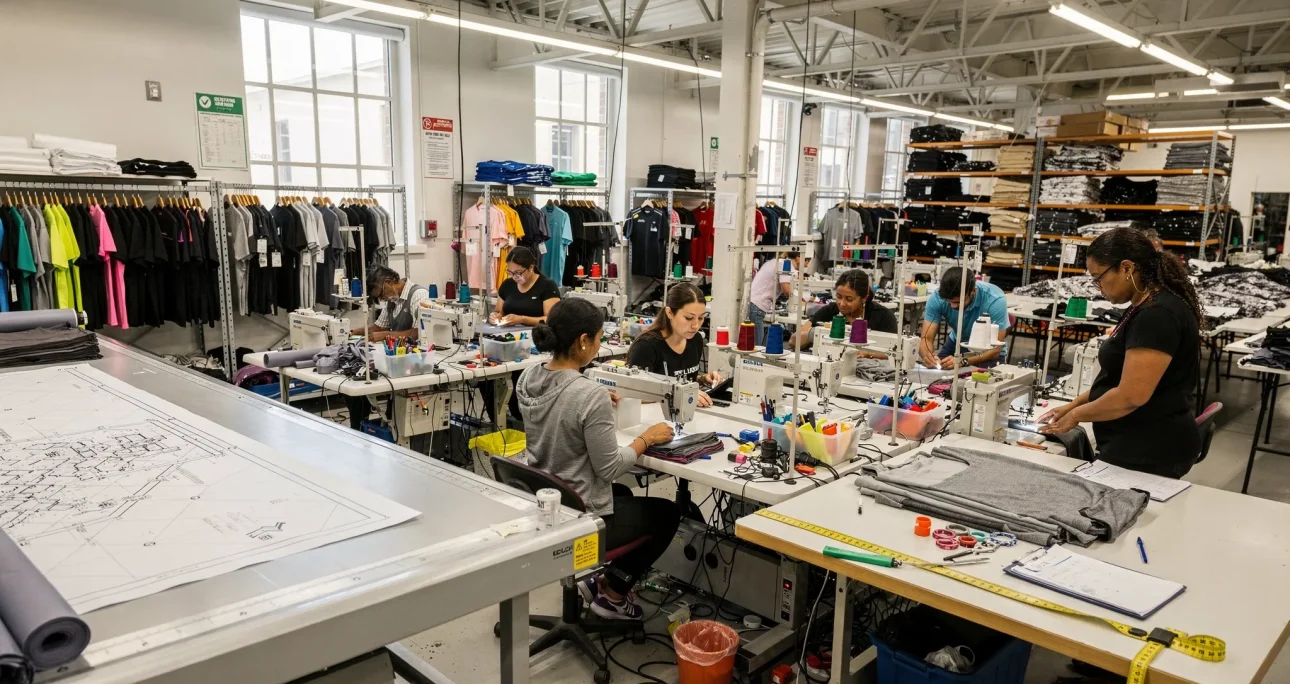
Choosing apparel manufacturers in the USA involves tradeoffs that look very different at launch, at first scale, and at national rollouts. If you are weighing domestic versus overseas production, this guide clarifies the real pros, cons, and costs in 2026, plus when a hybrid approach delivers the best total landed cost and lowest risk.
What “U.S. apparel manufacturing” usually means
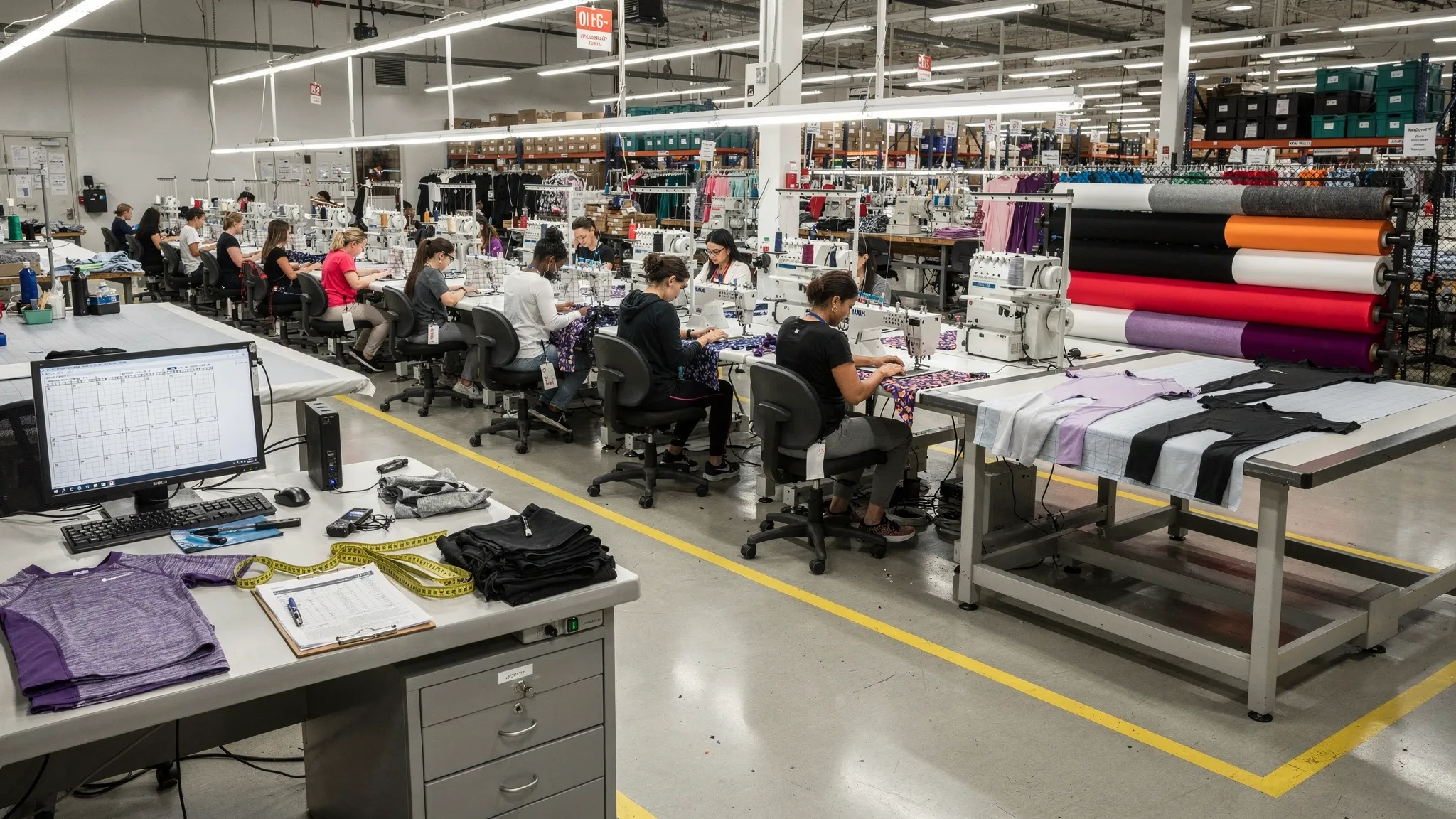
U.S. options range from boutique sample studios and small batch cut and sew shops to vertically capable contract manufacturers that handle development, sourcing, pattern work, and production. Many specialize by category. Common specializations include performance knits and activewear, intimates and underwear, sublimated teamwear and uniforms, denim, outerwear, and swimwear. Some facilities are fully domestic, others run hybrid workflows with domestic development and overseas bulk. Understanding the match between your product and a factory’s core processes is step one.
The case for U.S. manufacturers
- Speed and agility, development and small batch production can run in weeks, not months. Domestic freight is measured in days, not ocean cycles.
- Lower minimums, many U.S. shops support 50 to 200 units per color or style. This reduces inventory risk and lets you iterate.
- Quality control and communication, same language, time zone, and easier onsite visits. Miscommunication drops, first pass yield improves.
- IP protection and compliance, stronger protections and clearer standards. Sensitive categories like childrenswear and uniforms benefit.
- Total landed cost advantage for fast movers, you avoid duties, long cash conversion cycles, and the cost of holding excess inventory.
- Brand value, Made in USA can justify premium pricing in certain segments and channels.
- Sustainability and traceability, shorter supply chains, better documentation, and often higher labor standards.
For a deeper dive on advantages, see Arcus Apparel Group’s perspective in Reasons to Manufacture in the USA at arcusag.com/reasons-to-manufacture-in-the-usa.
Where U.S. manufacturing can fall short
- Higher per unit cut and make cost, labor and overhead are higher in the U.S., especially for labor intensive garments.
- Material constraints, many specialty fabrics and trims are imported, which can add lead time and cost.
- Capacity for very large runs, some factories top out at mid scale production.
- Price sensitive basics, commodity tees or fleece at big box price points are hard to hit domestically.
- Narrower finishing menu in some regions, specialized washes or coatings may be concentrated in a few hubs.
What it costs to make apparel in the USA in 2026
There is no single price per unit. Costs are driven by your bill of materials, standard minutes to sew, decoration steps, and batch size. The framework below helps you estimate and compare.
The cost framework
- Materials and trims: fabric, findings, labels, elastic, zippers, and packaging.
- Cut and make (CM): labor to cut, sew, and finish. A practical approach is Unit labor cost equals standard minutes to sew multiplied by the factory’s loaded hourly rate divided by 60. Loaded rate includes wages, benefits, and factory overhead.
- Decoration: screen print, embroidery, heat transfer, DTG, or dye sublimation.
- Preproduction: tech pack creation, digital patterning, grading, and prototypes.
- Quality and compliance: inspections and any required testing.
- Freight and logistics: inbound materials and outbound finished goods.
- Waste and overage: cutting yield and allowance for defects.
Typical domestic ranges, small to mid-size runs
These ballparks reflect common quotes for U.S. small batch to mid-size orders. Complexity, fabric type, and construction can move you outside these ranges.
| Cost component | Typical U.S. range | What changes the number |
|---|---|---|
| Digital pattern development, per style | 200 to 600 USD | Garment complexity, revisions needed |
| Grading, per size | 8 to 15 USD | Size run breadth, nested vs separate blocks |
| Prototype sample, per unit | 100 to 400 USD | Fabric, trims, difficulty, rush needs |
| Cut and make, basic tee | 3 to 9 USD | SMV, neck finish, hem type, sewing line efficiency |
| Cut and make, leggings or joggers | 8 to 26 USD | Panels, pockets, flatlock, gussets |
| Cut and make, hoodie or jacket | 18 to 65 USD | Zippers, lining, hardware, interlining |
| Screen print, per location | 1.50 to 6 USD | Colors, placement, flash cures, volume |
| Embroidery, per logo | 0.50 to 10 USD | Stitch count, backing, placement |
| Dye sublimation, full panel | Varies by coverage | Print area, color density, press size |
| Domestic ground freight | Low per unit at scale | Zone, parcel vs LTL, packaging |
Dye sublimation is a strong use case for domestic production, especially for teamwear, uniforms, and swim. For a technical primer, read Benefits of Sublimation for Apparel at arcusag.com/benefits-of-sublimation-for-apparel.
Lead times at a glance
| Phase | U.S. manufacturers | Overseas manufacturers |
|---|---|---|
| Development and sampling | 2 to 6 weeks | 4 to 12 weeks |
| Production, small to mid batch | 2 to 8 weeks | 6 to 16 weeks |
| Freight to U.S. DC | 2 to 7 days ground | 20 to 40 days ocean, faster by air |
| Typical MOQs | 50 to 200 units per style or color | 300 to over 1000 units per style or color |
| Duties to U.S. | Not applicable on domestic production | Many apparel categories carry meaningful duty rates |
Ramps and holiday calendars still matter, so confirm a factory’s exact schedule and cut off dates before you lock in launch timelines.
Hidden costs you avoid or incur
- Duties and brokerage, domestic production avoids import tariffs. Imported apparel often carries some of the highest duty rates in the U.S. tariff schedule.
- Inventory carrying costs, lower MOQs reduce holding costs and markdown exposure.
- Cash conversion cycle, domestic cycles are shorter, which preserves working capital.
- Rework and return risk, better communication and in person reviews reduce costly errors.
- Shipping volatility, domestic freight is more predictable than ocean capacity and fuel surcharges.
- Testing and compliance, for childrenswear, uniforms, and certain performance claims, domestic workflows ease lab coordination and documentation.
When USA manufacturing is the right strategic choice
- You need speed, for capsule drops, influencer activations, fast replenishment, or tight seasonal windows.
- You are validating fit and demand, early drops in the 50 to 300 unit range reduce risk and yield stronger data.
- You sell at premium price points, quality, Made in USA positioning, and fast repeat buys support margins.
- You run complex customization, sublimated uniforms, variable data numbers and names, or short cycle teamwear.
- You serve regulated or high trust segments, childrenswear, flame resistant, or institutional uniforms that demand tight QA.
If you are new to small batch manufacturing, the Beginners Guide to Small Batch Production Clothing Manufacturers at arcusag.com/beginners-guide-to-small-batch-clothing-manufacturers outlines how to plan MOQs, timelines, and vendor conversations.
A quick note on technology, payments, and compliance
Your manufacturing choice should sync with your commercial stack. Real time demand signals, fraud controls, multi currency checkouts, and data visibility directly shape the right production model. While the example below is from a different vertical, it shows what a modular, compliance ready platform looks like in practice. Teams evaluating their own commerce stack can learn from the approach taken by a modular, compliance-ready platform, which integrates payments, KYC and AML, analytics, and flexible APIs to speed launches and reduce operational risk.
How to choose a U.S. manufacturer, a practical checklist
- Match their specialty to your product, a factory that lives in activewear, intimates, or uniforms will deliver faster learning and better first pass yield.
- Ask for an SMV based estimate, understanding minutes to sew anchors realistic pricing and capacity planning.
- Confirm MOQs, change fees, and overage policies, so you plan size curves and colorways correctly.
- Review a preproduction plan, tech pack requirements, pattern ownership, sample rounds, and fit sessions. If you need a tech pack, start here, What is a tech pack at arcusag.com/what-is-a-tech-pack.
- Inspect quality controls, incoming material checks, inline inspections, and final AQL standards.
- Verify material sourcing options, local mills and import partners for your fabric class.
- Pilot a small batch, validate fit, shrinkage, colorfastness, and throughput before scaling.
For broader vendor selection strategy, see How to Choose the Best Clothing Manufacturers for Your Brand at arcusag.com/full-page-slider/clothing-manufacturers.
Budgeting your unit cost, a simple worksheet you can reuse
- List every BOM item per unit and include expected waste, then subtotal materials and trims.
- Estimate CM as minutes to sew multiplied by the factory’s loaded hourly rate divided by 60, add cutting and finishing allowances.
- Add decoration costs by method and location, embroidery by stitch count, screen print by colors and strokes.
- Include preproduction amortized per unit, pattern, grading, prototype, and any fit rounds.
- Add QA and any testing, AQL inspection, lab tests for specific claims.
- Add domestic freight and packaging.
- Sum to COGS, then apply your target gross margin to set wholesale and retail.
Domestic, overseas, or hybrid
Many brands settle on a hybrid approach. They develop and launch domestically to meet speed, fit, and quality goals. Once demand is proven and specs are locked, they move stable styles to overseas partners for larger runs, while keeping fast turn capsules and customization in the U.S. This approach balances unit cost with risk and cash flow.
Arcus Apparel Group supports this exact path. We provide full service custom apparel development and production with:
- Custom apparel development
- Material sourcing
- Pattern development
- Small batch manufacturing
- Low minimum order quantities
- In house production management
- International manufacturing options
- Dye sublimation printing
- Flexible scaling solutions
- Quality control at every stage
If you want help mapping your next collection to the right mix of domestic and international production, our team can align design, sourcing, timelines, and budget to your goals.
Key takeaways
- U.S. apparel manufacturing delivers speed, control, and lower risk, especially for smaller runs and higher value categories.
- Unit costs are higher, so use an SMV based model and a complete BOM to budget accurately.
- Include hidden costs in your comparison, duties, cash cycle, freight volatility, and markdown risk often flip the math.
- Consider a hybrid model once you validate demand and lock fit, it is often the best balance between agility and scale.
Ready to scope your next run or build a blended plan that fits your growth stage, reach out to Arcus Apparel Group to get started.



