
Viscose is everywhere, from drapey summer dresses to silky linings and soft loungewear. It’s often described as “plant-based,” but it’s not as simple as harvesting a fiber and spinning it like cotton or linen. Viscose is a regenerated cellulose fiber, meaning it starts as natural cellulose (usually wood pulp), then goes through a chemical process to become a spinnable filament.
If you’re building a clothing line, understanding what viscose is made out of helps you make better decisions about fabric performance, care labeling, and sustainability claims.
What is viscose, exactly?
Viscose is a type of rayon. “Rayon” is the umbrella term for regenerated cellulose fibers, while “viscose” refers to a specific manufacturing route that uses a viscose solution (a thick liquid) before the fiber is formed.
Because it’s derived from cellulose, viscose shares some “natural fiber” traits like breathability and absorbency. Because it’s chemically regenerated, it also has trade-offs (like weaker strength when wet, and a supply chain where process controls matter a lot).
For background, Encyclopaedia Britannica’s rayon overview is a solid starting point on how regenerated cellulose fibers are defined.
What is viscose made out of?
At its core, viscose is made out of cellulose, the same structural polymer found in plants.
Most viscose begins as dissolving pulp, a highly purified form of pulp designed for chemical conversion (not paper). Common cellulose sources include:
| Cellulose source | How it’s described in the market | Notes for brands |
|---|---|---|
| Wood (beech, eucalyptus, pine, spruce) | “Viscose,” “rayon,” sometimes “from eucalyptus” | Most common source; traceability depends on the mill and certification. |
| Bamboo | Often marketed as “bamboo viscose” | Still a viscose process; “bamboo” describes the feedstock, not a mechanical fiber like linen. |
| Other plant pulp | Sometimes “plant-based” or “botanical” | Vague terms can become greenwashing if sourcing is not documented. |
Even though the starting material is plant pulp, the final fiber is made by dissolving and re-forming cellulose through a multi-step chemical process.
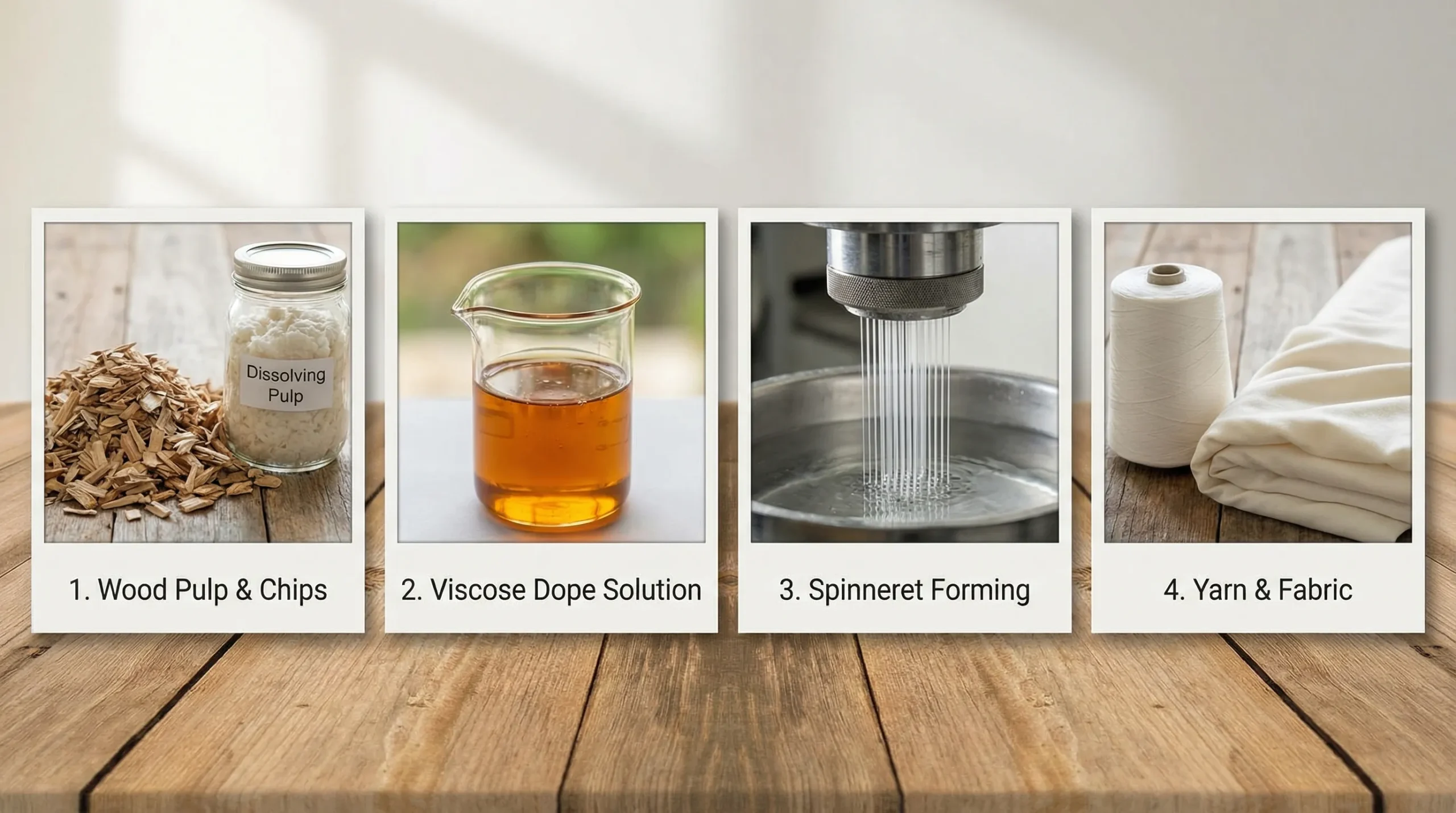
From pulp to fiber: how viscose is manufactured (high level)
Manufacturers may vary details, but the classic viscose process generally follows this sequence:
1) Pulping and purification
Wood (or other plant material) is chipped and processed into dissolving pulp with high cellulose content. Lignin, hemicellulose, and other components are reduced to make a consistent input for fiber production.
2) Steeping in caustic soda
The pulp is treated with sodium hydroxide (NaOH) to form “alkali cellulose.” This changes cellulose so it can be converted into a soluble form later.
3) Aging (controlled breakdown)
The alkali cellulose is aged under controlled conditions to adjust molecular chain length. This step influences important outcomes like viscosity (flow) and fiber properties.
4) Xanthation (creating cellulose xanthate)
Alkali cellulose is reacted with carbon disulfide (CS2) to create cellulose xanthate. This is a key step that makes cellulose dispersible and then soluble.
Carbon disulfide is one reason viscose manufacturing can be high-impact if systems are poorly controlled. Modern facilities can capture and recover chemicals, but performance varies by plant.
5) Making the “viscose” solution
Cellulose xanthate is dissolved (often in dilute NaOH) into a thick honey-like liquid called viscose dope. It is filtered and de-aerated to remove particles and bubbles that could cause defects.
6) Wet spinning (regenerating cellulose)
The viscose solution is extruded through spinnerets into an acid bath (commonly sulfuric acid), where cellulose is regenerated into filaments. The filaments are washed, desulfurized/neutralized, and finished (sometimes with lubricants or softeners).
7) Yarn and fabric production
The regenerated filaments can be:
- Cut into staple fiber and spun like cotton (common for woven viscose)
- Kept as continuous filament (often for smooth, silk-like applications)
From there, mills knit or weave it into fabric, then dye and finish it for the intended end use.
Why viscose is often called “semi-synthetic”
Viscose is neither a fully synthetic fiber (like polyester, which is made from petrochemicals) nor a minimally processed natural fiber (like cotton). It is best described as:
- Natural origin: it starts with plant cellulose.
- Chemically transformed: it’s dissolved and regenerated using industrial chemistry.
That dual nature is why viscose can feel “natural” to wear, but still requires careful sourcing if you’re making environmental or ethical claims.
What viscose feels like in apparel (and why brands use it)
Viscose is popular because it hits a sweet spot: it drapes beautifully, dyes well, and can be cost-effective versus silk.
Typical viscose performance characteristics:
- Soft hand feel with fluid drape (great for dresses, blouses, wide-leg pants)
- Breathable and absorbent compared with many synthetics
- Good color depth in dyeing
- Lower elasticity than many knits unless blended
- Can wrinkle more easily than polyester
- Can shrink or distort if not specified and tested correctly
- Weaker when wet than cotton, which affects wash durability and seam stress
Those last points matter in development. If viscose is central to your product, it’s worth calling out shrinkage targets, construction, and care expectations in your spec.
Viscose vs modal vs lyocell: same “family,” different processes
If you’ve seen modal and lyocell on hangtags, you’re looking at related regenerated cellulose fibers with different manufacturing methods and typical performance.
| Fiber | What it’s made from | How it’s generally made | Common apparel strengths |
|---|---|---|---|
| Viscose (rayon) | Dissolving wood pulp (cellulose) | Viscose process (viscose dope, wet spinning) | Drapey, soft, dye-friendly, versatile. |
| Modal (a rayon type) | Wood pulp (often beech) | Modified rayon process | Often softer and more dimensionally stable than standard viscose. |
| Lyocell | Wood pulp (cellulose) | Solvent spinning (commonly associated with closed-loop solvent recovery) | Often stronger (including when wet), smooth, and breathable. |
Arcus has a deeper fabric-focused breakdown here: What Type Of Fabric Is Modal?
Sustainability and safety: what to look for (without greenwashing)
Two sustainability questions determine whether “plant-based viscose” is a responsible choice:
1) Where did the pulp come from?
Viscose starts with trees (or other plants). The risk is deforestation, illegal logging, or sourcing from sensitive forests if the chain is not verified.
Useful indicators include:
- Forest certifications like FSC or PEFC
- Supplier transparency around pulp mill and forest origin
- Alignment with initiatives like Canopy’s work focused on protecting ancient and endangered forests
2) How well are chemicals managed at the fiber plant?
The classic viscose process uses chemicals that can be harmful if released to air or water, and hazardous to workers without proper controls.
As a brand, you usually won’t audit the chemistry yourself, but you can require credible proof points and documentation, and avoid vague claims.
If sustainability messaging matters for your line, Arcus’ guide on spotting vague claims is a useful companion: 11 Signs You’re Dealing with a Greenwashed Company
Spec’ing viscose for production: practical tips for brands
Knowing what viscose is made from is useful, but what you really need in product development is: how do you control outcomes?
Ask for the right fabric details (and put them in your tech pack)
Viscose can vary widely depending on weave/knit, yarn size, finishing, and blends. When you’re sourcing, you want specifics such as:
- Fiber content (example: 100% viscose, or viscose-spandex blend)
- Fabric construction (woven challis, twill, satin, jersey knit, rib knit)
- Weight (GSM or oz/sq yd)
- Width, color method (yarn dye vs piece dye), and finishing
- Shrinkage targets and test standards
If you want a cleaner handoff to sampling and bulk, document these requirements clearly. This is exactly where a strong tech pack helps: What is a tech pack?
Plan for shrinkage and skew early
Viscose is infamous for shifting if it’s not preshrunk or stabilized. Your development process should include wash testing at the sample stage, then confirmation in pre-production (PP) samples.
Choose construction that matches the fabric’s behavior
Because viscose can be weaker when wet and can grow with wear, pattern and construction choices matter:
- Stabilize stress points (necklines, shoulder seams, pocket openings)
- Select interlinings and fusing compatible with the fabric’s heat sensitivity
- Consider lining needs for sheerness and seam show-through
Write honest care labels
Many viscose garments do best with gentle washing and careful drying (or dry clean depending on construction and finishing). Care instructions should reflect real testing, not a generic template.
When viscose is a great choice (and when it’s not)
Viscose tends to excel when you want:
- Elegant drape without silk pricing
- Comfortable, breathable fashion pieces
- Strong color and print results
It may be a weaker fit when you need:
- Highly durable wash-and-wear uniforms with minimal wrinkles
- High-abrasion performance gear
- Structure that must stay rigid without special finishing
Blends (viscose-linen, viscose-nylon, viscose-poly, viscose-spandex) can solve some issues, but they also change feel, care, and end-of-life recyclability.

How Arcus Apparel Group can help you source and develop viscose styles
If you’re considering viscose for a new collection, the “what it’s made of” question is only step one. The bigger win is making sure your finished garments behave the way you intend in real customer use.
Arcus Apparel Group supports brands with material sourcing, pattern development, small-batch manufacturing, and end-to-end production management, with quality control built into each stage. If you want help selecting the right viscose (or viscose alternative), defining specs, and moving from sample to production with fewer surprises, you can start a conversation at Arcus Apparel Group.


