
Viscose shows up everywhere from flowy summer dresses to soft linings, but the way it is made can be confusing because it sits between “natural” and “synthetic.” If you’re building a clothing line, understanding what the fabric viscose is made of is more than trivia. It affects sourcing decisions, hand feel, labeling, cost, and what you can responsibly claim about sustainability.
Viscose in plain terms (and why people call it rayon)
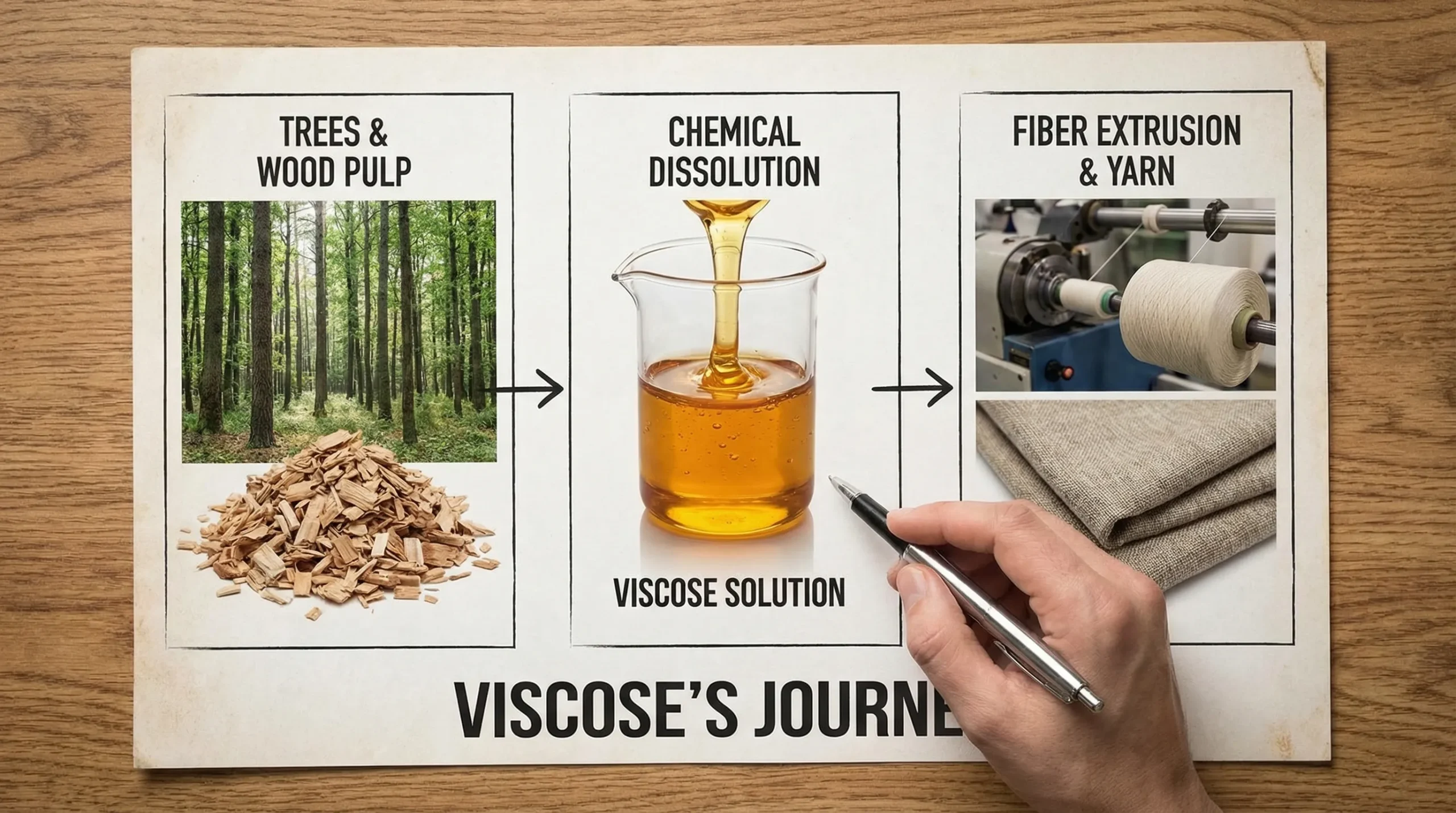
Viscose is a regenerated cellulose fiber. That means it starts as plant-based cellulose (most often wood pulp), gets dissolved and chemically processed into a liquid solution, and then is spun back into fibers.
In the textile world, viscose is commonly grouped under rayon (rayon is the broader family name). Viscose is one of the most common rayon production methods.
What is the fabric viscose made of?
At its core, viscose is made of cellulose, the same structural material found in plants.
1) The raw material: cellulose (usually from wood pulp)
Most viscose begins as dissolving pulp made from trees such as:
- Beech
- Eucalyptus
- Pine
- Spruce
You may also see “bamboo viscose.” In that case, the cellulose feedstock comes from bamboo, but the fiber is still produced through the viscose process.
2) The processing chemicals (the part most people miss)
While the finished fiber is cellulose-based, conventional viscose production typically uses chemicals to break down and reform the cellulose into spinnable filaments.
A simplified view of common inputs in traditional viscose manufacturing includes:
- Sodium hydroxide (caustic soda) to treat the cellulose
- Carbon disulfide to create cellulose xanthate (a key intermediate)
- Sulfuric acid in the spinning bath to regenerate cellulose fiber
These chemicals are part of why viscose is often described as semi-synthetic: plant-based origin, industrial chemical processing.
Quick clarity table: what goes in vs what remains
The goal below is conceptual, not a factory spec sheet. It helps brand owners understand why viscose can be “from plants” and still involve heavy chemistry.
| Component | What it does in production | Is it the final fiber? |
|---|---|---|
| Cellulose (wood or other plant pulp) | The base polymer that becomes the fiber | Yes, viscose is regenerated cellulose |
| Sodium hydroxide and other process chemicals | Enable cellulose to be dissolved and re-formed | No, not intended to remain as fiber content |
| Dyes and finishes (optional) | Add color and performance traits | Sometimes present (varies by mill and spec) |
For worker-safety context, carbon disulfide is a known occupational hazard if not properly controlled. The CDC/NIOSH Pocket Guide entry for carbon disulfide summarizes exposure concerns, which is why chemical management and controls matter when evaluating suppliers.
How viscose is made (clear, step-by-step)
If you’re comparing mills or writing a tech pack, it helps to understand the basic manufacturing flow.
- Pulping: Wood is processed into high-purity dissolving pulp.
- Alkali treatment: Pulp is treated (commonly with sodium hydroxide) to form “alkali cellulose.”
- Aging: The material is conditioned to reach the right viscosity and reactivity.
- Xanthation: Alkali cellulose reacts with carbon disulfide to form cellulose xanthate.
- Dissolving: Cellulose xanthate is dissolved into a viscous solution (this is where the name “viscose” comes from).
- Spinning/regeneration: The solution is extruded through spinnerets into an acid bath to regenerate cellulose into filaments.
- Washing and finishing: Fibers are washed, treated, and prepared for yarn spinning or filament use.
For a deeper technical definition of rayon as a regenerated cellulose fiber, Encyclopaedia Britannica’s rayon overview is a helpful reference.
What viscose feels like (and why)
Because viscose is regenerated cellulose, it tends to share some “plant-like” comfort characteristics, but its performance depends heavily on fiber quality, yarn type, and fabric construction.
Common viscose traits:
- Soft hand feel and smooth surface
- Excellent drape, popular for fashion silhouettes
- High absorbency, which can feel cool and comfortable
- Breathable in many constructions
Common drawbacks to plan for:
- Wrinkling (especially in lightweight wovens)
- Weaker when wet than many fibers, which affects care and durability
- Shrinkage risk depending on construction and finishing
Here’s a practical view for product planning:
| Property | What you’ll notice in the garment | Design implication |
|---|---|---|
| Drape | Flowing movement | Great for dresses, skirts, wide-leg pants |
| Absorbency | Comfortable against skin | Loungewear and tops can feel “cooler” |
| Wet strength | More delicate during washing | Choose care instructions and construction carefully |
| Wrinkling | Creasing in wear | Consider blends, weights, or finishes if needed |
Common viscose fabrics (and blends you’ll actually use)
“Viscose” usually refers to the fiber, but buyers touch the fabric. The same fiber can behave differently based on structure.
You’ll commonly see viscose in:
- Woven challis and plain weaves for blouses and dresses
- Crepe for texture and drape
- Twill for a slightly more structured hand
- Satin weaves for sheen and fluidity
- Jersey knits for soft tees, dresses, and loungewear
Blends are also common because they can reduce wrinkling, improve recovery, or cut cost:
- Viscose-elastane (spandex) for stretch and comfort
- Viscose-polyester for durability and wrinkle resistance
- Viscose-linen or viscose-cotton to balance hand feel and structure
Note: blends can affect recyclability and biodegradability, and they can complicate end-of-life options. If sustainability claims matter to your brand, blend decisions should be intentional.
Viscose vs modal vs lyocell (they’re related, but not identical)
Many brand owners run into viscose while also sourcing modal or lyocell. All three are regenerated cellulose fibers, but the process and typical performance can differ.
| Fiber | What it’s made from | How it’s typically made | Common brand-use takeaway |
|---|---|---|---|
| Viscose | Cellulose (often wood pulp) | Traditional viscose process (chemical dissolution and regeneration) | Great drape and softness, quality varies widely |
| Modal | Cellulose (often beech) | A type of rayon with process variations and often higher wet strength | Often softer and more dimensionally stable than standard viscose |
| Lyocell | Cellulose (wood pulp) | Dissolved in a solvent system (often described as more closed-loop) | Often stronger, good drape, commonly positioned as lower-impact |
If you want a dedicated deep dive on modal, Arcus has a separate guide: What Type Of Fabric Is Modal?.
Is viscose “natural,” “synthetic,” or something in between?
This is where a lot of marketing language gets fuzzy.
- Not fully natural: it does not remain in its original plant fiber form (like cotton or linen).
- Not fully synthetic: it is not made from petrochemicals in the way polyester or nylon are.
- Best description: viscose is semi-synthetic regenerated cellulose.
If you’re writing product pages, this nuance matters because consumers (and regulators) increasingly scrutinize vague eco-language.
For related reading on how unclear sustainability claims can backfire, see Arcus’s guide: 11 Signs You’re Dealing with a Greenwashed Company.
Sustainability reality check: what to ask your viscose supplier
Viscose can be sourced responsibly, but it can also come with real risks depending on feedstock, chemical controls, and wastewater treatment.
Key risk areas
- Forest sourcing: Are ancient and endangered forests being logged for dissolving pulp?
- Chemical management and worker safety: Are hazardous chemicals well-controlled and recovered?
- Water and wastewater: Are effluents treated to a high standard?
Better due diligence questions (brand-friendly)
These questions are specific enough to be actionable, without drifting into buzzwords:
- What is the pulp source (tree species, country, mill)?
- Does the pulp supplier have credible forestry certification such as FSC or PEFC?
- Can the supplier provide a chain-of-custody document for the pulp?
- Is the viscose part of a program that screens for forest risk, such as CanopyStyle?
- What chemical management standards are followed (for example, MMCF-focused initiatives from groups like ZDHC)?
Special note on “bamboo viscose”
Bamboo can be fast-growing, but bamboo viscose is still viscose. The sustainability profile depends on sourcing and processing controls, not the word “bamboo” on a hangtag.
Labeling: will it say viscose or rayon in the U.S.?
In the U.S., labeling rules focus on generic fiber names. Many viscose products are labeled as rayon, sometimes with additional wording in marketing copy.
If you sell in the U.S., it’s worth reviewing the FTC’s guidance: Threading Your Way Through the Labeling Requirements Under the Textile and Wool Acts.
(Always confirm final labeling with compliance counsel or your labeling specialist, especially if you sell across multiple markets.)
How to spec viscose correctly in a tech pack (so production matches your intent)
If you simply write “viscose” in a tech pack, you may get wide variation in weight, transparency, shrinkage, and pilling performance.
When you’re developing a product, a clearer viscose spec usually includes:
- Fiber content (100% viscose, or blend percentages)
- Construction (woven or knit, plus weave/knit type)
- Fabric weight (GSM or oz/yd²)
- Yarn details if critical (spun vs filament, ring-spun vs other)
- Finish requirements (pre-shrunk, wrinkle-resistant finish, enzyme wash, peach finish)
- Color and dye method (especially for shade matching and repeatability)
- Target performance (shrinkage limits, colorfastness expectations, pilling standards)
If you want a framework for documenting these decisions, Arcus has a strong primer here: What is a tech pack?.
Where viscose fits best in apparel lines
Viscose is usually a great choice when your customer values comfort and drape over rugged abrasion resistance.
Typical strong use cases:
- Dresses and skirts with movement
- Blouses and tops (especially for warm weather)
- Linings and fashion layers
- Soft knit styles where hand feel matters
You may want alternatives or blends when:
- The garment needs high durability (workwear, heavy-use uniforms)
- The consumer expects low-wrinkle performance
- Wet strength is a key requirement (certain activewear use cases)
Bringing it back to sourcing and manufacturing
For brand owners, the most useful takeaway is simple: viscose is made of regenerated plant cellulose, but the process and supply chain determine quality and credibility.
If you’re developing a viscose style and want help selecting the right construction, building a clear material spec, or managing sampling and production, Arcus Apparel Group supports end-to-end development from fabric sourcing through manufacturing. You can also explore their broader guidance on getting a line started in Apparel Design 101 and how to evaluate production partners in How to Choose the Best Clothing Manufacturers for Your Brand.


